Why Athletes, Musicians, and CEOs All Track Their Time (And You Should Too)
From Amateur to Pro: Why Professionals Track Their Time
Elite athletes track every training session — from LeBron James's meticulous body-care regimen to marathon runners logging every mile. Professional musicians log practice hours. Top salespeople record every call.
But knowledge workers? Most have no idea where their time actually goes.
This is the amateur-professional divide hiding in plain sight. Professionals treat time as their most valuable asset and measure it accordingly. Amateurs wing it and wonder why results are inconsistent.
The shift from amateur to professional isn't talent. It's tracking.
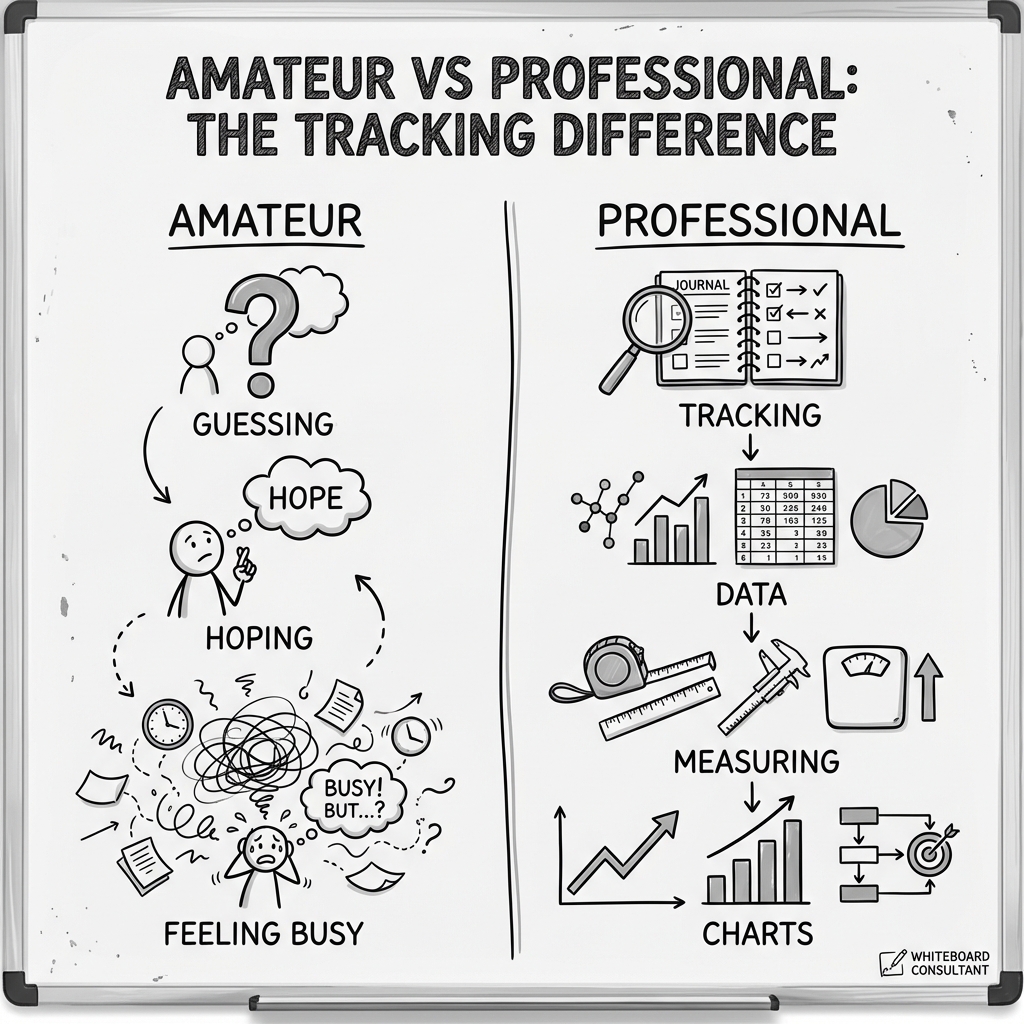
The Professional Mindset
What separates professionals from amateurs isn't just skill—it's relationship with data.
Amateurs:
- Work until they're tired
- Assume they're productive when busy
- Measure success by feeling, not numbers
- Hope to improve over time
Professionals:
- Work according to a plan
- Measure actual output against targets
- Track leading indicators, not just results
- Engineer improvement through data
This applies everywhere. A professional chef knows exactly how long each dish takes. A professional writer knows their words-per-hour rate. A professional developer knows their debugging time versus building time.
The question isn't whether to track. It's what to track.
Why Time Is the Metric That Matters
Revenue matters. Outputs matter. But time is the meta-metric that underlies everything.
Time is:
- Universal — Everyone has the same 24 hours
- Finite — Unlike money, you can't earn more
- Measurable — Objective, not subject to interpretation
- Controllable — You decide where it goes
When you track time, you're not tracking activity. You're tracking your most valuable, non-renewable resource.
If you don't know where your time goes, you don't know where your life goes.
What Elite Performers Actually Track
Athletes: Every Training Variable
A professional athlete's training log includes:
- Duration of each session
- Type of training (strength, endurance, skill, recovery)
- Perceived effort level
- Quality metrics (times, weights, distances)
- Recovery data (sleep, heart rate variability)
They don't just "work out." They follow periodized programs with specific time allocations. They know that 80% of training should be low-intensity and 20% high-intensity. They track whether they're hitting those ratios.
The result: intentional progression instead of random effort.
Musicians: Practice Hours
Professional musicians track:
- Total practice hours per day and week
- Time allocation by skill area (technique, repertoire, sight-reading)
- Specific pieces worked on and progress made
- Quality observations (what improved, what needs work)
The classic target: 10,000 hours of deliberate practice, as researched by Anders Ericsson and popularized in his book Peak: Secrets from the New Science of Expertise. But that's a simplified headline. What matters is how those hours are distributed and what they're focused on.
The result: measurable skill development instead of mindless repetition.
Salespeople: Activity Metrics
Top salespeople track:
- Calls made, emails sent, meetings held
- Time per activity
- Conversion rates at each stage
- Time from first contact to close
They know their numbers cold. "I make 50 calls to get 10 conversations to get 3 meetings to get 1 sale." That's not guessing—that's tracking.
The result: predictable pipeline instead of feast-or-famine.
Writers: Words and Hours
Professional authors track:
- Writing hours per day
- Words per session
- Editing hours versus drafting hours
- Time to complete each project phase
Stephen King writes 2,000 words every morning, as he describes in his memoir On Writing. That's not a suggestion — it's a tracked commitment. He knows his output rate because he measures it.
The result: consistent publication pace instead of sporadic output.
Applying Professional Tracking to Knowledge Work
Your work may not fit these categories neatly. But the principle transfers.
Step 1: Define Your Categories
What are the fundamental types of work you do?
For entrepreneurs, the Building/Promoting/Delivering framework captures most activity:
- Building: Product development, systems, infrastructure
- Promoting: Marketing, content, sales, lead generation
- Delivering: Client work, fulfillment, operations
For other knowledge workers, categories might include:
- Deep work: Complex, cognitively demanding tasks (a concept coined by Cal Newport)
- Shallow work: Administrative, routine tasks
- Communication: Meetings, email, collaboration
- Learning: Skill development, research, training
Define 3-4 categories that capture where your hours could go.
Step 2: Track Without Judgment
For the first week, just track. Don't try to optimize.
Log every work session:
- When did it start?
- When did it end?
- Which category?
Use a timer with category selection (like The Boring Clock) to automate this. Or use a simple spreadsheet. The format matters less than consistency.
After one week, you'll have data. Real data, not guesses.
Step 3: Review the Numbers
At week's end, add it up:
- Total hours worked
- Hours per category
- Percentage in each category
Common discoveries:
- "I thought I spent 20 hours Building, but it was only 8"
- "Shallow work took 60% of my time, not the 20% I assumed"
- "My most productive days had 3+ hours of uninterrupted time"
The gap between perception and reality is usually shocking.
Step 4: Set Targets
Based on your goals, set category targets:
Example for an entrepreneur:
- Building: 15 hours/week (currently 8)
- Promoting: 10 hours/week (currently 5)
- Delivering: 15 hours/week (currently 22)
Notice this person is spending too much time on Delivering and not enough on Building and Promoting. The business is stuck in fulfillment mode.
Setting targets isn't magic. It's making explicit what was previously implicit.
Step 5: Track Against Targets
Now tracking becomes active management:
- Start of week: Know your category targets
- During week: Log sessions and watch cumulative totals
- End of week: Compare actual to target
If you're hitting targets, great. If not, why not? Adjust either the targets or the behavior.
This weekly cycle—target, track, review, adjust—is how professionals improve continuously.
The Observer Effect
Tracking changes behavior even before you analyze the data.
This is the observer effect:
When you know you're logging your time, you make different choices.
- That 20-minute YouTube rabbit hole becomes visible and embarrassing
- Skipping the gym means logging zero in your exercise category
- Context switching creates lots of small entries instead of long focused blocks
The act of tracking creates accountability to yourself. You become your own coach.
Many people find this effect alone is worth the effort of tracking. The analysis is bonus.
Objections and Answers
"Tracking is too much overhead"
If tracking takes more than 2 minutes per hour of work, you're doing it wrong.
Modern tools make tracking nearly frictionless:
- Select a category and start a timer
- Timer runs until you stop it
- Data aggregates automatically
You're not filling out detailed time sheets. You're clicking one button.
"I don't do the same thing every day"
Good. Track the variation.
Tracking reveals patterns you didn't know existed:
- Maybe Mondays are always shallow-work-heavy
- Maybe you're most creative on Friday afternoons
- Maybe Wednesdays are your deepest work days
Variability isn't a problem for tracking—it's exactly what tracking exposes.
"My work doesn't fit categories"
Then define better categories.
The Building/Promoting/Delivering framework works for entrepreneurs. For you, try:
- By project: "Project A," "Project B," "Admin"
- By energy type: "Creative," "Analytical," "Communication"
- By value: "Revenue-generating," "Infrastructure," "Overhead"
Categories should feel natural for your work. Adjust until they fit.
"I already know I'm productive"
Do you? Based on what?
Most people confuse activity with productivity. Feeling busy is not the same as making progress.
Track for one week. If the data confirms your intuition, you've lost nothing. If it surprises you, you've gained invaluable insight.
The Professional's Weekly Review
Tracking without reviewing is like exercising without looking at progress.
Each week, spend 15 minutes reviewing:
The numbers:
- Total hours tracked
- Distribution across categories
- Comparison to targets
The patterns:
- Best day of the week (why?)
- Worst day of the week (why?)
- When did deep work happen?
The adjustments:
- What to protect next week
- What to reduce
- What to try differently
For a complete review framework, see The Weekly Review System.
Start Acting Like a Pro
The professional difference isn't complicated. It's this:
- Know where your time goes — through tracking
- Compare reality to intention — through review
- Adjust based on data — through weekly iteration
You don't need to be perfect. You need to be aware.
This week:
- Define 3-4 work categories
- Track every session with category and duration
- At week's end, add up the totals
- Be honest about what you find
That's it. That's how professionals start.
Amateurs hope they're spending time well. Professionals know.
The gap between where you are and where you want to be? It's hiding in your time data.
Start tracking. Start knowing. Start acting like a pro.
The first step to professional-grade productivity is simply paying attention to where the hours actually go.
Attention precedes improvement. And tracking is formalized attention.
Own your time. Measure it. Optimize it.
That's what professionals do.
You might also like
Where Do Your Hours Go? Why Generic Time Tracking Fails Entrepreneurs
You planned 4 hours of deep work but only got 45 minutes. Learn why tracking time by category reveals the leaks that generic timers miss.
Why Entrepreneurs Burn Out: The Hidden Cost of Neglecting One Part of Your Business
Most entrepreneurs unknowingly spend 80% of their time on one business function while the others decay. Learn how to audit and rebalance your time allocation.
Ready to take control of your focus?
Stop letting time slip away. The Boring Clock helps you track where your hours actually go, categorized by Building, Promoting, and Delivering.