Stop Doing Low-Value Work: The Delete-Automate-Delegate Framework for Deep Work
Delete, Automate, Delegate: Clearing Your Calendar for Deep Work
Before you optimize how you work, you need to question whether you should be doing that work at all.
This is the step most productivity advice skips. We jump straight to tips for working faster, focusing longer, or organizing better. But what if the real problem isn't how you work—it's what you're working on?
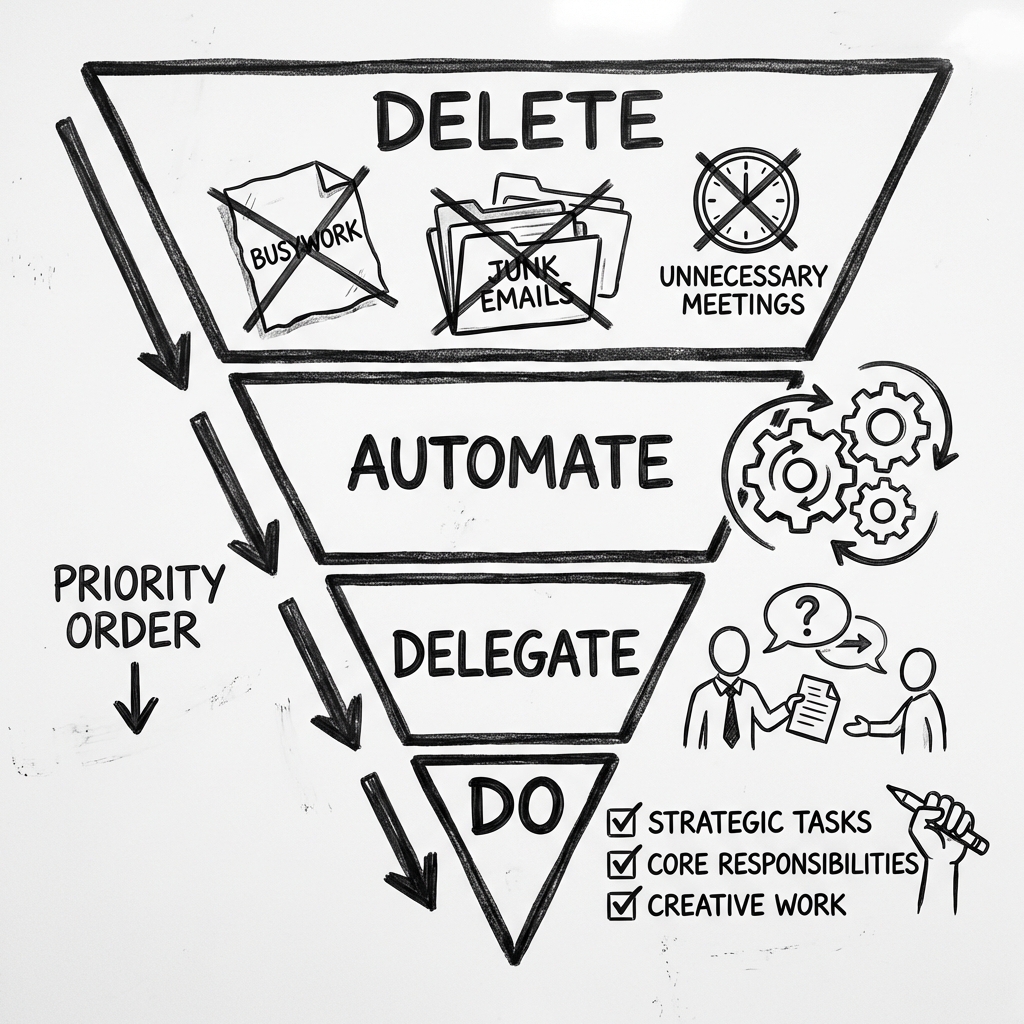
Alex Hormozi has a simple hierarchy for evaluating every task on your list:
- Delete — Can I remove this entirely?
- Automate — Can a system do this for me?
- Delegate — Can someone else do this?
- Do — Only after the first three fail
The order matters. Most people invert it—they try to do everything faster, then grudgingly delegate what's left. But the leverage is at the top of the list, not the bottom.
Why Delete Comes First
Let's start with the most radical step: removing tasks entirely.
Here's the uncomfortable truth: a significant portion of what you do every week creates zero value. It's work that exists because it's always existed, not because it needs to.
Weekly status meetings that could be a Loom video. Reports nobody reads. Processes inherited from the previous person in the role. Emails sent for CYA purposes rather than actual communication.
These tasks share a common trait: if you stopped doing them tomorrow, nothing bad would happen. The business wouldn't suffer. Customers wouldn't notice. The sky wouldn't fall.
But they fill your calendar because no one ever questioned them.
The deletion audit asks:
- What would happen if I didn't do this?
- Who actually uses the output of this work?
- Would I pay someone $100/hour to do this task?
- Is this creating value or preventing imaginary problems?
Be ruthless. The goal is to find tasks that can simply vanish.
Examples of Deletable Work
- Status meetings without clear outcomes
- CC'd emails you never read
- Formatting that nobody sees
- Approval chains for low-risk decisions
- Tracking metrics you never act on
- Reports that generate no actions
Every hour you delete is an hour reclaimed for deep work—with zero ongoing cost.
The Automation Layer
Once you've deleted what you can, look at what remains. The next question: can a machine do this?
Automation isn't just for technical people anymore. No-code tools mean anyone can automate repetitive workflows.
Candidates for automation:
- Recurring email responses (templates, auto-replies)
- Data entry and transfer between apps (Zapier, Make)
- Scheduling (Calendly, SavvyCal)
- Social media posting (Buffer, Hootsuite)
- Invoice generation and follow-ups
- Lead routing and tagging
- Onboarding sequences
The automation test:
- Does this task happen regularly?
- Does it follow predictable rules?
- Does it require human judgment, or just execution?
If it's regular, rule-based, and execution-focused, it can probably be automated.
The upfront investment in setting up automation pays dividends forever. A 3-hour automation setup that saves you 30 minutes per week pays off in 6 weeks. After that, it's pure profit—time you never have to spend again.
The 10X Automation Rule
Only automate things you'll do at least 10 more times.
Setting up automation for a one-off task is wasted effort. But if something happens weekly? Monthly? Every time a new customer signs up?
That's where automation creates massive leverage.
When to Delegate
Some tasks require human judgment but don't require your judgment specifically. These are delegation candidates.
The delegation question isn't: "Can I do this faster than explaining it?"
The delegation question is: "Is this the highest-value use of my time?"
If you're great at video editing but your hourly value is $200, hiring a $30/hour editor isn't a cost—it's an investment that returns $170/hour in freed attention. This is the core logic behind Tim Ferriss's approach in The 4-Hour Work Week: ruthlessly outsource anything below your effective hourly rate.
This math is obvious but emotionally hard to accept. We like doing things we're good at. We have high standards. We think "nobody else can do it right."
These are ego defenses, not business logic.
What to Delegate
Delegate tasks that:
- Someone else can do 80% as well as you
- Don't require your unique expertise
- Have trainable processes
- Happen repeatedly
- Don't energize you
Keep tasks that:
- Only you can do (true bottlenecks)
- Directly generate revenue or strategic advantage
- You're the world-class expert on
- Energize you and develop your skills
For entrepreneurs trying to balance delegated work with their core focus areas, see Building vs Promoting vs Delivering.
Creating Delegation Systems
Delegation without systems creates chaos. You need:
- Clear instructions: Document the process step-by-step
- Quality standards: Define what "good" looks like
- Feedback loops: Review outputs and course-correct
- Escalation paths: Define when to involve you
The goal is to delegate decisions, not just tasks. If someone needs your approval for every micro-choice, you haven't really delegated—you've just split the work in half and added coordination overhead.
The Busy Work Trap
Why do entrepreneurs resist Delete, Automate, Delegate? Because busy work feels productive.
Answering emails feels productive. Attending meetings feels productive. Organizing files feels productive. These activities create motion and noise—signals that look like work.
But there's a difference between being busy and being productive.
Busy work characteristics:
- Easy to start
- Low cognitive load
- Feels urgent
- Creates immediate, visible output
- Doesn't move the needle
Productive work characteristics:
- Hard to start (resistance)
- Requires deep focus
- Feels important but not urgent
- Creates delayed, compounding results
- Directly advances your goals
The trap is that busy work fills available time. If you don't delete it, it expands. Parkinson's Law: work expands to fill the time available.
Your calendar will never have empty space unless you create it deliberately. Delete, Automate, Delegate creates that space.
Creating Fortress Hours
Once you've freed up time, you need to protect it.
Fortress hours are blocks where nothing can interrupt you. No meetings, no messages, no "quick questions." The drawbridge is up.
This isn't about being unavailable permanently. It's about creating daily windows of protected time for deep work—the work that actually creates disproportionate value.
How to create fortress hours:
- Block them on your calendar — Treat them like immovable appointments
- Communicate the boundary — Tell your team when you're unavailable
- Remove yourself physically or digitally — Different room, closed apps, phone elsewhere
- Have a consistent schedule — Same time every day reduces explanation burden
Most entrepreneurs find that 2-4 hours of fortress time produces more than 8 hours of fragmented availability.
Scripts for Protecting Your Time
Saying no is uncomfortable. Here are scripts for the common situations:
The Unnecessary Meeting
"Thanks for including me. What would you need from me specifically? If it's information I can share, I'm happy to send it in advance. Otherwise, I wonder if I'm the right person for this."
The "Quick Question" Interruption
"I'm in the middle of something right now. Can you Slack me that question and I'll respond by [time]?"
The Recurring Meeting That's Outlived Its Purpose
"I want to make sure our time together is valuable. Can we review whether this meeting is still serving its original purpose, or if we can handle it async?"
The Task Someone Else Should Own
"I've been handling this, but I think [name/role] might be better suited. Can we transition it?"
You don't need to be aggressive. You just need to redirect gently and consistently.
The Calendar Audit Process
Once per month, audit your calendar with Delete-Automate-Delegate:
Step 1: Export last month's calendar
List every meeting, recurring task, and commitment.
Step 2: Apply the hierarchy
For each item, ask in order:
- Can I delete this without real consequences?
- Can I automate this with tools?
- Can I delegate this to someone else?
- Only for what remains: Do I need to do this myself?
Step 3: Execute the changes
Actually cancel the meetings. Actually set up the automations. Actually delegate the tasks. This is where most people fail—they analyze without acting.
Step 4: Block the recovered time
Don't let the freed hours get filled with new low-value work. Immediately block them as fortress time for deep work.
If you're already tracking your time by category using a tool like The Boring Clock, you'll have data on where your hours actually go—making this audit much faster.
The Entrepreneur's Paradox
Here's the paradox: entrepreneurs are typically the worst at Delete-Automate-Delegate.
They started by doing everything themselves. They're proud of being able to handle any role. Their identity is wrapped up in being busy.
But doing everything yourself is a startup survival strategy, not a success strategy. At some point, your willingness to do everything becomes the bottleneck limiting growth.
The question isn't "Can I do this?" It's "Should I be the one doing this?"
Your unique value is probably in a narrow zone:
- The strategic decisions only you can make
- The creative work only you can do
- The relationship work that requires your presence
- The bottleneck activities that limit growth
Everything else should face the hierarchy: Delete, Automate, Delegate.
Recovering 10+ Hours Per Week
Let's be conservative. If you:
- Delete 3 hours of work that creates no value
- Automate 2 hours of repetitive tasks
- Delegate 5 hours of work someone else can do
You've recovered 10 hours per week. That's 520 hours per year—the equivalent of 13 full work weeks.
What could you do with 13 extra weeks?
- Build the product you've been putting off
- Launch the marketing campaign that's been in your head
- Develop the skill that would level up your business
- Actually take a vacation
The time is there. It's just trapped in tasks that shouldn't exist, should be automated, or should belong to someone else.
Free it.
The Deep Work Dividend
Delete-Automate-Delegate isn't about working less. It's about working on what matters most.
The hours you recover should go directly to deep work—the Building, Promoting, or Delivering activities that create disproportionate results.
When you audit your week with The Boring Clock's category tracking, you'll see exactly how your time distributes. Are you spending your recovered hours on high-leverage deep work, or are they getting eaten by new busywork?
The data doesn't lie. Track it, protect it, invest it wisely.
Delete your way to the work that matters. Then go deep on what's left.
You might also like
Deconstructing Alex Hormozi's $100M Schedule: The 4/4/4 Method Explained
Learn how Alex Hormozi structures his day with the 4/4/4 method—splitting time between Building, Promoting, and Delivering for maximum business impact.
Stop Spending Time, Start Investing It: The ROI Framework for Productivity
Not all hours are equal. Some compound, others evaporate. Learn to evaluate your activities by their long-term returns and stop wasting focus on low-ROI tasks.
Where Do Your Hours Go? Why Generic Time Tracking Fails Entrepreneurs
You planned 4 hours of deep work but only got 45 minutes. Learn why tracking time by category reveals the leaks that generic timers miss.
Ready to take control of your focus?
Stop letting time slip away. The Boring Clock helps you track where your hours actually go, categorized by Building, Promoting, and Delivering.