Building vs Promoting vs Delivering: Where Should You Spend Your Time?
Building vs Promoting vs Delivering: Where Should You Spend Your Time?
There's a question that haunts every entrepreneur at 2 AM: "Am I spending my time on the right things?"
You work insane hours. You're always busy. But somehow, the business isn't growing as fast as it should. Revenue plateaus. Customers complain about slow service. Or worse—nobody knows you exist despite having an amazing product.
The problem isn't how hard you're working. It's where you're putting those hours.
Every business activity falls into one of three categories. Understanding these categories—and consciously deciding how to balance them—is the difference between strategic growth and chaotic hustle.
The Three Categories of Business Work
Let's define these clearly, because most entrepreneurs have never stopped to categorize their time this explicitly.
Building 🔨
Building is any work that creates or improves your offering. It's the infrastructure, the product, the systems that make your business function.
Examples of Building work:
- Developing new features or products
- Writing code or designing interfaces
- Creating SOPs and internal documentation
- Setting up automation tools
- Improving your tech stack
- Researching and developing new capabilities
Building is the category most technical founders gravitate toward. It feels productive. You can see tangible progress. You end the day with something that didn't exist before.
The trap? You can build forever without anyone ever knowing about it.
Promoting 📣
Promoting is any work that puts your offering in front of potential customers. It's the engine that fills your pipeline and grows your audience.
Examples of Promoting work:
- Content creation (blog posts, videos, podcasts)
- Social media engagement
- Sales calls and outreach
- Advertising and paid marketing
- SEO optimization
- Networking and partnership development
- Email marketing campaigns
Promoting is uncomfortable for many founders—especially technical ones. It feels like self-aggrandizement. It's harder to measure in the moment. And rejection stings.
But here's the uncomfortable truth: the best product in the world fails if nobody knows about it.
Delivering 📦
Delivering is any work that fulfills promises to existing customers. It's the operations, support, and execution that turns buyers into satisfied customers.
Examples of Delivering work:
- Customer support and communication
- Order fulfillment and processing
- Service delivery and consulting
- Quality assurance
- Client meetings and check-ins
- Troubleshooting and problem-solving
Delivering feels urgent. A customer emails with a problem—you have to respond. An order comes in—you have to ship it. This urgency makes it easy to spend all your time here.
The trap? You become a hostage to fulfillment. No time left to improve the product or grow the customer base.
For more on how Alex Hormozi applies this framework, see Deconstructing Alex Hormozi's $100M Schedule: The 4/4/4 Method.
Why All Three Categories Are Essential
Here's what makes this framework powerful: neglecting ANY of these categories creates specific, predictable failure modes.
- All Building, No Promoting: Beautiful product nobody knows about. Your GitHub repo has 47 stars—all from friends. You keep adding features that no one asked for because there are no customers to ask.
- All Promoting, No Delivering: Marketing is fire. Leads pour in. But delivery is a mess. Customers churn because expectations weren't met. You're acquiring customers as fast as you're losing them.
- All Delivering, No Building: Stuck in fulfillment mode. Every day is putting out fires. The product hasn't improved in months. Competitors iterate while you stagnate.
- All Building, No Delivering: Ship new features constantly, but customer experience suffers. Bugs pile up. Reviews mention "great potential" but complain about reliability.
- All Promoting, No Building: Selling a dream you can't deliver. Marketing outpaces capabilities. This is how reputations get destroyed.
- All Delivering, No Promoting: Serve existing customers beautifully—but slowly running out of them. Natural churn erodes your base. No pipeline.
The pattern is clear: sustainable growth requires investment in all three categories.
If you're wondering whether you're falling into one of these traps, read Are You an Imbalanced Entrepreneur?.
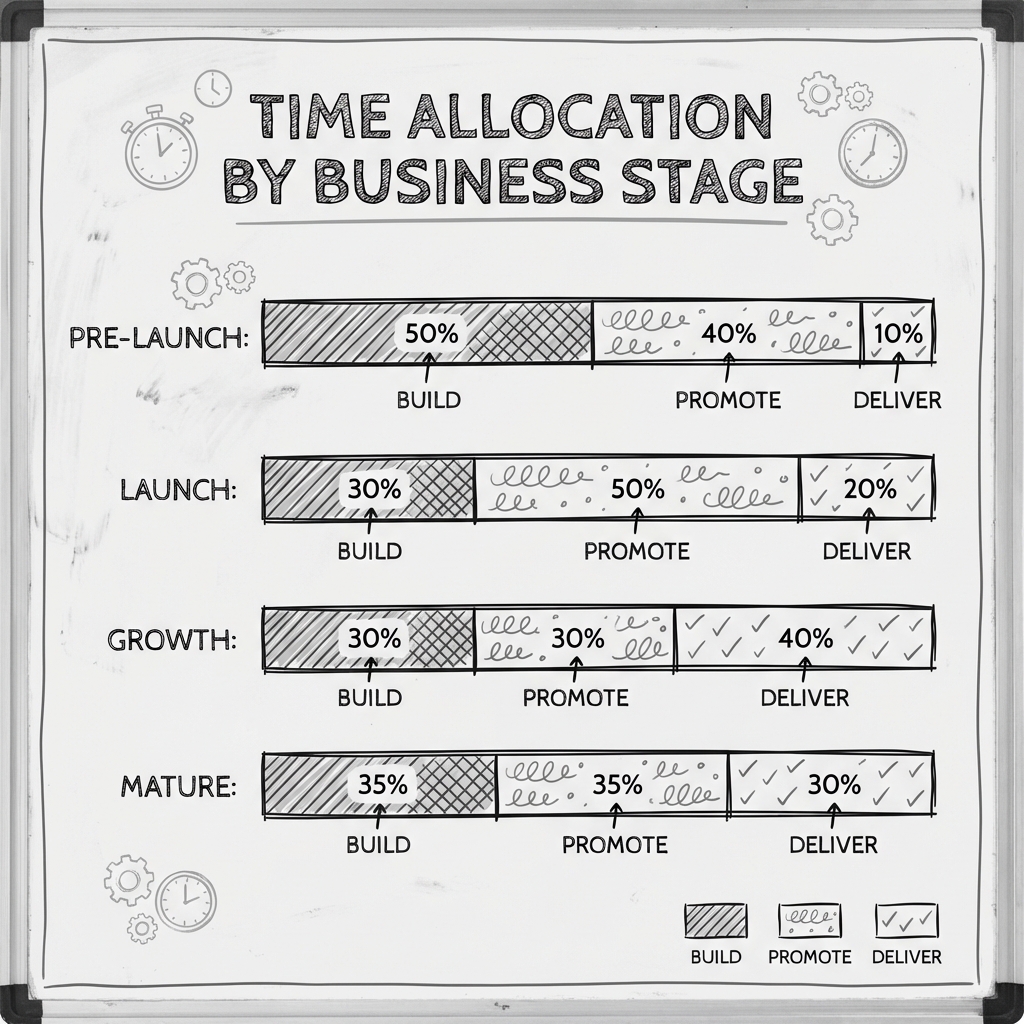
The Ideal Split Depends on Your Business Stage
So what's the "right" allocation? Here's the uncomfortable answer: it depends.
Different stages of business demand different splits. The allocation that works for a pre-launch startup would sink a scaling company. For more on how business stages shape founder priorities, the Y Combinator Startup Library is an excellent resource.
Pre-Launch / Building Stage
Suggested Split: 50% Building, 40% Promoting, 10% Delivering
Before you have customers, Building dominates. You're creating the thing. But smart founders start Promoting before they're "ready" — building audience, validating ideas, creating anticipation. Paul Graham makes this case in his essay Do Things That Don't Scale.
The 10% Delivering might seem odd when you have no customers. But delivering early—even to beta users, even for free—generates the feedback that makes your Building work actually valuable.
Launch / Traction Stage
Suggested Split: 30% Building, 50% Promoting, 20% Delivering
You have a product. Now you need customers. This is when Promoting becomes the highest-leverage activity. Every hour spent on marketing brings in the users that will fund everything else.
Building remains important but shifts to feature refinement based on user feedback rather than speculative development. Delivering grows as actual customers arrive.
Growth / Scaling Stage
Suggested Split: 30% Building, 30% Promoting, 40% Delivering
You've found product-market fit. Customers are coming in steadily. Now the bottleneck often shifts to Delivering. Can you actually serve all these people?
This is when you build systems, hire support, create knowledge bases—all Delivering activities that let you handle scale.
Mature / Optimization Stage
Suggested Split: 35% Building, 35% Promoting, 30% Delivering
A more balanced split. You're maintaining market position while continuing to improve. Delivering efficiency means you can do more with less.
How to Actually Track Your Allocation
Knowing the ideal split is useless if you don't know your actual split.
Most entrepreneurs have no idea where their time really goes. They feel like they're "always working on marketing" but the calendar tells a different story.
Here's how to get real data:
-
Track for one week without changing anything — Before you try to fix your allocation, measure it. Every time you switch activities, note the category. You'll probably be shocked at the results.
-
Be honest about miscategorization — It's tempting to count everything as "Building." That email about a feature request? Delivering, not Building. That tweet about your product? Promoting. That bug fix for a customer? Delivering.
-
Block time by category, not by task — Instead of planning "work on homepage" or "write blog post," schedule "2 hours Promoting" and then decide what Promoting activity is highest leverage in the moment.
-
Use a categorized timer — A focus timer that lets you select your category before each session creates instant awareness. At the end of the week, you see exactly where your time went—displayed as a breakdown you can't argue with.
When you see "15 hours Building, 3 hours Promoting, 8 hours Delivering" on your weekly report, the imbalance becomes impossible to ignore.
The Rebalancing Process
Once you know your actual allocation, you can start intentionally shifting it.
Identify the neglected category
Look at your last week's data. Which category has the smallest share? That's probably your bottleneck.
Protect time for the weak category
The neglected category is neglected for a reason—it's either uncomfortable or less urgent. You need to actively protect time for it.
Schedule it first thing in the morning, before the urgent tasks from other categories take over. Put it on your calendar as a recurring block. Treat it as a non-negotiable meeting with yourself.
Accept temporary imbalance in others
When you shift time to the neglected category, the others will suffer slightly. That's okay. The goal isn't perfection every day—it's balance over time.
One week you might go heavy on Promoting for a launch. The next week, you catch up on Delivering. The rolling average is what matters.
The Emotional Resistance
Let me address what you're probably feeling right now: resistance.
If you're a builder, the idea of spending more time on Promoting feels gross. "I'm not a salesperson. I'm not going to post cringe content on LinkedIn."
If you're a marketer, spending time on Delivering feels like a demotion. "I should be driving growth, not answering support tickets."
If you're an operator, spending time on Building feels indulgent. "I have real customers waiting. I can't disappear to code for four hours."
This resistance is exactly why tracking matters. Without data, you'll rationalize your natural imbalance forever. With data, you can't hide.
The categories don't care about your preferences. The business needs all three. Your job is to make sure all three get attention, even when it's uncomfortable.
For a related framework on identifying what truly moves the needle, see What is Your A+ Task?.
Practical Implementation
Here's a concrete system to start rebalancing this week:
- Today: Categorize everything you did last week. Don't trust your memory—look at your calendar, browser history, commit logs. Estimate hours in each category.
- Tomorrow: Identify your weakest category. Be honest about which one you've been avoiding.
- This Week: Block 2 hours daily for your weakest category. Put it early in the day before other demands take over.
- End of Week: Track your actual time with a categorized timer. Compare to your goal.
- Next Week: Adjust based on data. Maybe 2 hours isn't enough. Maybe you need to shift the time of day. Iterate.
The Bigger Picture
Time allocation isn't about productivity hacks. As Peter Drucker wrote in The Effective Executive, time is the scarcest resource — and unless it is managed, nothing else can be managed. It's about being intentional with the most finite resource you have.
You're already spending hours on your business. The question is whether those hours are creating the future you want—or just perpetuating today's imbalances.
Building, Promoting, and Delivering are not competing priorities. They're three legs of a stool. Remove any one, and the whole thing tips over.
The entrepreneurs who win aren't the ones who work the most hours. They're the ones who invest those hours strategically across all three domains.
Start measuring. Start rebalancing. Start treating your time like the investment it is.
Your weekly allocation isn't just a productivity metric. It's a prediction of where your business will be in a year.
What does your current allocation predict?
You might also like
Stop Spending Time, Start Investing It: The ROI Framework for Productivity
Not all hours are equal. Some compound, others evaporate. Learn to evaluate your activities by their long-term returns and stop wasting focus on low-ROI tasks.
Stop Doing Low-Value Work: The Delete-Automate-Delegate Framework for Deep Work
Before you can do deep work, you need to eliminate shallow work. Learn Alex Hormozi's hierarchy: Delete first, then Automate, then Delegate what remains.
Where Do Your Hours Go? Why Generic Time Tracking Fails Entrepreneurs
You planned 4 hours of deep work but only got 45 minutes. Learn why tracking time by category reveals the leaks that generic timers miss.
Ready to take control of your focus?
Stop letting time slip away. The Boring Clock helps you track where your hours actually go, categorized by Building, Promoting, and Delivering.