Deconstructing Alex Hormozi's $100M Schedule: The 4/4/4 Method Explained
Deconstructing Alex Hormozi's $100M Schedule: The 4/4/4 Method Explained
Here's something that'll make you uncomfortable: you probably spend 80% of your time on tasks that generate 20% of your results. And if you're an entrepreneur, that imbalance is likely costing you more than you realize. Hormozi breaks this down extensively in his book $100M Offers.
Alex Hormozi—the guy who built and sold multiple $100M+ businesses—doesn't leave his time allocation to chance. He uses a deceptively simple framework—developed through his work at Acquisition.com—that forces strategic distribution across the three activities that actually move the needle.
They call it the 4/4/4 method. And once you understand it, you'll never look at your calendar the same way.
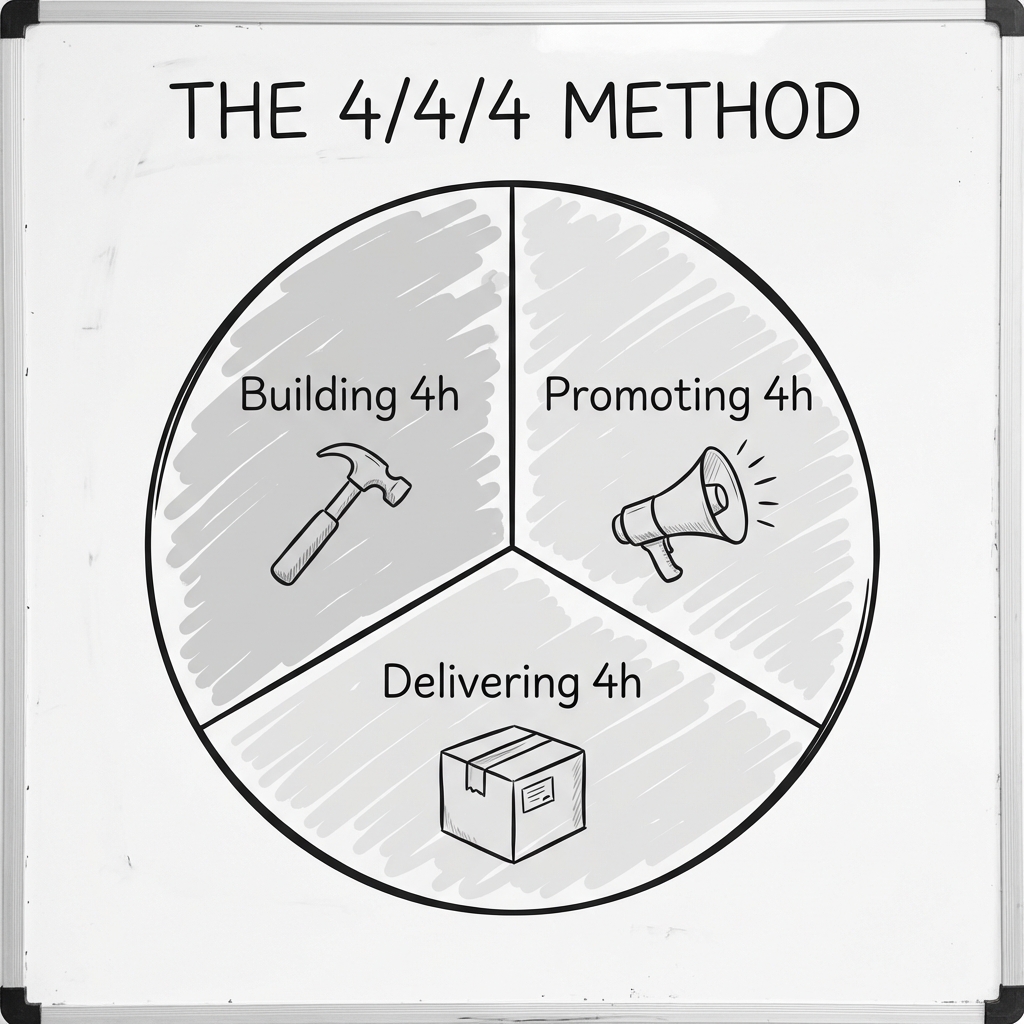
The Three Pillars of Business Growth
Alex Hormozi's framework divides all business work into three categories: Building (product development), Promoting (marketing and sales), and Delivering (client fulfillment). Every hour you work falls into one of these three buckets, and neglecting any one of them creates a predictable failure pattern.
Before we get into the specifics, let's break down what Hormozi considers the only three categories of work that matter:
Building 🔨 — This is product development, systems creation, infrastructure, and anything that makes your offering better. It's the thing you're probably best at and spend the most time on.
Promoting 📣 — Marketing, content creation, sales calls, lead generation, and anything that puts eyeballs on what you've built. This is often the most neglected category for technical founders.
Delivering 📦 — Customer fulfillment, support, operations, and anything that serves the people who've already paid you. It's essential but can become a time sink if you're not careful.
For a deeper dive into these categories, check out our guide on Building vs Promoting vs Delivering.
The insight here isn't groundbreaking. These three categories have existed since people started trading goods. But here's where Hormozi's approach gets interesting.
Why 4 Hours Each? The Strategic Logic
The equal 4-hour split forces entrepreneurs to invest in all three business functions daily instead of defaulting to the one they're most comfortable with. Without forced balance, most founders over-index on Building while Promoting and Delivering decay.
Most entrepreneurs don't consciously allocate time to these categories. They react. An email comes in, they respond. A bug appears, they fix it. A customer complains, they handle it.
This reactive mode creates a predictable failure pattern: you become exceptional at one category while the others decay.
- The developer who only builds ends up with a beautiful product nobody knows about.
- The marketer who only promotes makes promises the business can't deliver.
- The operator who only delivers never has time to improve the product or grow the audience.
The 4/4/4 split—four hours of Building, four hours of Promoting, four hours of Delivering—forces balance. It's not about working more hours. It's about ensuring none of the three pillars gets neglected.
If you're wondering whether you're falling into one of these traps, read Are You an Imbalanced Entrepreneur?.
The Hidden Philosophy: No Meeting Days
The 4/4/4 method only works if you protect each block from interruption. A single 30-minute meeting can destroy a 4-hour focus block because of context-switching costs before and after, which is why Hormozi eliminates scattered meetings entirely.
Here's something people miss when they try to copy the 4/4/4 method: Hormozi is famously anti-meeting.
Why? Because a 30-minute meeting doesn't cost you 30 minutes. It costs you the entire focus block it sits inside.
Think about it. If you have a 10 AM meeting, you won't start deep work at 9:30 because "what's the point, the meeting's coming up." And after the meeting ends at 10:30, you need 15-20 minutes to reload context and get back into flow.
That "30-minute meeting" just cost you two hours of productive time.
The 4/4/4 method only works if you protect those blocks from interruption. That means:
- Batching all meetings into specific days
- Creating "fortress hours" where nothing can interrupt you
- Treating your calendar like a budget, not a suggestion
Implementation: How to Actually Do This
To implement the 4/4/4 method, start by auditing your current time allocation for one week, then begin with a 2/2/2 split (two hours per category). Protect your Promoting block first since it's the most neglected, and use a categorized timer to track distribution rather than total hours.
Alright, so how do you implement this if you don't have a team running your business?
Step 1: Audit your current week
Before changing anything, track where your time currently goes. For one week, log every work activity into one of three categories: Building, Promoting, or Delivering.
You'll probably be shocked. Most solopreneurs discover they spend 70%+ on one category and almost nothing on another.
Step 2: Start with 2/2/2
Don't try to jump to 12-hour days immediately. Start with a minimum of 2 hours in each category, every day. That's 6 hours of intentional, categorized work.
Step 3: Protect the Promoting block
For most technical founders, Promoting is the hardest to protect. It feels less "productive" than building and less urgent than delivering.
Schedule it first thing in the morning before the fires start. Write the content, make the post, send the outreach—before you open Slack.
Step 4: Use a categorized timer
This isn't about tracking total hours. It's about tracking the distribution. A timer that lets you select your category before each focus session creates instant awareness.
Want to start tracking your Building, Promoting, and Delivering time? Try The Boring Clock for free—it's built exactly for this purpose.
When you see your weekly report showing 15 hours of Building, 2 hours of Promoting, and 10 hours of Delivering... you know exactly what needs to change.
The Deeper Principle: Awareness Precedes Change
You cannot fix a time allocation problem you haven't measured. The 4/4/4 method works because it forces you to categorize every working hour, which surfaces the imbalances you were ignoring — the ones where Building felt safe, Delivering felt urgent, or Promoting felt uncomfortable.
The 4/4/4 method isn't magic. It's a forcing function.
Most productivity advice tells you to "work smarter" or "prioritize better." As Hormozi explains in $100M Leads, you can't prioritize what you're not measuring. You can't change patterns you're not aware of.
By requiring equal investment across all three domains, Hormozi's approach surfaces the imbalances that were always there—the ones you were ignoring because Building felt safe, or Delivering felt urgent, or Promoting felt uncomfortable.
The framework doesn't require you to achieve perfect 4/4/4 every single day. Some days are launch days (more Promoting). Some days are customer-heavy (more Delivering). Some days are deep creation (more Building).
But over a week or a month, the averages should balance out. If they don't, you're building a lopsided business.
Common Mistakes When Implementing 4/4/4
The four most common mistakes are treating the 4/4/4 ratio as a rigid daily mandate instead of a weekly target, counting meetings as productive work time, misclassifying tasks into wrong categories, and skipping the initial time audit that establishes your baseline.
The framework sounds simple. Implementation is where most people fail.
Mistake 1: Treating categories as rigid boxes. If you're in the middle of a launch, your Promoting block might need 6 hours that week. The 4/4/4 ratio is a weekly target, not a daily mandate. Flexibility within structure is the goal.
Mistake 2: Counting meetings as work time. A 30-minute meeting doesn't cost 30 minutes—it costs the focus block it sits inside. If you have 3 meetings scattered across your Building time, you effectively had zero Building hours. Batch meetings into a single day or time slot.
Mistake 3: Misclassifying tasks. Writing a sales email is Promoting, not Delivering. Fixing a bug reported by a customer is Building, not Delivering. Onboarding a new client is Delivering, not Building. Be honest about where each activity belongs. If you're not sure, ask: "Does this make the product better, reach more people, or serve existing customers?"
Mistake 4: Skipping the audit. You can't fix a distribution you haven't measured. Most entrepreneurs who "try" the 4/4/4 method skip the first step—tracking their current allocation—and jump straight to scheduling ideal blocks. Without a baseline, you're guessing.
Adapting 4/4/4 for Solopreneurs
Solopreneurs should start with their weakest category first each day, match categories to energy levels instead of fixed clock times, and accept imperfect splits. A 40/35/25 distribution is dramatically better than the typical 80/15/5 most solo founders default to.
Hormozi runs a portfolio of companies with teams in each. If you're a solopreneur, the principle still applies, but the execution shifts.
Start with your weakest category. Track your time for one week. You'll likely discover one category gets less than 10% of your attention. That's your growth constraint—the one thing holding your business back. Schedule that category first each day, before reactive work takes over.
Use energy levels, not clock order. Hormozi can afford dedicated team members for each category. You're switching between all three yourself. Match categories to your energy: creative Building in the morning, social Promoting midday, operational Delivering in the afternoon. Your brain has different capacities at different times—use them.
Accept imperfect splits. A solo founder doing 40% Building, 35% Promoting, 25% Delivering is dramatically better off than one doing 80% Building, 15% Delivering, 5% Promoting. Progress over perfection.
The Pomodoro Technique was born from a similar insight—one student's realization that awareness of how time passes is the precondition for changing how you spend it.
Your Move
Here's what I want you to do right now:
Look at your last week. Not what you planned—what actually happened. If you had to categorize every hour you worked, what would the split be?
Be honest. Nobody's watching.
That number is your reality. And if you want a different result, you need a different allocation.
The 4/4/4 method is just a framework. But frameworks work when generic intentions fail. They turn ambition into action.
Start tracking. Start categorizing. Start protecting the blocks.
Ready to implement the 4/4/4 method? The Boring Clock helps you track your time across Building, Promoting, and Delivering—so you can see exactly where your hours go and rebalance accordingly.
You might also like
Stop Doing Low-Value Work: The Delete-Automate-Delegate Framework for Deep Work
Before you can do deep work, you need to eliminate shallow work. Learn Alex Hormozi's hierarchy: Delete first, then Automate, then Delegate what remains.
Stop Spending Time, Start Investing It: The ROI Framework for Productivity
Not all hours are equal. Some compound, others evaporate. Learn to evaluate your activities by their long-term returns and stop wasting focus on low-ROI tasks.
Where Do Your Hours Go? Why Generic Time Tracking Fails Entrepreneurs
You planned 4 hours of deep work but only got 45 minutes. Learn why tracking time by category reveals the leaks that generic timers miss.
Ready to take control of your focus?
Stop letting time slip away. The Boring Clock helps you track where your hours actually go, categorized by Building, Promoting, and Delivering.