Why Entrepreneurs Burn Out: The Hidden Cost of Neglecting One Part of Your Business
Are You an Imbalanced Entrepreneur? Why Tracking Your Time Categories Matters
Let me describe three founders. See if any of them sound familiar.
Founder A spent eight months perfecting their product. The code is beautiful. The UI is polished. The feature set rivals competitors who've been around for years. There's just one problem: nobody knows it exists. Three beta users. Zero revenue. The product's exceptional; the marketing's nonexistent.
Founder B has 50,000 followers and a growing email list. Their content game is strong. Launches always get engagement. But behind the scenes? They're drowning in unfulfilled promises, shipping delays, and customer complaints. The audience keeps growing; the reputation keeps shrinking.
Founder C wakes up everyday firefighting. Customer support tickets, operational issues, fulfilling orders. They're so buried in delivery that they haven't shipped a new feature in months. And marketing? What marketing?
These aren't three different personality types. They're the same person at different times. Maybe even you, right now.
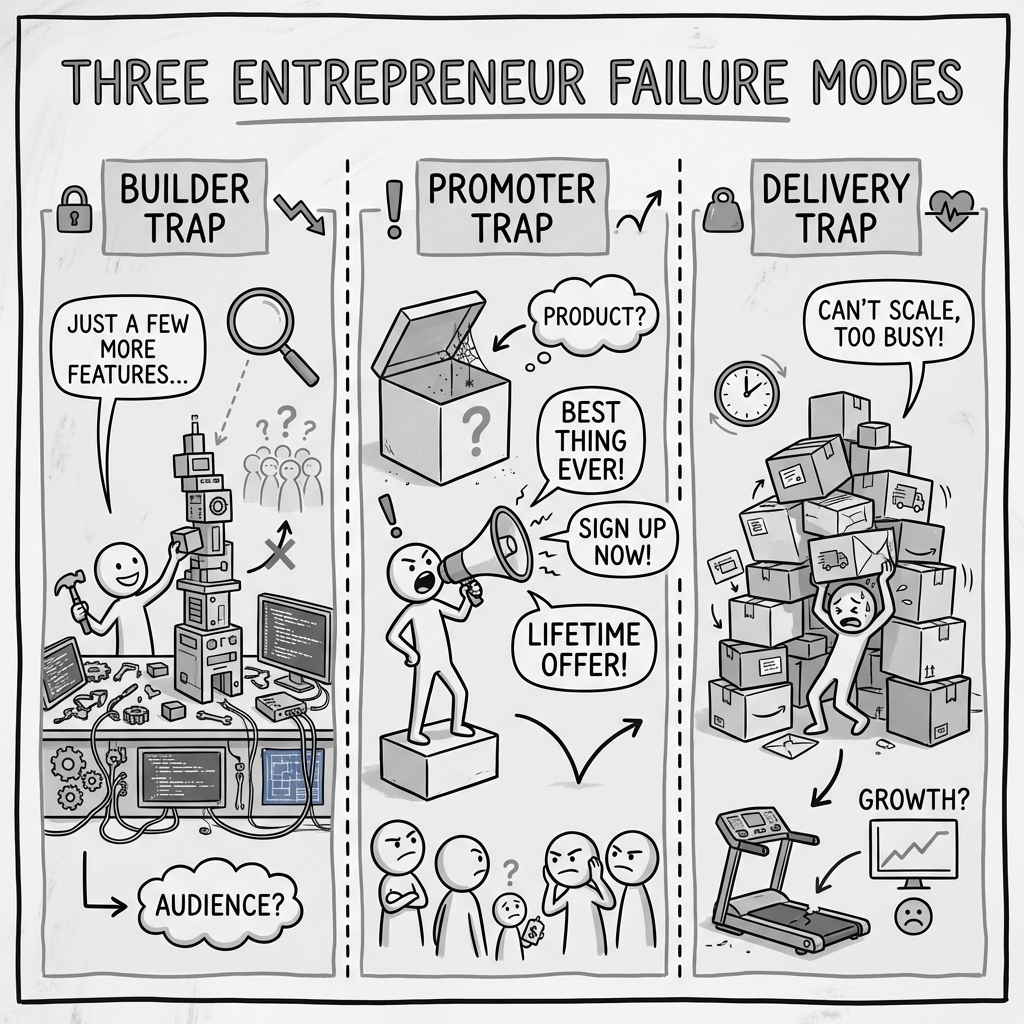
The Three Failure Modes
Every entrepreneur falls into one of these imbalanced states at some point. The question isn't whether it happens—it's whether you're aware enough to correct it.
- The Builder Trap: Amazing at creating but building without promoting is like throwing a party and forgetting invitations. Great product, empty room.
- The Promoter Trap: A content machine getting attention, but attention without delivery is just hype. Trust erodes. The unfollows start.
- The Delivery Trap: Reliable and loved by customers, but so deep in operations there's no time to improve or grow. You're building a job, not a business.
The painful truth? Most entrepreneurs can't accurately describe how their time is currently distributed. A landmark Harvard Business Review study on how CEOs manage their time found that even top executives are surprised by how their hours actually break down when tracked.
For more on how to balance these categories, see Building vs Promoting vs Delivering: Where Should You Spend Your Time?.
The Awareness Gap
I asked 50 founders to estimate their time split across Building, Promoting, and Delivering. Then I had them actually track it for a week.
The gap was enormous.
Founders who believed they were balanced (roughly 33/33/33) were often wildly skewed (60/25/15 or 20/10/70). They weren't lying. They genuinely didn't see it.
Why? Because untracked time is invisible time.
When you don't categorize your work, everything blends together. You feel busy—because you are busy. But being busy doesn't mean being balanced.
Here's what's worse: the category you neglect is usually the category you're uncomfortable with.
- Introverted developers avoid Promoting because it feels performative.
- Marketing-minded founders avoid Delivering because it feels tedious.
- Operations-focused founders avoid Building because it feels risky.
Your weakness hides in your blind spot. And without tracking, the blind spot stays dark.
The Observer Effect
Here's something psychologists call the observer effect: the act of measuring something changes it.
When you start tracking where your time goes—actually categorizing each focus session—you'll notice something strange. The imbalance starts correcting itself.
Not because you're forcing it. But because awareness creates friction. It becomes harder to spend your fifth consecutive hour building when the Promoting category shows a big fat zero.
Tracking isn't just data collection. It's intervention.
If you're ready to see where your focus time actually goes, start tracking with The Boring Clock—it's designed specifically for categorized time tracking.
How to Run a Time Category Audit
Ready to see your actual distribution? Here's how to run an honest audit:
-
Week 1: Track without judgment — Don't try to change anything. Just categorize every work session into Building, Promoting, or Delivering. Be honest. If you spent 3 hours on Instagram "for marketing" but really just scrolled, that doesn't count as Promoting.
-
Week 2: Analyze the pattern — Look at your totals. What's the percentage split? Which category is getting the most attention? Which is getting almost nothing?
-
Week 3: Set a minimum — Pick your weakest category—the one you're most avoiding. Set a daily minimum. Even one hour. Protect that time before anything else.
-
Ongoing: Review weekly — This isn't a one-time exercise. Your distribution will shift based on business phase, product launches, and a dozen other factors. The weekly review is what keeps you calibrated.
This framework is inspired by Alex Hormozi's 4/4/4 method—learn more about it in Deconstructing Alex Hormozi's $100M Schedule.
What Your Data Should Tell You
Once you have a few weeks of tracking, the patterns become actionable:
- If Building dominates: You need to ship and promote. Stop polishing. The market will tell you what needs improvement faster than your assumptions will.
- If Promoting dominates: You need to deliver on your promises and build the product that matches the narrative. Otherwise, you're building an audience for a product that doesn't exist.
- If Delivering dominates: You need to systematize, delegate, or say no to some customers. As Michael Gerber illustrates in The E-Myth Revisited, working in your business instead of on it is the most common trap for small business owners. Growth requires capacity, and capacity requires time you're not currently spending on growth activities.
The specific ratio that's "right" depends on your business stage. Early startups often need 40% Promoting just to get initial traction. Mature businesses might shift toward 40% Delivering to maintain quality.
But no stage is sustainable with 0% in any category. That's the imbalance that kills.
From Awareness to Balance
I'm not going to tell you that perfect 33/33/33 balance is achievable or even desirable. Real weeks aren't that clean.
What I am saying is that chronic imbalance is preventable—if you measure it.
Most entrepreneurs treat time like air: abundant, invisible, and roughly the same everywhere. But time is more like money. Where you spend it determines what you get back. As Peter Drucker argued in The Effective Executive, systematically tracking and managing your time is the foundation of all effectiveness.
Would you run a business without tracking revenue and expenses? Of course not. So why would you run a business without tracking where your hours go?
The work still has to be done. But now you'll know if you're doing the right work in the right amounts.
Start tracking. Start categorizing. Start correcting.
You might also like
Where Do Your Hours Go? Why Generic Time Tracking Fails Entrepreneurs
You planned 4 hours of deep work but only got 45 minutes. Learn why tracking time by category reveals the leaks that generic timers miss.
Stop Spending Time, Start Investing It: The ROI Framework for Productivity
Not all hours are equal. Some compound, others evaporate. Learn to evaluate your activities by their long-term returns and stop wasting focus on low-ROI tasks.
Stop Doing Low-Value Work: The Delete-Automate-Delegate Framework for Deep Work
Before you can do deep work, you need to eliminate shallow work. Learn Alex Hormozi's hierarchy: Delete first, then Automate, then Delegate what remains.
Ready to take control of your focus?
Stop letting time slip away. The Boring Clock helps you track where your hours actually go, categorized by Building, Promoting, and Delivering.