The Bottleneck Method: How to Find Your One High-Leverage Task
What is Your A+ Task? The One-Thing Focus Method for Entrepreneurs
You finished 47 tasks this week. You answered every email. You cleared every Slack thread. You attended every meeting. You even got in some exercise.
You should feel accomplished. But something's off.
The business didn't actually move forward. Revenue is the same. The product is the same. The opportunity you've been "meaning to pursue" is still sitting there, untouched.
This is the productivity trap that catches most entrepreneurs: completing many tasks while ignoring the one that matters.
You don't have a hustle problem. You have a focus problem. And solving it requires asking a question most people avoid:
What is your A+ Task?
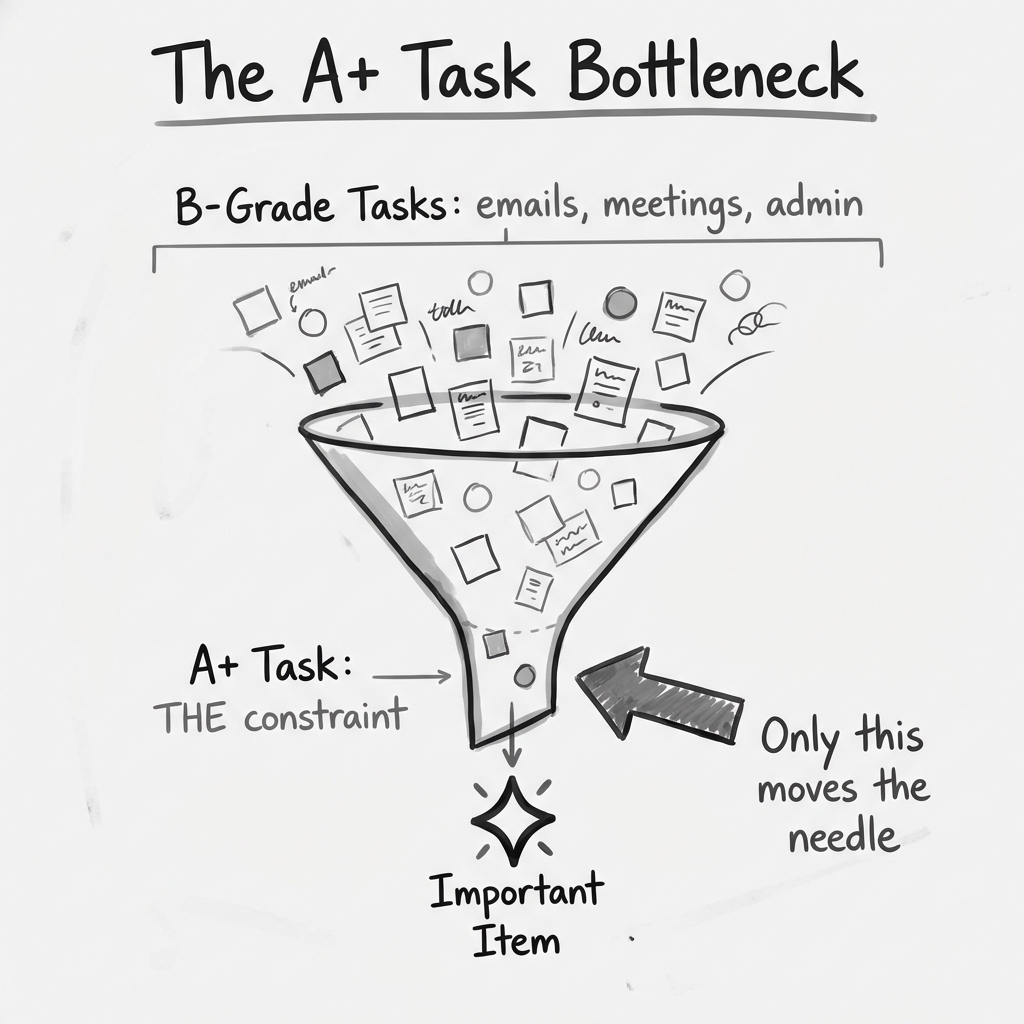
The Theory of Constraints Applied to Personal Productivity
In manufacturing, there's a concept called the Theory of Constraints, introduced by Eliyahu Goldratt in his business novel The Goal. It goes like this:
Every system has exactly one bottleneck that limits overall throughput. Improving anything that isn't the bottleneck doesn't improve the system. Only improving the bottleneck matters.
Think of a factory production line. If one machine can only produce 100 units per hour while every other machine can produce 200, the factory's output is capped at 100 units per hour. Upgrading those 200-unit machines to 300 units changes nothing. Only upgrading the 100-unit machine moves the needle.
This principle applies directly to your business—and to how you spend your time.
Your business has exactly one bottleneck—one constraint that limits growth more than anything else. Your A+ Task is the work that directly addresses that bottleneck.
Everything else is B-grade work. Important, maybe. Necessary, sometimes. But not the thing that actually moves the needle. This echoes the Pareto Principle—roughly 80% of your results come from 20% of your efforts—but takes it even further by asking you to identify the single highest-leverage activity.
Why Completing 10 Tasks Feels Good But Moves You Nowhere
Here's a psychological trap that's hard to escape:
Small tasks provide more frequent dopamine hits than big tasks.
Answering an email takes 2 minutes and gives you the satisfaction of "completing something." Working on the product overhaul that will unlock your next revenue tier takes 20 hours and provides no completion dopamine until it's done.
So your brain gravitates toward emails.
After a day of answering 50 emails, you feel productive. But nothing changed. The product is the same. The bottleneck is still there. Tomorrow will look exactly like today.
The 10 small tasks felt good because they were completable, measurable, and non-threatening. The A+ Task felt bad because it was ambiguous, scary, and might reveal that you don't know what you're doing.
This asymmetry is why most entrepreneurs stay busy while their businesses stagnate. The completion feeling of B-grade work masks the emptiness of avoiding A-grade work.
Identifying Your A+ Task
Your A+ Task has specific characteristics:
- It directly addresses your business's bottleneck. Not a secondary concern—THE constraint. The one thing that, if solved, would unlock the next level of growth.
- It's probably uncomfortable. If it were comfortable, you would have done it already. The fact that it's been sitting on your list for weeks is a sign you're avoiding it.
- It has asymmetric returns. Completing it would have impact far beyond the time invested. This isn't incremental improvement—it's step-change progress.
- It requires focused, uninterrupted time. You can't do it in 15-minute increments between meetings. It needs sustained attention.
Let me give you some examples across different business stages:
- If you have no customers: Your A+ Task is probably shipping something people can use. Not perfecting it. Not researching more. Shipping. The bottleneck is that nobody can buy anything yet.
- If you have customers but no growth: Your A+ Task is probably acquiring more customers. The bottleneck is distribution. Building more features for existing customers won't fix this.
- If you have growth but chaos: Your A+ Task is probably building systems. The bottleneck is operational capacity. More sales into a broken system just creates more fires.
- If you have systems but stagnation: Your A+ Task is probably innovation. The bottleneck is competitive differentiation. The market has changed and you haven't.
Notice how different these are. The entrepreneur at stage 1 who tries to build systems is wasting time. The entrepreneur at stage 3 who tries to acquire more customers is making things worse.
Your A+ Task depends on your specific bottleneck. There's no universal answer.
The Uncomfortable Question
Here's an exercise that reveals your A+ Task with uncomfortable clarity:
This is the central insight of Gary Keller's The ONE Thing: extraordinary results come from narrowing your focus, not expanding it.
Imagine you could only complete ONE task this week. Everything else would remain untouched. Emails unanswered. Meetings skipped. Slack ignored.
But you could finish ONE thing.
What would have the biggest impact on your business six months from now?
Not the biggest immediate impact—the biggest lasting impact. The thing that compounds. The thing that removes constraints rather than just managing them.
That's your A+ Task.
Write it down. Look at it. Feel the discomfort.
Now ask yourself: how many hours did you spend on that this week?
If the answer is less than a third of your working time, you've revealed the problem. You're spending the majority of your time on things that don't address your actual bottleneck.
Why Category Tracking Exposes This
Let's connect this to the Building/Promoting/Delivering framework.
Your A+ Task lives in one of these categories. And whatever category it lives in is probably the one you're neglecting.
If your A+ Task is Building (developing that new feature that unlocks a new market), but your time tracking shows you spend 60% of your time Delivering, you've found the problem.
If your A+ Task is Promoting (launching that marketing campaign that fills the pipeline), but you're hiding in Building, you've found the problem.
Category tracking creates visibility that task lists can't provide. You might have "launch marketing campaign" on your task list for six weeks. Without time data, you can tell yourself you're "working on it."
With time data, you can see "2% of time in Promoting last month." The self-deception becomes impossible.
This is why strategic focus requires measurement. Not to make you feel guilty, but to force awareness. The first step to changing a pattern is seeing it clearly.
For more on how to balance these categories, see Building vs Promoting vs Delivering: Where Should You Spend Your Time?.
Protecting Time for Your A+ Task
Identification isn't enough. You also have to protect time for actual execution.
Here's the brutal truth: your A+ Task won't get done in leftover time. It won't get done "when things calm down." It won't get done between meetings.
It needs protected, scheduled, defended time.
Step 1: Block the time first
When you plan your week, the A+ Task gets blocked before anything else. Not after you fit in meetings. Not after you clear emails. First.
Step 2: Make it the first thing
Schedule your A+ Task time for the first 2-3 hours of your day, before the world interrupts with its own priorities. Your peak cognitive hours should go to your highest-leverage work.
Step 3: Protect aggressively
The world will try to steal this time. Clients will want calls. Team members will have "quick questions." Emergencies will appear that aren't actually emergencies.
Decline. Delegate. Defer. Your A+ Task is more important than everything trying to replace it.
Step 4: Track it separately
Use a timer that lets you specifically track A+ Task time versus other work. At the end of the week, you should be able to answer: "How many hours did I spend on the thing that actually matters?"
If the number is less than 10 hours in a 50-hour work week, you're not serious about moving the needle. You're just busy.
The Compounding Effect
Here's what happens when you consistently prioritize A+ Task work:
- Week 1: You feel uncomfortable. The emails pile up. The Slack channels feel abandoned. But you make real progress on the bottleneck.
- Week 2: The bottleneck starts giving way. You see movement that hasn't happened in months.
- Week 4: The constraint that was limiting your business is measurably reduced. New problems emerge—good problems.
- Month 2: You've solved the original bottleneck. Now you can identify the new one. The business is at a higher level.
- Month 6: Looking back, those piled-up emails didn't matter. The missed meetings didn't sink you. But the A+ Task work transformed the trajectory.
The compound effect of focused A+ Task work accumulates while the "urgent" busywork washes away like it never happened.
The Weekly A+ Task Review
Build this into your weekly review:
- Identify the current A+ Task. Your bottleneck may shift. What was the A+ Task three months ago might be solved. Reassess weekly.
- Review hours invested. Look at your time tracking. How many hours went to A+ Task work versus everything else?
- Evaluate progress. Did those hours actually move the bottleneck? Or did you fill the time without impact?
- Protect next week's time. Block A+ Task time on the calendar before anything else gets scheduled.
- Be honest about avoidance. If you're consistently logging low A+ Task hours, ask why. What are you afraid of? What's the real reason you're hiding in busywork?
For related concepts on protecting focused work time, see Deconstructing Alex Hormozi's $100M Schedule. Hormozi shares more about bottleneck-first thinking at Acquisition.com.
The Entrepreneurial Test
There's a simple test for whether you're thinking like an entrepreneur or an employee:
Employees are rewarded for completing many tasks. Their value is measured in throughput, reliability, and responsiveness.
Entrepreneurs are rewarded for completing the right tasks. Their value is measured in business results, which come from solving bottlenecks.
If you started a business but still think like an employee—measuring success by inbox zero and task list completion—you're optimizing for the wrong metric.
The entrepreneur who completes one A+ Task per week while letting everything else slide will build a bigger business than the entrepreneur who completes 50 B-grade tasks while avoiding the A+.
This is uncomfortable. It requires saying no. It means some things won't get done.
But those things weren't going to transform your business anyway.
Your Move
Right now. Not later. Answer this:
What is the single biggest constraint limiting your business growth?
Write it down.
What specific work would directly address that constraint?
Write it down. That's your A+ Task.
How many hours did you spend on it last week?
If it's less than you spent on email, you have your diagnosis.
Now decide: are you going to keep completing B-grade work that makes you feel productive? Or are you going to focus on the one thing that actually matters?
The calendar is right there. Block the time.
Your A+ Task is waiting.
You might also like
The Weekly Review System: How to Analyze Your Productivity Data
Learn how to conduct an effective weekly review that uses your productivity data to identify patterns, adjust priorities, and set targets for continuous improvement.
Stop Spending Time, Start Investing It: The ROI Framework for Productivity
Not all hours are equal. Some compound, others evaporate. Learn to evaluate your activities by their long-term returns and stop wasting focus on low-ROI tasks.
The Planning Fallacy: Why You Always Underestimate How Long Tasks Take
Learn why humans are hardwired to underestimate task duration, and discover practical techniques to create realistic time estimates using actual tracking data.
Ready to take control of your focus?
Stop letting time slip away. The Boring Clock helps you track where your hours actually go, categorized by Building, Promoting, and Delivering.