Digital Body Doubling: How a Focus Timer Becomes Your Accountability Partner
Digital Body Doubling: How a Focus Timer Becomes Your Accountability Partner
Here's something that sounds strange until you try it: working alongside another person—even if they're not helping with your task—makes you more focused.
You're not collaborating. You're not even talking. They're just... there. And somehow, their presence makes you productive.
This phenomenon has a name: body doubling. And it's quietly revolutionizing how people — especially those with ADHD — approach focus and productivity. Organizations like CHADD (Children and Adults with ADHD) have highlighted body doubling as a practical strategy for managing attention challenges.
But what if you don't have someone to work alongside? What if you're remote, or solo, or just not in the mood for a Zoom coworking session?
That's where digital body doubling comes in. And your focus timer might be the best accountability partner you've never considered.
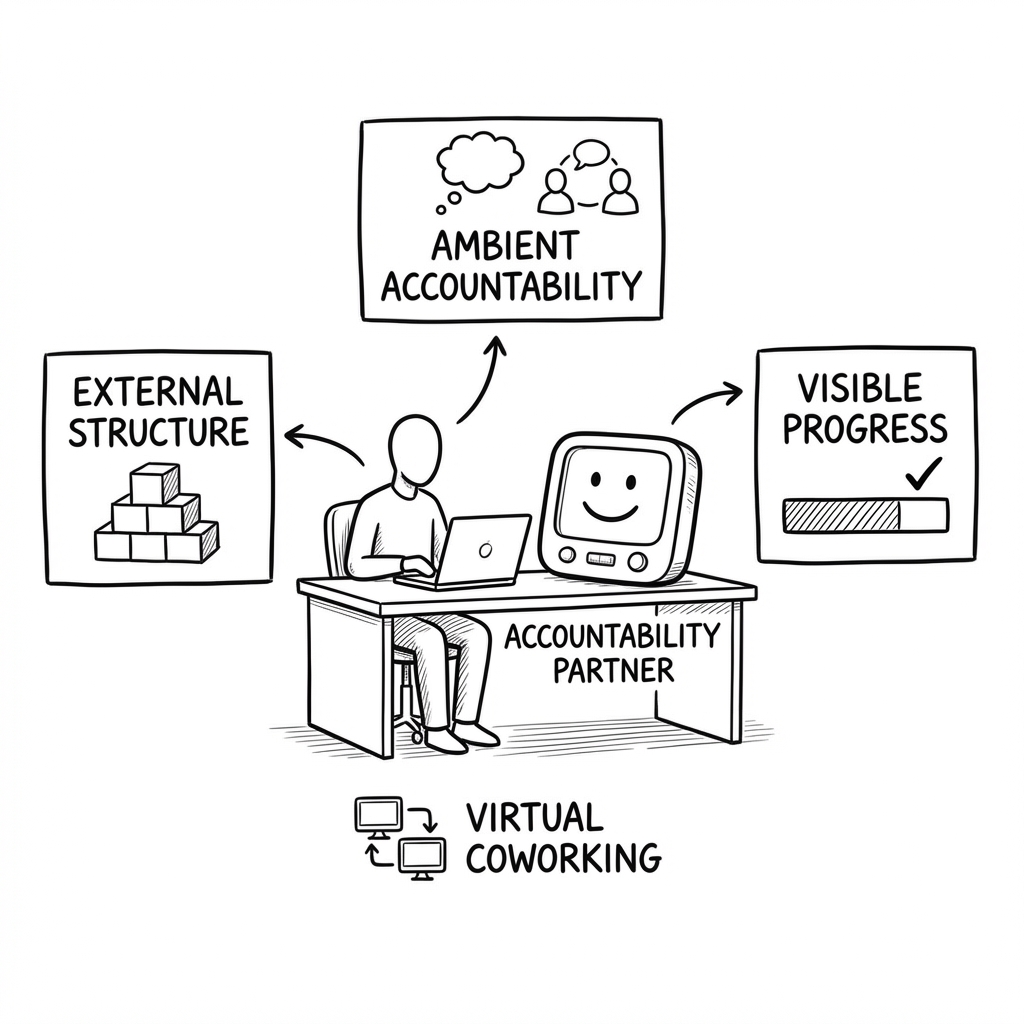
What Is Body Doubling?
Body doubling is the practice of having another person present while you work—not to collaborate or assist, but simply to create ambient accountability.
The other person might be:
- A friend doing their own work in the same room
- A coworker at a shared desk
- A stranger in a coffee shop
- A virtual coworking partner on video call
They don't need to interact with you or even know what you're working on. Their presence alone creates a psychological shift that makes focus easier.
It sounds almost too simple to work. But it does work—consistently.
Why Body Doubling Works
Several psychological mechanisms explain the body doubling effect:
1. External Accountability
When someone is present, there's an implicit social contract to stay on task. You don't want to be seen scrolling social media or staring into space. The mere presence of another person creates gentle pressure to appear productive.
This isn't about judgment. It's about the natural human tendency to perform better when observed—what psychologists call the "audience effect."
2. Reduced Isolation
Working alone can feel empty, especially for extended periods. Body doubling provides companionship without the distraction of conversation. You're alone together.
This is why many people find it easier to focus in coffee shops than in silent home offices. The ambient presence of others creates a sense of shared purpose.
3. Matching Energy
When you see someone else focused and working, your brain receives cues to do the same. You're mirroring their productive state.
This is particularly powerful for ADHD brains, which often struggle to self-generate motivation but can borrow momentum from external cues.
4. Breaking the Initiation Barrier
The hardest part of any task is starting. Body doubling lowers the activation energy by providing structure and expectation.
"I told my body double I'd work from 9 to 11" creates external commitment. You show up. You start. The rest often follows.
The ADHD Connection
Body doubling has become especially popular in ADHD circles, and for good reason.
ADHD brains often struggle with:
- Initiation: Starting tasks, especially boring or challenging ones
- Sustained attention: Maintaining focus without external structure
- Self-regulation: Staying on track without reminders
- Time perception: Operating as if time is elastic
Body doubling addresses all four.
The external presence provides initiation structure ("We're starting now"). It creates sustained accountability ("Someone is here watching"). It offers regulation through social expectation. And the timer creates concrete temporal boundaries that combat time blindness.
For more on ADHD-friendly productivity approaches, see Harnessing Hyperfocus: Why ADHD Brains Thrive with Extended Focus Blocks.
Virtual Body Doubling: The Remote Evolution
The pandemic accelerated virtual body doubling. With in-person coworking harder to access, people discovered that video calls could serve the same function.
Common virtual body doubling formats:
1. Focusmate and Similar Platforms
Services like Focusmate match you with a stranger for 25-minute or 50-minute work sessions. You video call, state your intention, work silently, and check in at the end.
Thousands of people swear by this format. The stranger dynamic actually increases accountability—you don't want to look unfocused in front of someone you just met.
2. Study With Me Streams
YouTube and TikTok are filled with "Study With Me" videos — hours-long recordings of people studying or working, often with ambient sounds and visible timers.
Viewers work alongside the creator. It's parasocial body doubling—one-directional presence that still provides the ambient accountability effect.
3. Discord and Slack Coworking Channels
Many online communities have channels where members silently cowork, sharing when they start and finish sessions. The asynchronous presence creates lightweight accountability.
4. Coworking With Friends
The simplest version: get on a low-stakes video call with a friend, state what you're working on, and work in parallel. Occasional check-ins optional.
The Timer as Body Double
Here's the insight that changes everything: a running timer creates similar psychological effects to a human body double.
When you start a focus timer, something shifts. There's now an external entity observing your work. The countdown creates presence—something is watching, measuring, counting.
The timer creates:
- External structure: The session has defined boundaries
- Ambient accountability: The counting feels like observation
- Initiation trigger: Starting the timer triggers starting work
- Visible progress: The countdown shows time passing concretely
For ADHD brains especially, this external structure compensates for weak internal regulation. The timer becomes your accountability partner—always present, never judgmental.
What Makes a Good Digital Body Double
Not all timers work equally well as body doubles. The best ones share characteristics:
1. Visible Countdown
You should be able to see the time remaining. This creates the "observation" effect and makes time concrete.
2. Category Awareness
Knowing what TYPE of work you're doing—Building, Promoting, Delivering—creates additional accountability. You're not just "working," you're investing in a specific domain.
3. Session Logging
Seeing your completed sessions accumulate provides the compounding satisfaction of progress. Each logged session is proof that you showed up.
4. Weekly Progress
Being able to review your week shows patterns. You can see when you worked, how your categories balanced, and how your investment of time played out.
5. Non-Disruptive
Unlike Pomodoro bells every 25 minutes, a good digital body double doesn't interrupt flow unnecessarily. It's present without being intrusive.
Setting Up Your Digital Body Doubling Practice
Here's how to use a timer as your accountability partner:
Step 1: Choose Your Session Length
For ADHD brains, 30-minute sessions often work better than 25-minute Pomodoro sessions. There's time to warm up AND get productive work done.
For particularly resistant tasks, even 15-minute sessions work. The goal is starting, not marathon sessions.
Step 2: Pre-Select Your Category
Before starting the timer, choose your category: Building, Promoting, or Delivering.
This eliminates decision fatigue ("What should I work on?") and creates clear focus scope. You're not doing "everything"—you're doing one type of work.
Step 3: State Your Intention
Even without a human body double, stating your intention out loud or writing it down creates commitment.
"For the next 30 minutes, I'm writing the product spec."
This is your contract with your timer-body-double.
Step 4: Start the Timer
The moment you start the timer, work mode activates. The countdown is running. Someone is watching.
If your mind wanders to distractions, the visible timer reminds you: "You're in session. Come back."
Step 5: Complete or Extend
When the timer ends, you have a choice:
- Stop and break: Log the session, rest
- Extend: If you're in flow, keep going and log the extended session
Unlike rigid Pomodoro, this approach respects your natural rhythms while providing accountability structure.
Step 6: Review Weekly
At the end of the week, review your sessions. How many hours did you log? How did categories balance? Which days were strongest?
This review creates the "progress visible" effect that reinforces the practice.
Stacking Body Doubling Methods
For maximum effect, stack multiple body doubling techniques:
Level 1 (Timer alone):
- Focus timer running
- Category selected
- Visible countdown
Level 2 (Timer + ambient):
- Focus timer running
- "Study With Me" video playing in background
- Lo-fi music for additional ambient presence
Level 3 (Timer + human):
- Focus timer running
- Virtual coworking partner on call
- Shared intention-setting at start
Level 4 (Full stack):
- Focus timer with category tracking
- Virtual coworking group
- Public accountability (tweet your session)
- Weekly review with community
Each layer adds accountability. Start with Level 1 and add as needed.
The Psychology of Observation
There's a deeper principle at work here: the observer effect changes behavior.
In physics, observing a system changes it. In psychology, being observed changes how we act. Body doubling leverages this by creating the experience of observation—even when the "observer" is a timer counting down.
The key insight is that the observer doesn't need to be human, intelligent, or even technically observing. It just needs to create the psychological experience of presence.
A ticking timer does this. A video of someone else working does this. A simple progress bar does this.
You're hacking your brain into thinking someone is watching. And your brain responds by focusing.
Why This Matters for Solo Workers
The rise of remote work created a focus crisis. Without office presence, many people discovered they couldn't concentrate. The accountability of being surrounded by coworkers was gone.
Body doubling—physical and digital—recreates that accountability artificially.
If you work alone, you can:
- Create virtual coworking sessions with friends
- Use Focusmate or similar services
- Play "Study With Me" content
- Use a timer as constant ambient presence
You don't need an office. You need presence. And presence can be constructed intentionally.
Getting Started
Here's your practice starting point:
Day 1-7: Use a focus timer for at least three 30-minute sessions daily. Select your category before each session. Notice how the running timer affects your focus.
Day 8-14: Add one virtual coworking session using Focusmate or a friend. Notice how human presence compares to timer-only sessions.
Day 15-21: Experiment with stacking: timer + ambient video, timer + music, timer + human. Find what combination works for your brain.
Ongoing: Review your weekly session logs. Celebrate consistency. Adjust based on what you learn about your patterns.
Ready to start your digital body doubling practice? The Boring Clock provides the timer, category tracking, and weekly progress visibility that makes this approach work.
You're Not Working Alone
The core message of body doubling is this: you were never meant to focus entirely alone.
Human brains evolved in social contexts. We're wired to respond to presence, to accountability, to the energy of others working nearby.
Modern solo work—remote offices, home desks, isolated screens—removes these natural supports. Body doubling puts them back, whether through humans or design.
Your timer is watching. Your sessions are being logged. Your categories are being tracked.
You're not alone. And that's exactly why you'll focus.
You might also like
ADHD and the Pomodoro Technique: Why 25-Minute Timers Don't Work for ADHD Brains
Standard Pomodoro timers can sabotage ADHD productivity. Discover why extended focus blocks with category tracking unlock your natural hyperfocus ability.
The Hidden Cost of Context Switching: How Much Focus Are You Losing?
Studies show it takes 23 minutes to refocus after each interruption. Learn how to calculate your true context switching cost and protect your productivity.
Ready to take control of your focus?
Stop letting time slip away. The Boring Clock helps you track where your hours actually go, categorized by Building, Promoting, and Delivering.