ADHD and the Pomodoro Technique: Why 25-Minute Timers Don't Work for ADHD Brains
Harnessing Hyperfocus: Why ADHD Brains Thrive with Extended Focus Blocks
Here's the paradox nobody talks about: ADHD brains struggle to start focusing but can become absolutely unstoppable once they do.
You've experienced it. You sit down planning to work for 30 minutes, and suddenly four hours have evaporated. You forgot to eat. You didn't notice the sunset. You built something remarkable while the world disappeared.
That's hyperfocus. And it's not a bug—it's a feature.
The problem is that most productivity systems treat ADHD like a focus deficit to be managed. They break work into tiny chunks. They ring bells every 25 minutes. They assume you need constant interruption to stay on track.
But what if the opposite is true? What if the key to ADHD productivity isn't more interruptions—it's fewer?
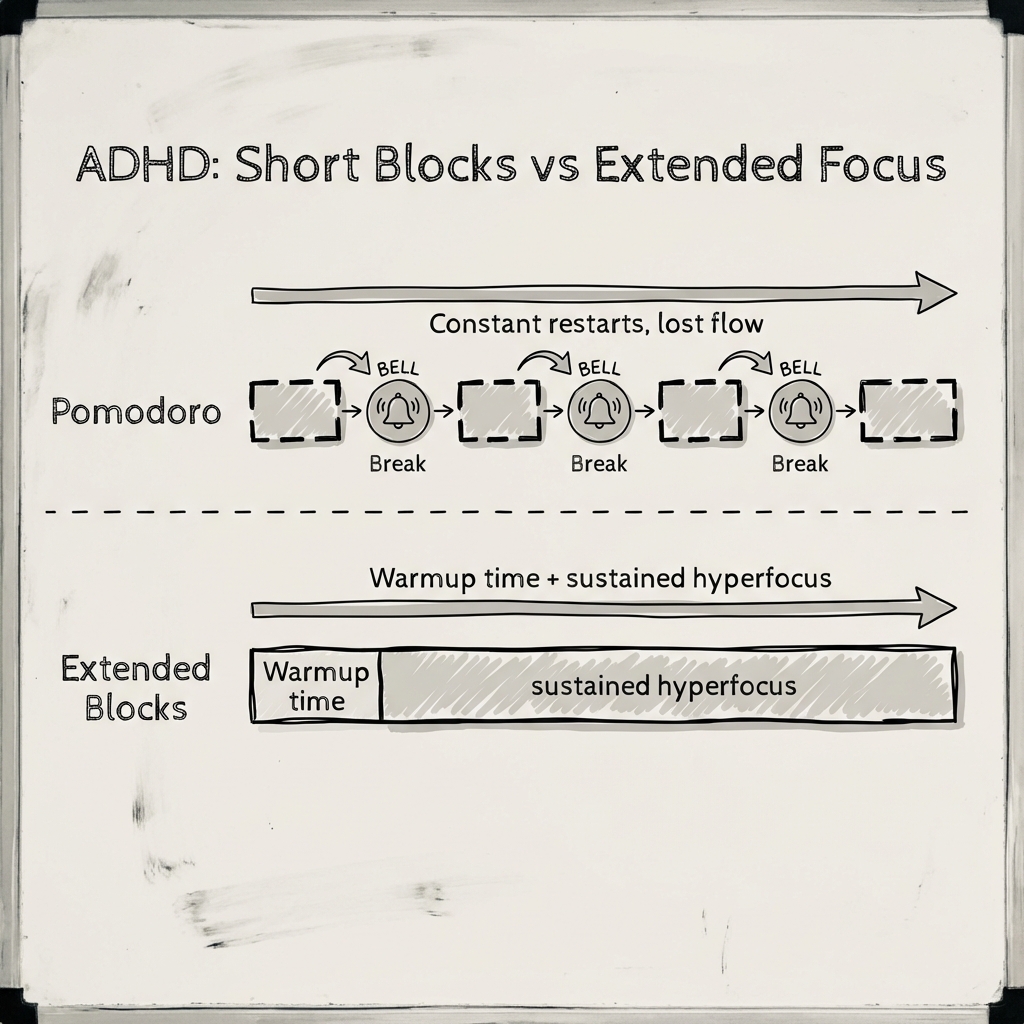
The Hyperfocus Advantage
Let's understand what's actually happening in an ADHD brain during hyperfocus.
Contrary to popular belief, ADHD isn't about an inability to pay attention. It's about difficulty regulating attention. As ADDitude Magazine explains, the ADHD brain doesn't lack focus — it lacks the ability to direct focus on demand.
When something captures an ADHD brain's interest, attention regulation stops being a problem. The brain locks on. Distractibility vanishes. Time perception distorts.
This isn't a malfunction. It's an adaptation.
Research suggests that hyperfocus may have evolved as a survival mechanism—the ability to become completely absorbed in a critical task, tuning out everything else until it's complete.
The modern challenge is learning to trigger and harness this state rather than waiting for it to happen accidentally.
Why Traditional Pomodoro Fails ADHD Brains
The Pomodoro Technique was invented in the 1980s for a neurotypical brain. It assumes that 25 minutes is the ideal focus duration and that forced breaks restore mental energy.
For ADHD brains, this creates two specific problems.
Problem 1: The Startup Cost is Too High
ADHD brains often need 15-20 minutes just to "warm up" to a task. This is sometimes called "attention inertia"—the difficulty of initially directing focus toward something.
If you're spending 15 minutes getting into a task and then getting interrupted at minute 25, you're only getting 10 minutes of actual productive work per session. That's a 60% efficiency loss.
And here's the cruel part: after the break, you have to go through the startup process all over again. The bell that was supposed to help becomes a reset button that erases your progress.
Problem 2: Breaking Hyperfocus is Painful
When an ADHD brain finally achieves hyperfocus, interrupting it isn't like waking from a light nap. It's like being pulled out of deep water.
The 25-minute bell doesn't just pause your work—it shatters the mental state you fought so hard to achieve. And unlike neurotypical brains, you can't easily slip back into that state. You might not get there again for hours. Or days.
ADHD forums are filled with people who describe the Pomodoro bell as "jarring," "infuriating," and "counterproductive." They're not exaggerating. For some brains, forced interruptions during flow are genuinely painful.
For more on the neuroscience behind this, see The Neuroscience of Flow: Why the 25-Minute Bell is a Trap.
The Extended Focus Block Solution
What if, instead of fighting your brain, you worked with it?
Extended focus blocks—30 minutes, 60 minutes, or even 90-minute sessions—align with how ADHD brains actually function. They give you time to warm up AND time to capitalize on hyperfocus once it kicks in.
Here's why this works:
- Longer sessions respect the startup cost. If you spend 15 minutes getting focused, a 60-minute session gives you 45 minutes of hyperfocus. That's 75% efficiency versus 40% with Pomodoro.
- No arbitrary interruptions. Instead of a bell pulling you out at random, you choose when to break based on internal signals—hunger, fatigue, natural completion of a subtask.
- Hyperfocus gets to play. When you're in the zone, you stay there. No artificial limits. No guilt about "going over time."
- Category selection reduces decision fatigue. One of the biggest ADHD barriers is deciding WHAT to work on. If you pre-select a category (Building, Promoting, Delivering) before starting the timer, you've eliminated the "what should I do?" decision paralysis.
Digital Body Doubling: Your Virtual Accountability Partner
There's another concept the ADHD community has embraced: body doubling.
Body doubling is the practice of having another person present while you work — not to help or interact, just to be there. Their presence creates gentle accountability that helps regulate attention. Platforms like Focusmate have built entire services around this concept.
This is why many ADHD adults find they can focus in coffee shops but not at home. It's why virtual coworking sessions have exploded in popularity.
A focus timer serves as a form of digital body doubling.
The countdown creates external structure. Something is watching. Something is measuring. That background awareness provides just enough accountability to keep the ADHD brain from wandering.
It's not about judgment. It's about presence.
When the timer is running, you're not alone with your task. You have a digital accountability partner counting alongside you. For many ADHD brains, this simple presence makes all the difference.
The Pre-Selection Strategy
Decision fatigue hits ADHD brains particularly hard. The executive dysfunction that characterizes ADHD means that choosing what to do can be more exhausting than actually doing it.
This is why category-based timers outperform simple stopwatches for ADHD productivity.
The strategy: select your category BEFORE you start working.
Here's the difference:
Without pre-selection:
- Sit down to work
- Wonder what you should do
- Open browser "just to check something"
- Realize 45 minutes have passed
- Feel guilty
- Decide to start tomorrow
With pre-selection:
- Select category (e.g., "Building")
- Timer starts
- Brain knows it's "Building time"
- Scope of possible activities is limited
- Decision paralysis eliminated
- Work happens
The category pre-selection doesn't just help you track time—it eliminates the deciding phase that derails so many ADHD work sessions.
Visual Progress as Dopamine Fuel
ADHD brains are often described as "interest-driven" rather than "importance-driven." This isn't a moral failing—it's neurochemistry.
The ADHD brain has altered dopamine processing. It needs more immediate, visible reward signals to maintain engagement. Distant, abstract rewards don't provide enough neurological fuel.
This is why tracking visual progress works so well for ADHD productivity.
When you can see:
- A timer counting down
- A streak building
- A progress bar filling
- A weekly category breakdown
...you're getting constant micro-doses of completion satisfaction. Each visual update is a small dopamine hit that keeps the brain engaged.
This is also why category tracking creates motivation that simple time tracking doesn't.
Seeing "I worked 6 hours today" is mildly satisfying.
Seeing "I worked 3 hours Building, 2 hours Promoting, 1 hour Delivering" is specific and actionable. You can feel proud of the balance. You can spot the gaps. You have something concrete to optimize.
For the ADHD brain that craves novelty and visible progress, this granular feedback is rocket fuel.
Building an ADHD-Friendly Focus Practice
Let me give you a concrete system to try.
Step 1: Prepare Your Environment
Before you start the timer, eliminate the obvious traps. Close unnecessary browser tabs. Put your phone in another room. Tell housemates you're unavailable.
ADHD brains are stimulus-responsive. If the stimulus isn't there, the distraction can't happen.
Step 2: Pre-Select Your Category
Decide what TYPE of work you're doing before you sit down. Not the specific task—just the category.
"I'm doing Building work" is enough. Within that category, let your interest guide specific tasks. You might start with code, shift to documentation, end with research—all Building activities.
The category keeps you in the lane. Interest drives which specific lanes you use.
Step 3: Set an Extended Timer
Start with 30 minutes if you're new to this. Work up to 60 or 90 minutes as you build capacity.
The timer creates gentle external structure without the violent interruption of Pomodoro bells. You know roughly when you'll take a break, but you're not being yanked out at arbitrary moments.
Step 4: Respect the Hyperfocus
If the timer ends and you're in deep flow—keep going. You don't have to stop just because the session ended.
The timer is a minimum, not a maximum. Log the extra time, take credit for it, and ride the wave until it naturally breaks.
Step 5: Review Your Patterns
At the end of each week, look at your category breakdown.
Which category got the most time? Which got neglected?
ADHD brains often hyperfocus on comfortable activities while avoiding uncomfortable ones. The weekly review reveals these patterns without judgment—just data.
Working With, Not Against, Your Brain
Here's the deeper principle: ADHD isn't something to be fixed. As Dr. Edward Hallowell — a leading ADHD expert and author of Driven to Distraction — emphasizes, it's a different operating system that requires different productivity tools.
The strategies that work for neurotypical brains—short bursts, constant breaks, rigid schedules—often backfire for ADHD brains. They create friction instead of flow.
Extended focus blocks with category tracking align with how your brain actually functions:
- Long warmup → long sessions give time for the startup cost
- Category pre-selection eliminates decision paralysis
- No forced interruptions respects hyperfocus
- Visual progress tracking provides dopamine feedback
- Digital body doubling creates gentle accountability
You don't need to fight your brain. You need tools that speak its language.
For more alternatives to the traditional Pomodoro method, check out 5 Pomodoro Technique Alternatives.
The Hyperfocus Reframe
I want to leave you with a reframe.
For years, the narrative around ADHD has been about deficits. Attention deficit. Executive dysfunction. Disorder. Organizations like CHADD are working to shift this narrative toward understanding ADHD strengths alongside challenges.
But hyperfocus isn't a deficit. It's a superpower that most people wish they had.
When your brain locks onto something, you can outwork, out-create, and outproduce anyone. You just can't do it on demand or in 25-minute chunks.
The goal isn't to become neurotypical. It's to build systems that let your natural superpowers emerge.
Extended focus blocks. Category tracking. Visual progress. Digital accountability.
These aren't accommodations for a broken brain. They're optimizations for a different kind of brain—one that can achieve remarkable things when given the right conditions.
Your hyperfocus is waiting. Give it room to emerge.
You might also like
Digital Body Doubling: How a Focus Timer Becomes Your Accountability Partner
Discover why body doubling works for focus, and how a simple timer can serve as your virtual accountability partner—especially for ADHD and neurodivergent brains.
Stop Doing Low-Value Work: The Delete-Automate-Delegate Framework for Deep Work
Before you can do deep work, you need to eliminate shallow work. Learn Alex Hormozi's hierarchy: Delete first, then Automate, then Delegate what remains.
Deconstructing Alex Hormozi's $100M Schedule: The 4/4/4 Method Explained
Learn how Alex Hormozi structures his day with the 4/4/4 method—splitting time between Building, Promoting, and Delivering for maximum business impact.
Ready to take control of your focus?
Stop letting time slip away. The Boring Clock helps you track where your hours actually go, categorized by Building, Promoting, and Delivering.