The Neuroscience of Flow: Why the 25-Minute Bell is a Trap
The Neuroscience of Flow: Why the 25-Minute Bell is a Trap
You've finally figured out the bug. Or the sentence. Or the solution to the problem that's been nagging you for days.
The pieces are coming together. Your mind is making connections it couldn't make an hour ago. You're in the zone—that rare mental state where work feels almost effortless.
And then... the timer goes off.
Twenty-five minutes. Time for a break.
By the time you come back, the insight is gone. The threads you were holding have scattered. You spend the next 15 minutes trying to remember what you were even working on.
Does this sound familiar? You're not alone. And you're not doing it wrong.
The problem is the timer itself.
The Loading Time Nobody Talks About
When you sit down to do complex work—coding, writing, designing, strategizing—you don't start at peak productivity. You can't. Your brain needs time to load the problem.
Think of it like booting up a computer. Before you can run the program, you need to load the operating system, open the relevant applications, and pull up the specific files you're working on.
For your brain, this means:
- Recalling context: What problem am I solving? Where did I leave off?
- Activating working memory: Loading the relevant variables, dependencies, and constraints
- Tuning out distractions: Shifting from scattered awareness to focused attention
- Building mental models: Constructing the conceptual framework you'll manipulate
Research by Gloria Mark at UC Irvine found that office workers take an average of 23 minutes and 15 seconds to return to a task after an interruption. (She explores this and much more in her book Attention Span.) Twenty-three minutes. That's not laziness—that's the neurological cost of context switching.
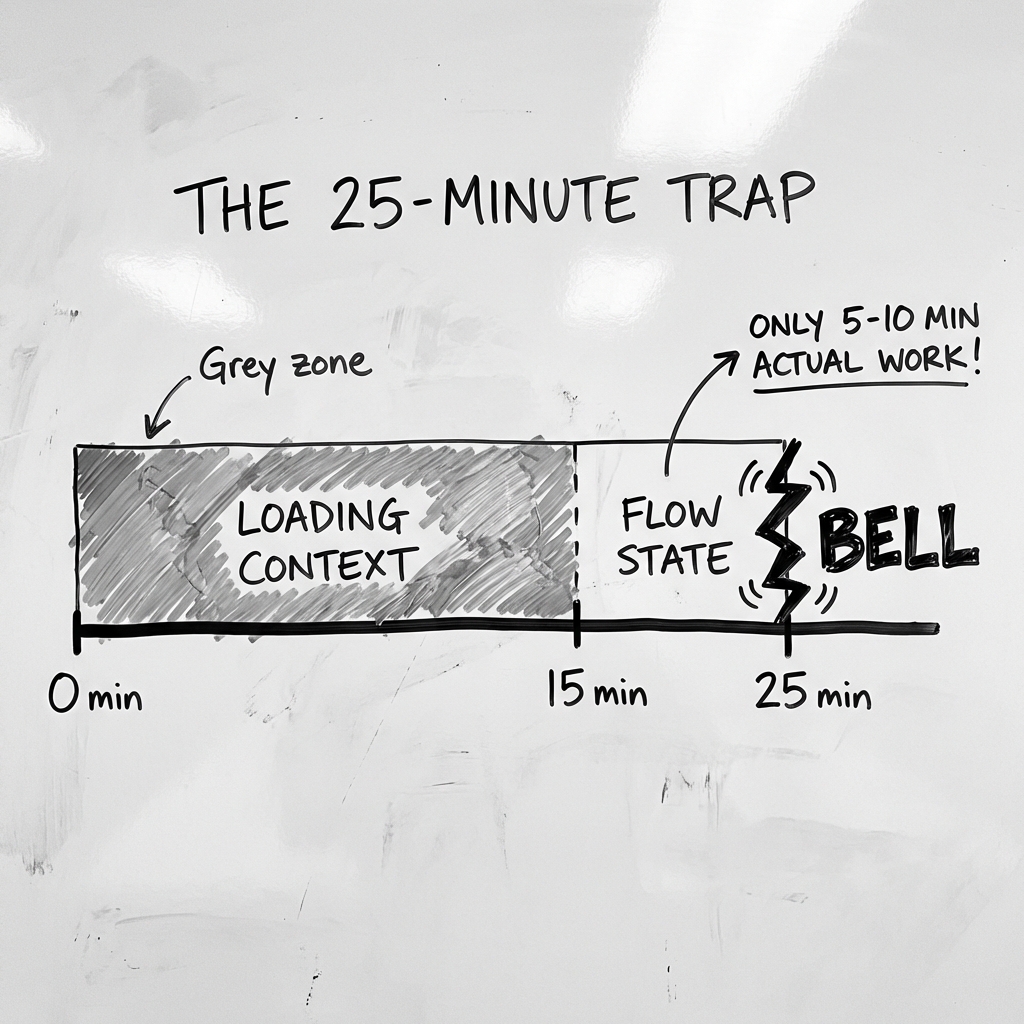
With a 25-minute work block, you're interrupting yourself right when your brain finishes loading.
What Actually Happens During Flow State
Psychologist Mihaly Csikszentmihalyi (don't worry, nobody can pronounce it) spent decades studying what he called "flow"—that state of optimal experience where you're fully immersed in an activity. His foundational book Flow: The Psychology of Optimal Experience and his TED talk on flow remain essential reading on the topic.
In flow state, several neurological changes occur:
- Transient hypofrontality. Your prefrontal cortex—the part responsible for self-criticism, worry, and time awareness—temporarily quiets down. That's why time seems to disappear when you're in flow.
- Increased neuroplasticity. Your brain becomes more receptive to new connections. This is when insights happen—when your mind links concepts that seemed unrelated.
- Elevated dopamine and norepinephrine. These neurochemicals enhance focus, motivation, and pattern recognition. You literally think better in flow.
- Enhanced alpha wave activity. Brain scans show increased alpha waves during flow, associated with relaxed alertness and creativity.
Here's the problem: flow doesn't happen instantly. Research from the Flow Research Collective suggests it takes 15-20 minutes of uninterrupted focus before you enter flow state. Some people take longer.
The 25-minute Pomodoro timer gives you, at best, 5-10 minutes of actual flow before ripping you out of it.
That's like warming up for 20 minutes, sprinting for 5, and then being told to stop. You never reach peak performance.
The Attention Residue Problem
Researcher Sophie Leroy discovered something fascinating about interrupted work: part of your brain keeps thinking about the unfinished task even after you've switched to something else. Her influential paper "Why Is It So Hard to Do My Work?" documents the phenomenon in detail.
She called it "attention residue."
When the Pomodoro timer forces you to stop, you don't cleanly transition. A portion of your cognitive processing remains stuck on the interrupted task. Your brain is trying to close the loop, find resolution, make sense of where you were.
This isn't just inefficient—it's exhausting. Attention residue fragments your mental energy across multiple unfinished threads.
The result? You feel tired without feeling accomplished. You've worked all day, but the deep work never really happened.
Who Pomodoro Was Actually Designed For
Here's the thing: the Pomodoro Technique isn't bad. It's just designed for a different kind of work.
Francesco Cirillo invented it in the late 1980s while struggling to study for university exams — a decision rooted in kitchen timer constraints, not neuroscience. The 25-minute blocks helped him overcome procrastination and stay focused on material he was actively resisting.
For that use case, it's brilliant. Short sprints to initiate focus. Frequent rewards to boost motivation. The technique fights procrastination by making the commitment small enough that you'll actually start.
Pomodoro works well for:
- Tasks you're avoiding
- Administrative work that doesn't require deep thought
- Learning new material in early stages
- High-stress work where regular breaks prevent burnout
- Work with many small, independent subtasks
Pomodoro struggles with:
- Complex problem-solving that requires sustained attention
- Creative work that builds on itself
- Programming, where you need to hold multiple variables in working memory
- Writing, where losing the narrative thread means starting over
- Any work where flow state is the goal
If your work falls into the second category, the 25-minute bell isn't helping you—it's actively sabotaging your best work.
For practical alternatives, see 5 Pomodoro Technique Alternatives for When 25 Minutes Isn't Enough.
The Alternative: Respecting Your Brain's Rhythm
So what actually works for deep work?
- Longer focus blocks. Most research suggests 52-90 minutes is optimal for complex cognitive work. This gives you time to load context, enter flow, and actually produce something meaningful before breaking.
- Flexible timers. Instead of rigid 25-minute blocks, some methods (like Flowtime) let you track your natural focus duration and take proportional breaks. Over time, you learn your actual rhythm.
- Categorized awareness. For entrepreneurs, the length of the session matters less than the type of work you're doing. A 30-minute session of Building is fundamentally different from 30 minutes of Delivering. Tracking by category reveals strategic imbalances.
- Protected blocks. The session length matters less than the protection around it. Turn off notifications. Close unnecessary tabs. Tell people you're unavailable. Interruptions from others are as destructive as interruptions from timers.
If you're a developer struggling with Pomodoro interruptions, check out Why Developers Hate Pomodoro.
The 30-Minute Sweet Spot
Why do we recommend 30-minute sessions at The Boring Clock?
It's a compromise—long enough to enter a reasonable focus state, short enough to remain flexible.
Twenty-five minutes felt too short. Fifty-two minutes felt too rigid. Thirty minutes gives you enough runway to do real work while remaining practical for a variable day.
But the length isn't really the point.
The point is awareness. Knowing that you spent 4 hours building, 1 hour promoting, and 2 hours delivering. Seeing the imbalance before it becomes a crisis.
The timer isn't there to interrupt your flow. It's there to measure where your time actually goes.
For ADHD brains that experience hyperfocus, these extended blocks can be especially powerful—learn more in Harnessing Hyperfocus: Why ADHD Brains Thrive with Extended Focus Blocks.
Your Brain Knows Best
Here's what I want you to take away:
Your brain has natural rhythms. It needs loading time. It takes time to reach peak performance. Interrupting it every 25 minutes because a technique from 1987 said so might be costing you your best work.
The goal isn't to optimize for timer compliance. The goal is to optimize for sustained, meaningful output.
If Pomodoro works for you—great. Keep using it.
But if you've ever found yourself frustrated by the bell, wondering why you feel like you're constantly starting over, never quite reaching the zone... it's not you.
It's the system.
Try longer blocks. Track your natural flow. Protect your focus time like the precious resource it is.
Your brain will thank you.
You might also like
The Founder's First Two Hours: Why Checking Email Last Multiplies Your Output
Your first two hours determine your entire day. Learn why successful founders protect their morning for high-leverage work and how to design a routine that sticks.
Why 25 Minutes Might Kill Your Flow (And How the 90-Minute Ultradian Cycle Works)
Discover the science behind 90-minute work cycles and why they may produce better results than traditional 25-minute Pomodoro sessions for deep work.
5 Pomodoro Technique Alternatives for When 25 Minutes Isn't Enough
The Pomodoro Technique isn't for everyone. Discover 5 proven alternatives that might work better for developers, writers, and anyone who needs deeper focus blocks.
Ready to take control of your focus?
Stop letting time slip away. The Boring Clock helps you track where your hours actually go, categorized by Building, Promoting, and Delivering.