5 Pomodoro Technique Alternatives for When 25 Minutes Isn't Enough
5 Pomodoro Technique Alternatives for When 25 Minutes Isn't Enough
I'm going to say something controversial: the Pomodoro Technique might be sabotaging your best work.
Before you dismiss me as a productivity heretic, hear me out. The Pomodoro method—25 minutes of focus, 5 minutes of break—was designed in the late 1980s by a university student trying to study for exams.
It's great for that use case. Short bursts. Task initiation. Fighting procrastination on work you're avoiding.
But if you're a developer debugging complex systems, a writer chasing a narrative thread, or an entrepreneur building something that requires sustained thinking... that 25-minute timer might be cutting you off right when you're getting somewhere.
Let's look at five alternatives that might work better.
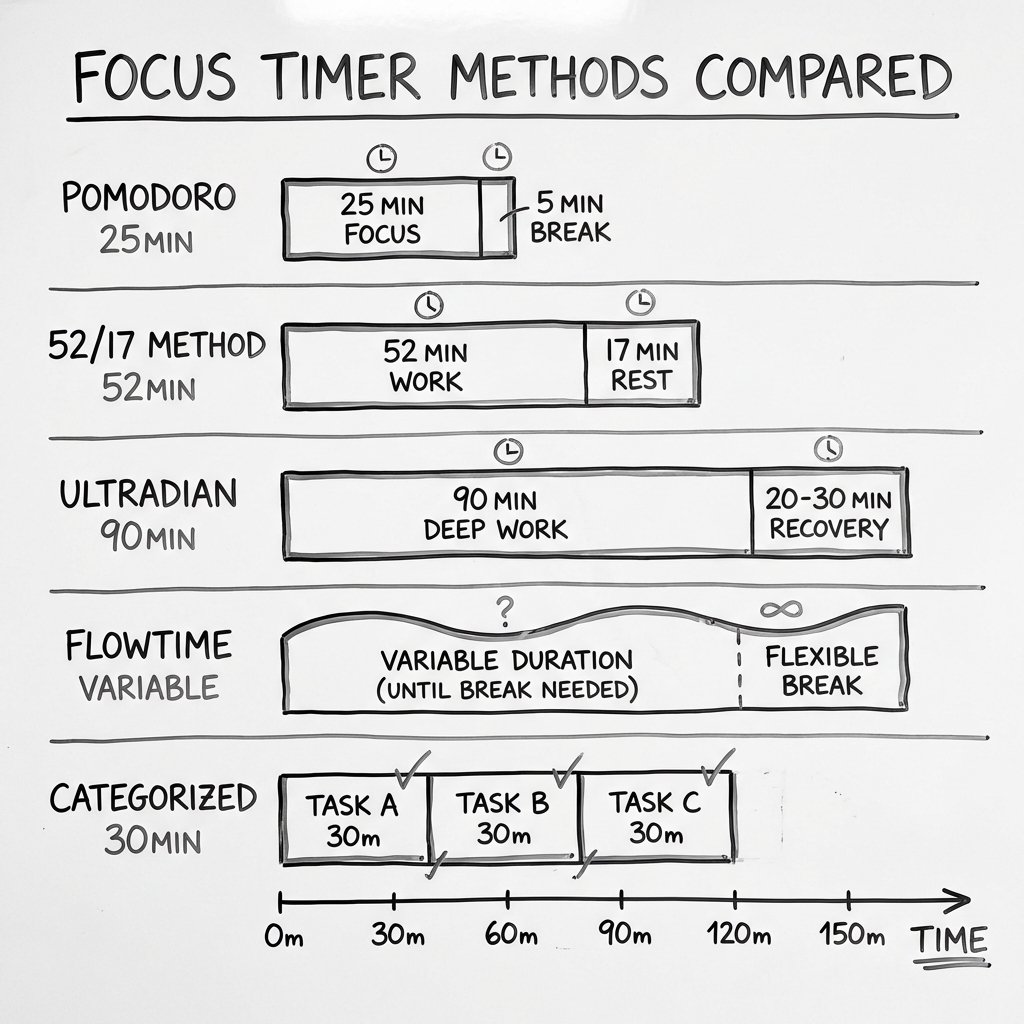
Why Pomodoro Fails for Deep Work
Before we explore alternatives, it's worth understanding why Pomodoro breaks down for certain types of work. For a deeper dive into the neuroscience, see The Neuroscience of Flow: Why the 25-Minute Bell is a Trap.
The loading problem. Complex work requires loading context into working memory. For programmers, this means understanding the codebase, the current function's dependencies, and the problem you're solving. Research suggests this takes 15-20 minutes.
With a 25-minute timer, you get 5-10 minutes of actual productive work before you're interrupted.
The flow problem. Psychologists call it "flow state"—that feeling when work becomes effortless, time disappears, and you're operating at peak capability. Flow typically kicks in around the 15-20 minute mark... exactly when Pomodoro tells you to stop.
The context switching cost. Studies consistently show it takes about 23 minutes to fully refocus after an interruption. Pomodoro's forced breaks create artificial interruptions every half hour.
The method isn't bad. It's just designed for a different kind of work than what many of us do.
Alternative 1: The 52/17 Method
In 2014, a productivity app called DeskTime analyzed their most productive users and discovered a pattern: the highest performers worked for 52 minutes, then took 17-minute breaks.
How it works:
- Work with full focus for 52 minutes
- Take a complete 17-minute break (no emails, no "quick checks")
- Repeat
Why it might work for you:
The extra 27 minutes (compared to Pomodoro) gives you time to fully enter flow state and actually accomplish something before breaking. The longer break also provides genuine recovery—enough time to walk, stretch, or do something restorative.
Best for: Knowledge workers, writers, designers—anyone whose work benefits from uninterrupted thinking time.
Alternative 2: Ultradian Rhythm Blocks (90 Minutes)
Your body operates on natural cycles called ultradian rhythms. These roughly 90-minute cycles govern your energy levels throughout the day, moving from high alertness to low alertness and back.
How it works:
- Work for 90 minutes aligned with your natural energy peak
- Rest for 20-30 minutes during the energy trough
- Repeat 3-4 times per day
Why it might work for you:
Instead of fighting your biology, you're working with it. The 90-minute block is long enough for truly deep work—enough time to complete substantial portions of complex projects rather than just nibbling at edges.
Best for: Programmers, researchers, and anyone doing cognitively demanding work that requires sustained concentration.
Alternative 3: Flowtime Technique
Flowtime takes a radically different approach: instead of imposing arbitrary time blocks, you track your natural focus periods.
How it works:
- Start working and start a timer
- Work until you naturally feel the need to break
- Record how long you worked
- Take a break proportional to your focus time (roughly 5:1 ratio)
- Over time, identify your natural focus patterns
Why it might work for you:
Flowtime respects that different tasks require different focus durations. A creative brainstorm might need 30 minutes; debugging a complex system might need 3 hours. By tracking rather than prescribing, you learn your actual rhythms.
Best for: People who've felt constrained by rigid timers, creative workers, anyone whose work varies significantly in depth.
Alternative 4: Time Blocking (Cal Newport Method)
Cal Newport, author of Deep Work, advocates for blocking entire sections of your day for specific types of work—not just timed sessions, but dedicated time slots.
How it works:
- At the start of each day (or the night before), block out your calendar
- Assign each block to a specific task or category of work
- Treat blocks as appointments you can't reschedule
- Work without timer interruptions during each block
Why it might work for you:
Time blocking shifts the focus from "how long should I work?" to "what will I work on during this time?" It's particularly powerful when combined with category awareness—knowing whether you're Building, Promoting, or Delivering during each block.
Best for: Entrepreneurs, managers, and anyone juggling multiple types of work who needs strategic allocation.
Alternative 5: Categorized Focus Sessions (The Boring Clock Method)
This is our approach, and it addresses a gap the other methods don't: awareness of where your time goes, not just how long you work.
How it works:
- Choose your focus category before starting: Building, Promoting, or Delivering
- Work for 30-minute sessions (longer than Pomodoro, more structured than Flowtime)
- Review your weekly breakdown across categories
- Adjust your allocation based on what the data reveals
Why it might work for you:
Most productivity methods treat time as homogeneous—an hour of work is an hour of work. But entrepreneurs know that's not true. An hour of marketing is fundamentally different from an hour of customer support or product development.
Categorized sessions track not just how much you're working, but what kind of work you're doing. This makes strategic imbalances visible before they become business problems.
Ready to try categorized focus sessions? Give The Boring Clock a try—it's built for exactly this purpose.
Best for: Entrepreneurs, solopreneurs, founders—anyone who needs to consciously balance multiple business domains.
How to Choose Your Method
Here's a quick decision framework:
- Choose Pomodoro if: You're struggling with procrastination, need help starting tasks, or do work in small, independent chunks.
- Choose 52/17 if: You need more focus time than Pomodoro allows but still want structured breaks.
- Choose 90-minute blocks if: Your work is deeply cognitive and you need extended periods without interruption.
- Choose Flowtime if: You feel constrained by any fixed timer and want to discover your natural rhythms.
- Choose Time Blocking if: Your challenge is prioritization and making time for strategic work, not maintaining focus during work.
- Choose Categorized Sessions if: You're an entrepreneur who needs to balance building, promoting, and delivering—and want data on how you're actually allocating time.
If you're a developer specifically frustrated with Pomodoro, you might enjoy Why Developers Hate Pomodoro (And What to Use Instead).
The Real Answer: Experiment
Here's what I've learned from years of working with productivity-minded people: there is no universally best method. There's only the method that works for you, for your current work, at this stage of your life.
The productivity influencers who insist their method is the one true way are usually selling something.
What actually works is experimentation. Try a method for a week. Track how it feels and what you accomplish. Adjust. Try another. Tools like Forest can gamify your focus sessions, while Focusmate adds virtual accountability by pairing you with another person for co-working sessions.
The goal isn't to find the perfect system. The goal is to find a system that helps you do your best work, consistently, without burning out.
And if that means abandoning the sacred 25-minute timer that everyone else swears by? So be it.
Your work is too important to squeeze into someone else's arbitrary time box.
You might also like
The Founder's First Two Hours: Why Checking Email Last Multiplies Your Output
Your first two hours determine your entire day. Learn why successful founders protect their morning for high-leverage work and how to design a routine that sticks.
Best Pomodoro Timer for Entrepreneurs: Why Category Tracking Changes Everything
Comparing focus timers for entrepreneurs. Learn why category-based time tracking (Build, Promote, Deliver) gives you insights that basic Pomodoro apps miss.
How to Structure Your Ideal Focus Block: A Step-by-Step Template
Master the art of deep work with this practical focus block template. Learn exactly how to prepare, execute, and close each session for maximum productivity.
Ready to take control of your focus?
Stop letting time slip away. The Boring Clock helps you track where your hours actually go, categorized by Building, Promoting, and Delivering.