The Planning Fallacy: Why You Always Underestimate How Long Tasks Take
The Planning Fallacy: Why You Always Underestimate How Long Tasks Take
You've done it again.
You estimated the project would take a week. It took three. You blocked two hours for a task. It swallowed the entire afternoon. You promised delivery by Friday, and now you're working through the weekend.
This isn't a character flaw. It's a cognitive bias so universal that psychologists gave it a name: the planning fallacy.
And once you understand it, you'll stop beating yourself up for being "bad at time estimation"—and start using strategies that actually work.
What Is the Planning Fallacy?
The planning fallacy is the tendency to underestimate the time, costs, and risks of future actions while overestimating their benefits.
It was first identified by Daniel Kahneman and Amos Tversky in 1979, though humans have been falling for it since the first deadline was invented.
Here's what makes it particularly insidious: the fallacy persists even when you have extensive experience with similar tasks. Even when you've been burned before. Even when you know you tend to underestimate.
You remember the last project took twice as long as planned. You think, "This time will be different." It isn't.
The bias is so strong that awareness alone doesn't fix it. You need systematic countermeasures.
Why Your Brain Does This
The planning fallacy isn't random. It stems from how our brains naturally process future events.
The Inside View
When you estimate a task, you automatically take the "inside view." You imagine the specific steps involved, picture yourself doing them efficiently, and sum up the ideal-case durations.
- Step 1: 30 minutes
- Step 2: 45 minutes
- Step 3: 1 hour
- Total: 2 hours 15 minutes
This feels logical. You've thought through each component. You've been thorough.
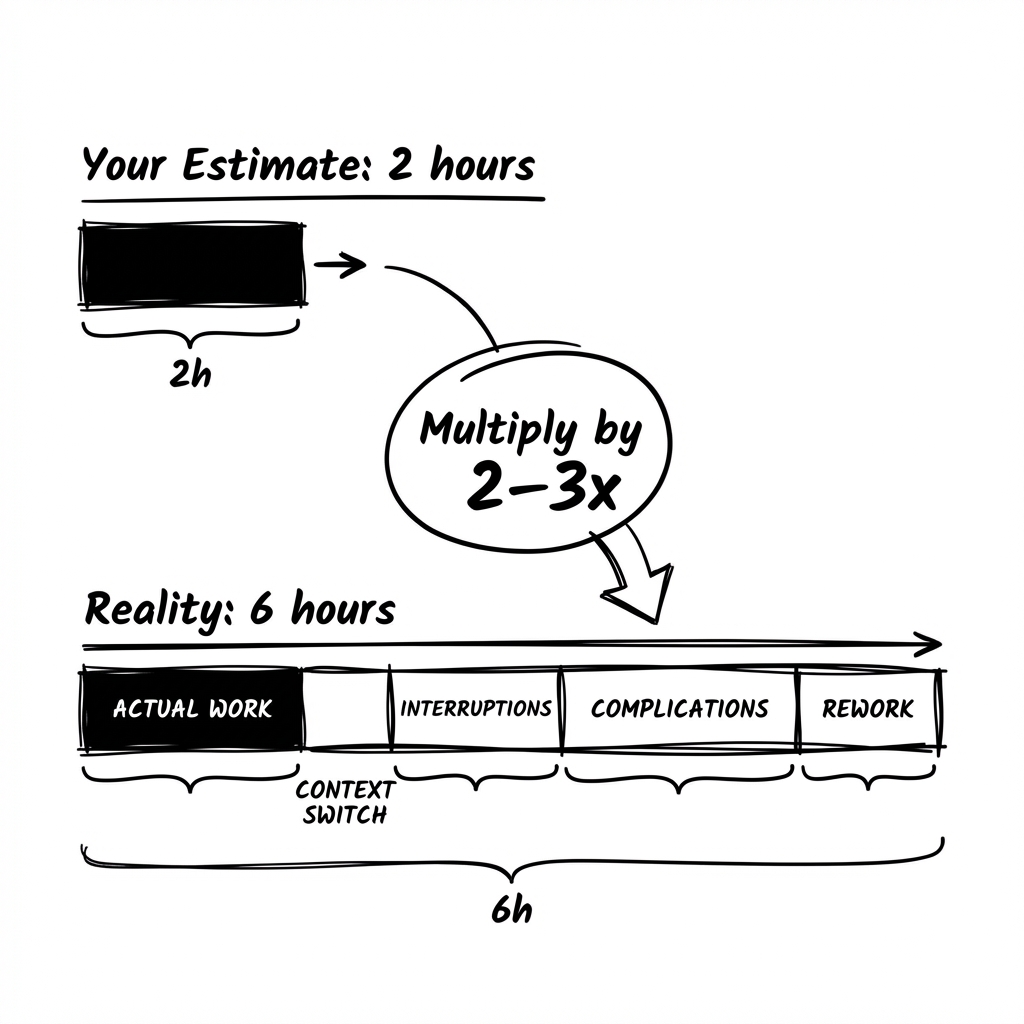
But you've missed everything that's not a component:
- The time to context-switch into the task
- The unexpected complications that always arise
- The meetings that interrupt your work
- The dependencies that aren't ready when you need them
- The decisions that require clarification
- The errors that need debugging
- The energy depletion that slows you down
The inside view only sees the happy path. It doesn't account for reality.
The Outside View
The outside view ignores the specifics and asks: "How long do tasks like this usually take?"
Not this task specifically. This type of task, based on historical data.
If similar projects have historically taken 3 weeks, the outside view predicts 3 weeks—regardless of how different this one feels.
This approach is less satisfying (where's the detailed planning?), but it's dramatically more accurate. Because historical data includes all the complications, interruptions, and surprises that the inside view conveniently ignores.
Kahneman's insight (explored in depth in his bestseller Thinking, Fast and Slow): experts consistently do worse at estimation when forced to use inside-view thinking. The more detailed their plans, the more optimistic—and wrong—their estimates become.
The Reality Buffer
Given the planning fallacy, what's the corrective action?
Simple: multiply your estimate by 2-3x.
This sounds absurd until you test it. Take your next project estimate. Apply the 2.5x multiplier. Watch what actually happens.
For most knowledge work:
- Your 1-hour estimate becomes 2.5 hours → closer to reality
- Your 1-day estimate becomes 2.5 days → closer to reality
- Your 1-week estimate becomes 2.5 weeks → closer to reality
The multiplier isn't pessimism. It's calibration.
You're not padding for laziness. You're adjusting for the systematic optimism bias baked into human cognition.
Multiplier Guidelines
Different work types have different bias levels:
| Task Type | Suggested Multiplier |
|---|---|
| Routine, familiar tasks | 1.5x |
| Standard knowledge work | 2x |
| Creative/complex projects | 2.5-3x |
| Tasks with external dependencies | 3x |
| Anything involving coordination | 3x+ |
The more novel the task and the more people involved, the higher your bias tends to be.
The Reference Class Approach
The 2-3x multiplier is a blunt instrument. For better calibration, use reference classes.
Reference class forecasting asks: "What happened when people did this type of thing before?"
Step 1: Identify the reference class
What category does this task belong to? "Writing a blog post" is different from "Writing technical documentation." "Building a landing page" is different from "Building a checkout system."
Step 2: Gather historical data
How long have similar tasks taken in the past? Not your estimates—actual durations.
If you're tracking your focus time (you should be), you can pull this data directly. How long did your last 5 blog posts actually take? That's your reference class.
Step 3: Use the class average, not your optimistic guess
If similar tasks averaged 4 hours, estimate 4 hours—even if you feel like this one should be faster.
Step 4: Adjust only for documented differences
If there's a specific, concrete reason this task is different (you already have the research done, or this codebase is unfamiliar), adjust by a defined amount. Don't adjust for "gut feeling" that this will go smoothly.
Building Your Estimation Database
The reference class approach requires historical data. That means tracking actual task durations—not just estimates.
For each significant task:
- Record your estimate before starting
- Track actual time spent
- Note the variance
- Categorize by task type
Over time, you build a personal estimation database. You stop guessing and start calculating.
Example tracking:
| Task | Estimate | Actual | Variance |
|---|---|---|---|
| Blog post | 3 hours | 5 hours | +67% |
| Feature spec | 2 hours | 6 hours | +200% |
| Code review | 30 min | 45 min | +50% |
| Client call | 1 hour | 1.5 hours | +50% |
After 20-30 data points, patterns emerge. You learn that you consistently underestimate blog posts by 60%. You learn that specs always take 3x longer than expected. You learn that calls run over by 50%.
Now you can apply personal correction factors instead of generic multipliers.
Why Tracking Fixes the Fallacy
Here's why time tracking is the ultimate planning fallacy cure:
1. It creates accountability
When you're tracking time, you can't pretend the 2-hour task only took 2 hours. The data is objective. The numbers don't lie.
2. It surfaces invisible work
Most estimates miss the work between the work: context switching, communication, problem-solving tangents, research rabbit holes. Tracking captures all of it.
3. It calibrates your intuition
Over months of tracking, your estimates naturally improve. Your brain updates its internal model based on actual feedback instead of wishful thinking.
4. It enables reference classes
You can't use reference class forecasting without historical data. Tracking creates the database that makes accurate estimation possible.
This is why category-based tracking is so powerful. When you log your focus sessions as Building, Promoting, or Delivering, you're building reference classes automatically.
Want to start building your estimation database? The Boring Clock tracks your focus time by category, making it easy to see how long different types of work actually take.
The Pre-Mortem Technique
Before starting a project, conduct a pre-mortem.
Regular post-mortem: "The project failed. What went wrong?"
Pre-mortem: "Imagine the project has failed. What went wrong?"
This subtle shift unlocks realistic thinking. Instead of defending your optimistic plan, you're suddenly identifying risks and complications.
Run a pre-mortem:
- Assume the project took 3x longer than planned
- Ask: "Why did that happen?"
- List every reason you can think of
- For each reason, ask: "How likely is this?" and "How would I prevent it?"
The reasons you generate in a pre-mortem are exactly the factors your inside-view estimate ignored. Dependencies, scope creep, unclear requirements, resource conflicts, technical debt, communication delays.
Now you can either add buffer time for these factors or address them before starting.
Hofstadter's Law
There's a recursive joke in computer science:
Hofstadter's Law: It always takes longer than you expect, even when you take into account Hofstadter's Law.
Originally coined by Douglas Hofstadter in Gödel, Escher, Bach: An Eternal Golden Braid, this captures the frustrating persistence of the planning fallacy. Even when you know about the bias and try to correct for it, you tend to under-correct.
Applied 2x multiplier? Should have been 3x. Added a week of buffer? Needed two. Accounted for complications? Didn't account for the complications with the complications.
The lesson: err on the side of pessimism. Your corrected estimate probably isn't corrected enough.
It's better to deliver early than to deliver late. Better to have slack than to be scrambling. Better to under-promise and over-deliver than the reverse.
The Strategic Implications
The planning fallacy doesn't just affect task completion. It shapes business strategy.
Hiring decisions: "We'll have the product ready in 6 months, so we'll hire sales then." Reality: 12 months.
Funding timelines: "This runway gives us 18 months." Reality: 12 months because development took longer.
Launch dates: "We'll launch by Q3." Reality: Q4. Or next year.
Optimistic estimates compound. As the Standish Group's CHAOS Reports have documented for decades in software projects, a project with 5 dependencies, each underestimated by 50%, ends up taking 4x longer than planned.
For entrepreneurs, the planning fallacy is an existential threat. You run out of runway. You miss market windows. You burn out teams. All because the estimates were wrong.
Want to understand how this connects to strategic time allocation? Read Are You an Imbalanced Entrepreneur?.
Starting Your Calibration Journey
Here's a practical starting point:
This week:
- Pick your three biggest upcoming tasks
- Write down your honest estimate for each
- Track actual time spent (use a timer)
- At week's end, calculate your variance
Don't change your behavior yet. Just observe.
You'll probably find that you underestimated by 50-100%. Maybe more. That's normal. That's the planning fallacy doing its thing.
Next week:
- Apply a 2x multiplier to your estimates
- Track actual time again
- See if you're closer
The following weeks:
- Adjust your multiplier based on data
- Start building reference classes by task type
- Notice how your stress levels change when estimates are realistic
The Freedom of Realistic Estimates
Here's the counterintuitive payoff: realistic estimates are liberating.
When you estimate accurately:
- You stop overpromising
- You stop working nights and weekends to meet impossible deadlines
- You stop feeling like a failure for "always being late"
- You build trust with clients and colleagues
- You plan your weeks sanely
The planning fallacy makes you seem productive (look at all these ambitious estimates!) while making you feel like a failure (why can't I ever finish on time?).
Accurate estimation reverses this. You seem measured but you deliver reliably. That's a better trade.
The Data Doesn't Lie
You can debate with yourself about whether a task "should" take 2 hours or 6 hours. Your ego wants the optimistic answer.
But when you have weeks of tracking data showing that this type of task takes 5 hours on average, the debate ends.
The data doesn't lie. Your optimism does.
Track your time. Build your reference classes. Trust the numbers more than your feelings.
That's how you beat the planning fallacy—not through willpower, but through data.
You might also like
The Weekly Review System: How to Analyze Your Productivity Data
Learn how to conduct an effective weekly review that uses your productivity data to identify patterns, adjust priorities, and set targets for continuous improvement.
Stop Spending Time, Start Investing It: The ROI Framework for Productivity
Not all hours are equal. Some compound, others evaporate. Learn to evaluate your activities by their long-term returns and stop wasting focus on low-ROI tasks.
Stop Doing Low-Value Work: The Delete-Automate-Delegate Framework for Deep Work
Before you can do deep work, you need to eliminate shallow work. Learn Alex Hormozi's hierarchy: Delete first, then Automate, then Delegate what remains.
Ready to take control of your focus?
Stop letting time slip away. The Boring Clock helps you track where your hours actually go, categorized by Building, Promoting, and Delivering.