The Hidden Cost of Context Switching: How Much Focus Are You Losing?
The Hidden Cost of Context Switching: How Much Focus Are You Losing?
Every time you switch tasks, you pay a tax. Not in dollars—in cognitive capacity, creative energy, and time you'll never get back.
Most people dramatically underestimate this tax. They think switching from email to coding to a meeting costs them the sum of transition time. Five minutes here, two minutes there.
They're wrong by an order of magnitude.
Research from Gloria Mark at the University of California, Irvine found that it takes an average of 23 minutes and 15 seconds to fully refocus after an interruption. Mark details this and other findings in her book Attention Span: A Groundbreaking Way to Restore Balance, Happiness and Productivity. Not to resume work—to return to the same depth of focus you had before.
Let that sink in. Every. Single. Switch. Twenty-three minutes.
Now count how many times you switched tasks yesterday.
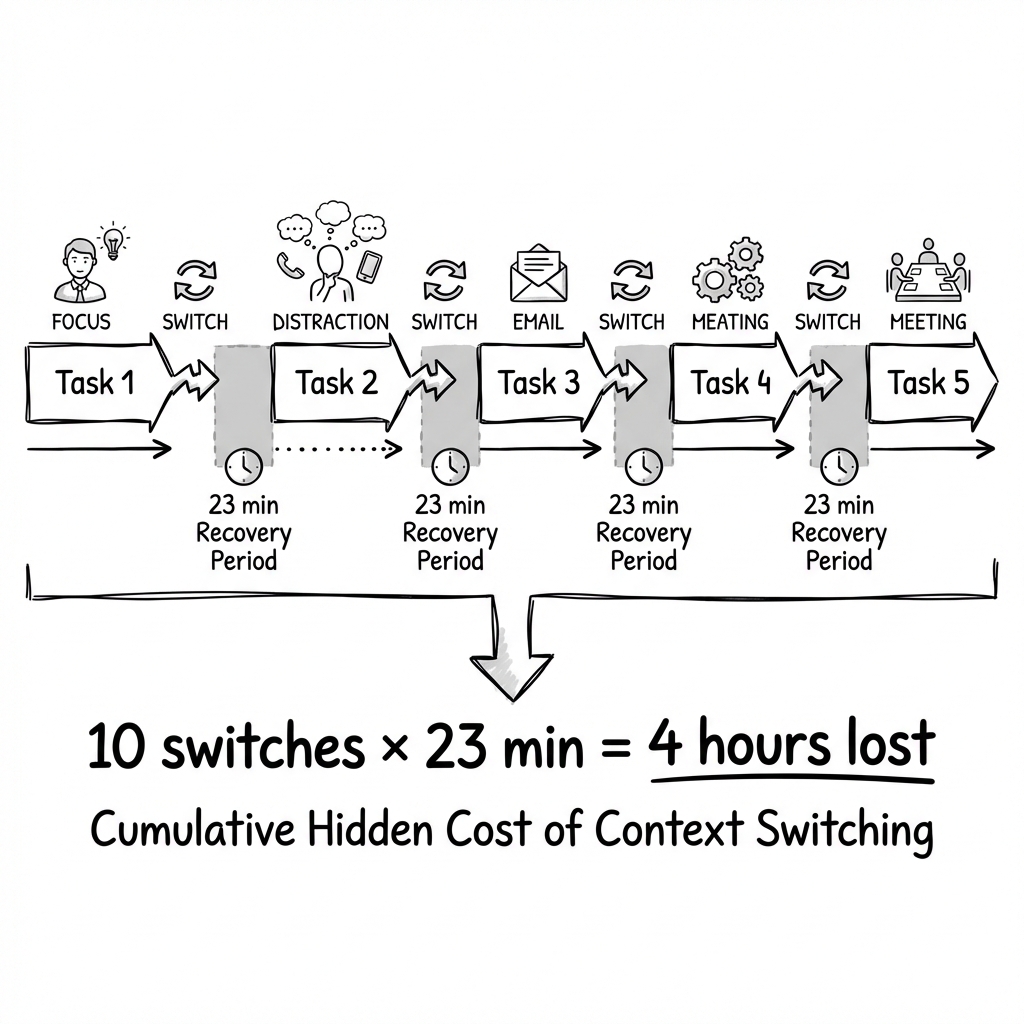
What Happens in Your Brain During a Context Switch
When you're deeply focused on a task, your brain constructs an intricate mental model. For a developer, that's the architecture of the codebase, the relationships between functions, the state of variables, the logic you're building.
This model lives in working memory—a limited, fragile resource.
When an interruption happens:
- Your brain pauses the current model
- Attention shifts to the new task
- A new mental model starts loading
- The old model begins decaying in the background
- "Attention residue" keeps part of your mind on the old task
That last point is the killer.
Attention Residue: The Ghost of Your Previous Task
Psychologist Sophie Leroy coined the term "attention residue" in her influential paper "Why Is It So Hard to Do My Work?" to describe what happens when you switch tasks before completing the previous one.
Even after you've moved to a new activity, part of your brain is still processing the unfinished task. This concept, rooted in the Zeigarnik effect, explains why incomplete tasks linger in our minds. It's running in the background, consuming cognitive resources, reducing the quality of attention you can give to your current work.
Her research showed that:
- People who switch tasks frequently perform worse on both tasks
- The more attention residue, the lower the performance
- Completion signals reduce residue (finishing a task clears the backlog)
This explains why you feel mentally exhausted after a fragmented day even when you haven't done much "real" work. Your brain was constantly juggling incomplete tasks, never fully present anywhere.
The Context Switching Calculator
Let's quantify the damage.
Assumptions based on research:
- Average refocus time: 23 minutes
- Partial focus period after switch: ~10 minutes at reduced capacity
- Effective focus loss per switch: ~15 minutes (conservative estimate)
Now calculate:
| Switches Per Day | Focus Time Lost | Hours Lost Per Week |
|---|---|---|
| 5 | 1.25 hours | 6.25 hours |
| 10 | 2.5 hours | 12.5 hours |
| 15 | 3.75 hours | 18.75 hours |
| 20 | 5 hours | 25 hours |
Let that table hit you.
If you switch tasks 10 times per day—which is conservative for most knowledge workers—you're losing 12.5 hours of focused work every week. That's more than a full day gone to transition costs alone.
And the 10-switch estimate is probably low. Count your switches honestly:
- Checking email
- Responding to Slack
- Attending a meeting
- Returning from a meeting
- Quick question from a colleague
- Phone notification
- Social media check
- Switching between projects
Most people switch tasks 30-50 times per day. The math becomes horrifying.
The Categories of Context Switches
Not all switches are equally expensive. Here's a rough hierarchy:
Low-Cost Switches
- Moving between similar tasks (email to email, code file to code file)
- Returning to a task you just paused briefly
- Switching between well-practiced, automatic activities
Medium-Cost Switches
- Moving between different projects in the same domain
- Switching from shallow work to moderately complex work
- Transitioning after a short meeting
High-Cost Switches
- Moving from deep creative work to administrative tasks
- Returning to complex work after an emotional conversation
- Switching between completely unrelated projects
- Re-engaging after a long meeting or multiple small interruptions
The most expensive switches are those that interrupt flow states. When you're deep in problem-solving or creative work and get pulled out, the reconstruction cost is maximum.
For more on why flow interruption is so devastating, read The Neuroscience of Flow: Why the 25-Minute Bell is a Trap.
Why Pomodoro Creates Artificial Switches
Here's the uncomfortable truth about the Pomodoro Technique: it forces context switches.
Every 25 minutes, the bell rings. You're instructed to stop—even if you're in flow—and take a break. After the break, you restart.
That's not a break. That's a context switch.
You might argue that returning to the same task isn't a switch. But research on attention residue suggests otherwise. The break itself creates cognitive distance. You need to reload the mental model. You pay the switch tax.
If you're doing shallow work—answering emails, organizing files—this tax is minimal. Pomodoro works fine.
But if you're doing deep work—coding, writing, designing—the forced 25-minute interrupt is creating 8-12 artificial context switches per day. According to our calculator, that's 2-3 hours of lost focus time.
The very tool meant to help you focus is fragmenting your attention.
The Strategic Response
Knowing the cost, how do you reduce context switching?
1. Batch Similar Tasks
Don't check email throughout the day. Check it at 9 AM, 12 PM, and 4 PM. That's 3 switches instead of 30.
Don't respond to Slack immediately. Process messages in 2-hour batches.
Batching converts 10 small context switches into 1 larger transition. The math works in your favor because you pay the 23-minute tax once instead of ten times.
2. Create Transition Rituals
When you must switch tasks, create a deliberate closure ritual for the current task.
- Write a brief note about where you are
- List the next small step you'd take
- Mentally "close the file"
This reduces attention residue by giving your brain completion signals. You're telling it: "This task is paused properly. You can release it."
3. Extend Your Focus Blocks
Longer focus sessions mean fewer switches per day.
If you work in 90-minute blocks instead of 25-minute Pomodoros, you're reducing potential daily switches from 16 to 5. That's 2+ hours of recovered focus time.
Track your focus time by category—Building, Promoting, Delivering—to ensure you're batching similar work together. When you stay in one category for an extended period, switches within that category cost less.
Want to see how your focus time distributes across categories? Try The Boring Clock—it's built for exactly this kind of tracking.
4. Protect Your Peak Hours
Your best cognitive hours are finite. Most people have 4-5 hours of peak mental performance per day.
Don't waste these hours on meetings, email, or administrative tasks. Reserve them for deep work that requires pristine focus.
Schedule meetings and shallow work for your natural low-energy periods. Let your switches happen when the cost is lower.
5. Make Switching Harder
Friction reduces behavior frequency.
- Close email tabs during focus blocks
- Put your phone in another room
- Use website blockers during deep work
- Log out of Slack
Each barrier you add makes switching less likely. You're not relying on willpower—you're designing an environment that protects your focus.
The Weekly Switch Audit
Once per week, review your calendar and ask:
How many context switches did I create this week?
Count:
- Meetings (especially scattered ones)
- Task-switching within the day
- Reactive interruptions (chat, email, others)
- Self-inflicted distractions (social media, news)
Which switches were necessary? Which were optional?
Many switches feel necessary but aren't. Three fifteen-minute check-ins could have been one 30-minute meeting. Ten Slack responses could have been one batch session.
What patterns do I see?
Maybe Tuesdays are your worst day because of scattered meetings. Maybe afternoons are fragmented because you haven't blocked deep work time. Maybe mornings get interrupted because you start with email.
For a complete framework on reviewing your productivity patterns, see The Weekly Review System.
The Single-Tasking Mindset
Multitasking isn't working on multiple things at once. It's switching between things so fast that it feels simultaneous.
Our brains can't actually parallel-process complex work. As the American Psychological Association has noted, when you think you're "multitasking," you're just switching rapidly and paying the tax each time.
The single-tasking mindset says:
- One task at a time
- Finish or deliberately pause before switching
- Minimize open loops
- Protect focus blocks ruthlessly
This isn't about being inflexible. It's about being intentional. You choose when to switch based on strategy, not based on what interruption happens to arrive.
The Compound Effect
Here's the final reframe.
Context switching doesn't just cost you time today. It costs you compound growth over years.
Every hour lost to switching is an hour you didn't spend getting better at your craft. Every day of fragmented attention is a day without deep practice. Every week of rapid switching is a week where your skills stagnated.
The knowledge worker who protects their focus for 4 hours daily and the one who fragments those same 4 hours across the day will have vastly different careers after 10 years. Not because one worked more, but because one actually entered the depths where mastery happens.
Deep work compounds. Context switching is the anti-compound interest of productivity.
Your Real Productivity Number
You think you work 8 hours. But if you switch tasks 10 times, you're really getting 5.5 hours of work after transition costs.
And those aren't 5.5 hours of deep focus—they're 5.5 hours of fragmented, residue-contaminated attention.
Your real productivity number might be 2-3 hours of genuine focused work per day. Everything else is overhead.
The good news: you can change this.
Reduce your daily context switches from 10 to 5, and you recover over an hour of focus time. Extend your focus blocks from 25 to 60 minutes, and you reduce switch frequency dramatically.
These aren't heroic changes. They're design decisions.
Choose how you work. Protect your transitions. Count the hidden cost.
Your 23 minutes are waiting to be reclaimed.
You might also like
The Weekly Review System: How to Analyze Your Productivity Data
Learn how to conduct an effective weekly review that uses your productivity data to identify patterns, adjust priorities, and set targets for continuous improvement.
Stop Spending Time, Start Investing It: The ROI Framework for Productivity
Not all hours are equal. Some compound, others evaporate. Learn to evaluate your activities by their long-term returns and stop wasting focus on low-ROI tasks.
The Planning Fallacy: Why You Always Underestimate How Long Tasks Take
Learn why humans are hardwired to underestimate task duration, and discover practical techniques to create realistic time estimates using actual tracking data.
Ready to take control of your focus?
Stop letting time slip away. The Boring Clock helps you track where your hours actually go, categorized by Building, Promoting, and Delivering.