Francesco Cirillo and the Kitchen Timer: The True Origin of Pomodoro
Francesco Cirillo and the Kitchen Timer: The True Origin of Pomodoro
Every productivity technique has an origin story. Most are forgotten. But the Pomodoro Technique's origin is too good to ignore—it literally started with a tomato.
In the late 1980s, a struggling Italian university student picked up a kitchen timer shaped like a tomato. That mundane act launched one of the most widely used productivity methods in the world.
This is the real story of how the Pomodoro Technique was born, why it worked, and what we can learn from its origins for our own productivity today.
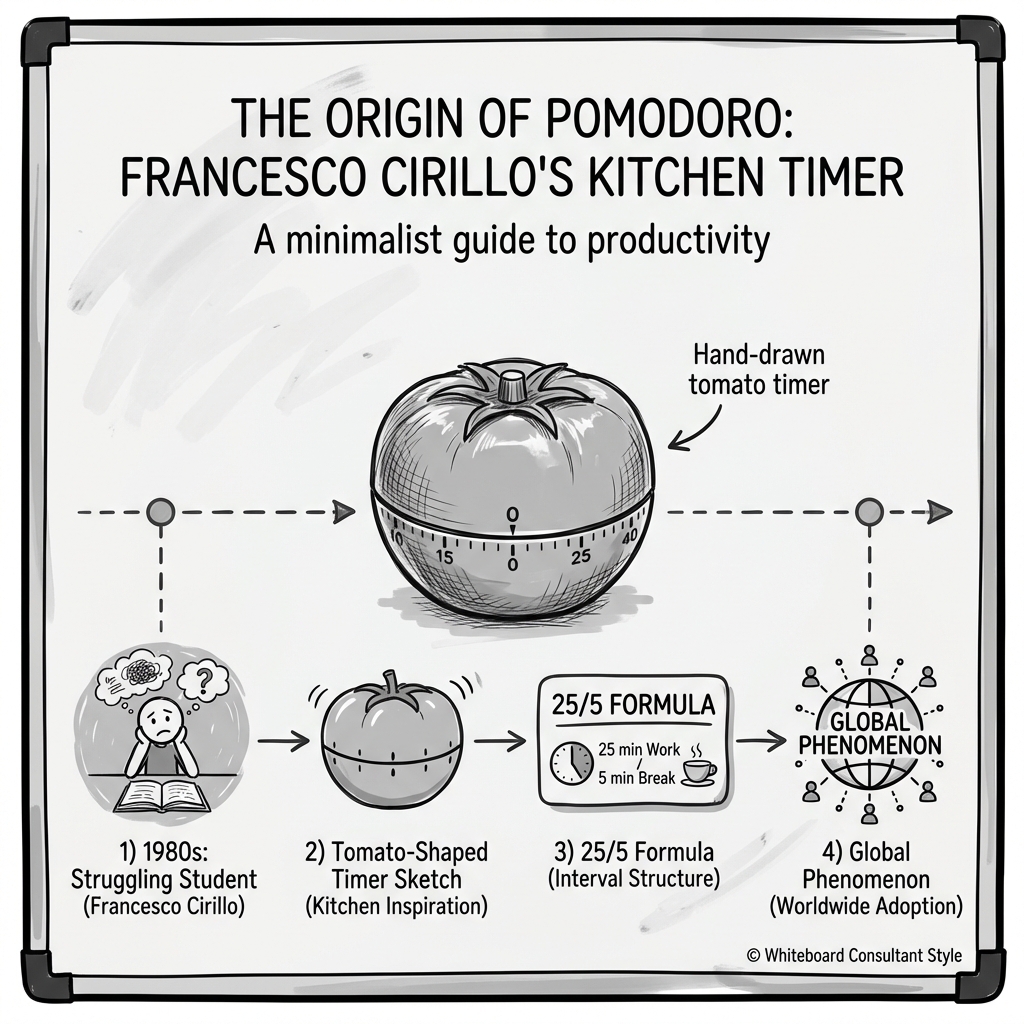
The Struggling Student
Francesco Cirillo was a first-year student at Luiss Business School in Rome in the late 1980s who couldn't focus. His inability to concentrate through study sessions — and the desperation it created — led him to experiment with a tomato-shaped kitchen timer, which became the foundation of the Pomodoro Technique.
Francesco Cirillo was not a productivity guru. He was a first-year university student at Luiss Business School in Rome, and he was failing.
Like many students, Cirillo found himself unable to focus. Hours would pass with little accomplishment. He'd sit down to study, become distracted, check the clock, realize time had vanished, and end the day frustrated.
Sound familiar?
What set Cirillo apart wasn't genius—it was desperation. He decided to conduct an experiment on himself.
The Bet That Started Everything
The very first Pomodoro session was a 10-minute bet Cirillo made with himself: could he sustain genuine, undistracted focus for just 600 seconds? He grabbed a tomato-shaped kitchen timer from his mother's kitchen, set it for 10 minutes, and started studying. That single experiment launched the entire method.
Cirillo made a simple bet: Could he focus—truly focus—for just 10 minutes?
Not an hour. Not until the next break. Just 10 minutes of genuine, undistracted attention.
He looked around his kitchen and grabbed the first timer he saw: a red tomato-shaped kitchen timer his mother used for cooking. ("Pomodoro" is Italian for tomato.)
He set it for 10 minutes. Started studying. And waited for the bell.
That was the first Pomodoro session. Not a sophisticated technique—just a desperate student trying to prove to himself he could focus for 600 seconds.
The Evolution of the Method
Cirillo's method evolved from 10-minute sessions to the now-standard 25/5 structure through iterative experimentation. The 25-minute duration was shaped partly by kitchen timer limitations (most maxed at 30 minutes) and partly by Cirillo's finding that 25 minutes was long enough for meaningful work but short enough to maintain focus.
That initial 10-minute experiment proved Cirillo could focus if he:
- Had a clear start time
- Had a clear end time
- Had an external signal (the timer) marking both
From there, Cirillo experimented:
From 10 Minutes to 25
Cirillo gradually extended his sessions. He found that 25 minutes was long enough to accomplish meaningful work but short enough to maintain focus without burnout.
Why 25 specifically? Partly experimentation, partly the timer itself. Most kitchen timers of the era had 30-minute maximums. 25 minutes of work plus a 5-minute break fit the constraint.
The 25/5 structure that now defines Pomodoro wasn't scientifically derived—it emerged from practical testing and kitchen timer limitations.
The Five-Minute Break
Cirillo discovered that forcing himself to take breaks—even when he felt like continuing—sustained his focus across longer study sessions.
The 5-minute break wasn't arbitrary either. It was short enough to prevent total disengagement but long enough to provide mental reset.
The Longer Breaks
After every four Pomodoros (about 2 hours of work plus breaks), Cirillo found he needed a longer 15-30 minute break to maintain performance throughout the day.
This pattern—four cycles, then extended rest—reflected natural cognitive fatigue rhythms.
The Method Gets Named
Cirillo codified his method into five steps — choose a task, set a 25-minute timer, work until it rings, take a 5-minute break, and take a longer 15-30 minute break after every four cycles. He named it "Pomodoro" (Italian for tomato) after the kitchen timer that started it all.
The technique accumulated rules through experimentation:
- Choose a task
- Set the timer for 25 minutes
- Work on the task until the timer rings
- Take a 5-minute break
- After 4 Pomodoros, take a 15-30 minute break
Cirillo called it the "Pomodoro Technique" after the tomato timer that started it all. The name stuck because it was memorable and slightly silly—easier to remember than "structured time-boxing intervals."
From Personal Hack to Publishing
After graduating, Cirillo brought the technique into software development and began teaching it to colleagues in the early 1990s. He formally documented it by 1998, published a book, and the internet accelerated adoption — turning a personal study hack into a global phenomenon with thousands of apps and millions of practitioners.
Cirillo graduated university (successfully, after his productivity turnaround) and began working in software development. He continued using and refining his technique.
In the early 1990s, he began teaching the method to colleagues. Word spread within Italian tech circles.
By 1998, Cirillo had documented the technique formally. He eventually wrote a book—The Pomodoro Technique—and began teaching widely.
The internet accelerated adoption. Productivity blogs discovered the method. Simple timer apps made it accessible to anyone. By the 2010s, Pomodoro had gone from personal hack to global phenomenon.
Today, there are thousands of Pomodoro apps, millions of practitioners, and an entire industry built on a tomato-shaped kitchen timer.
Why Pomodoro Works (When It Works)
Pomodoro is effective for five reasons: it provides external accountability through the timer, defines clear start and end points for each session, forces regular breaks that prevent focus degradation, supports task initiation through a simple ritual, and creates countable progress that gamifies productivity.
Understanding the origin helps explain why the technique is effective:
1. External Accountability
The timer provides external structure that internal willpower often can't match. You're not fighting yourself—you're racing a clock.
Cirillo didn't trust himself to focus. He outsourced that judgement to a mechanical timer. The technique externalizes discipline.
2. Defined Start and End
Knowing exactly when a work session starts and ends reduces ambiguity. There's no "I'll work until I feel like stopping"—there's a specific endpoint.
For procrastinators, this is powerful: "I only have to focus for 25 minutes" is far less daunting than "I have to study all afternoon."
3. Forced Breaks
Most people skip breaks until exhaustion forces them. Pomodoro's mandatory breaks prevent the slow degradation of focus that comes from marathon work sessions.
4. Task Initiation Support
Getting started is often the hardest part. The Pomodoro structure—pick a task, set the timer, begin—provides a ritual that initiates action.
5. Countable Progress
Completing Pomodoros feels like progress. "I did 6 Pomodoros today" is more satisfying than "I worked for a while." The technique gamifies productivity.
Why Pomodoro Fails (When It Fails)
Pomodoro fails in three key situations: it was designed for studying (tasks with natural segmentation), not creative or programming work where flow states need longer unbroken blocks; the 25-minute duration came from kitchen timer constraints, not cognitive science; and one fixed interval cannot accommodate all cognitive patterns and task types.
The technique's origins also explain its limitations:
It Was Designed for Studying
Cirillo was a student. He was reading, memorizing, and doing homework—tasks with natural segmentation.
Creative work, programming, and deep analysis often don't fit 25-minute boxes. Once you're "in the zone," a timer bell can shatter concentration rather than structure it.
25 Minutes Isn't Based on Science
The duration came from kitchen timer constraints and personal experimentation, not cognitive science. Research on flow states—a concept pioneered by psychologist Mihaly Csikszentmihalyi—suggests 45-90 minutes may be optimal for complex work.
For more on alternative timing, see The 90-Minute Flow Protocol.
One Size Doesn't Fit All
Cirillo's brain isn't your brain. What worked for a struggling Italian student in the 1980s may not match your cognitive patterns.
This isn't a flaw—it's an invitation to adapt. The principle (structured intervals with breaks) matters more than the specific numbers.
What We Can Learn From the Origin
The Pomodoro origin story teaches five principles: start with your specific problem rather than generic advice, use whatever tools are available, iterate based on results, favor simplicity over complexity, and give your method a memorable name. Cirillo's constraints shaped the solution — and yours can too.
Cirillo's story offers insights beyond the technique itself:
1. Start with Your Problem
Cirillo didn't read about productivity first. He confronted his specific problem (inability to focus) and experimented directly.
What's your specific problem? Start there, not with generic advice.
2. Use What's Available
Cirillo didn't buy specialized equipment. He grabbed a kitchen timer. The constraint (timer's maximum settings) actually shaped the method.
You don't need the perfect app. Start with what you have.
3. Iterate Based on Results
The technique evolved through testing. 10 minutes became 25. Break duration adjusted. Rules added based on experience.
Whatever you try, observe results and refine. Your system should evolve.
4. Simple Beats Complex
Pomodoro's power is its simplicity: Set timer. Work. Break. Repeat.
Complex productivity systems often fail because they're hard to maintain. Simple systems survive.
5. Names Matter
"The Pomodoro Technique" is more memorable than "25-minute focused intervals with 5-minute breaks." A good name spreads.
Adapting Pomodoro for Modern Work
Modern Pomodoro practitioners should use flexible intervals (25/5 for shallow work, 50/10 for moderate tasks, 90/20 for deep creative work), track time by business category rather than just by task, skip the bell when flow is strong, and use digital timers that accumulate data for weekly analysis.
Cirillo developed his technique for studying in the 1980s. Modern knowledge work has different demands.
Adaptation 1: Flexible Intervals
Honor the principle (structured work with intentional breaks) but adjust timing:
- 25/5 for shallow work and task initiation
- 50/10 for moderately complex work
- 90/20 for deep creative work
Match duration to task demands.
Adaptation 2: Category Tracking
Cirillo tracked Pomodoros by task. Modern practitioners can track by category:
- Building (product creation, systems)
- Promoting (marketing, content, sales)
- Delivering (client work, operations)
This reveals time allocation patterns. See Building vs Promoting vs Delivering.
Adaptation 3: Skip the Bell When In Flow
Cirillo's original method insists on completing intervals fully. But for creative work, sometimes the right move is to continue when flow is strong.
Use the timer to initiate work, not necessarily to interrupt it.
Adaptation 4: Digital Timers with Data
Kitchen timers don't track history. Digital tools like The Boring Clock provide the same structured intervals plus accumulated data for weekly analysis.
The Legacy of a Tomato
The Pomodoro Technique grew from one student's 10-minute focus experiment into a worldwide productivity movement with thousands of apps and millions of users. Its lasting lesson: the best productivity systems emerge from personal struggle and simplicity, not theory and complexity.
From a struggling student's kitchen timer to a global productivity movement—Pomodoro's journey is remarkable.
What started as one person's desperate attempt to focus for 10 minutes became a technique used by millions worldwide. The simple tomato timer gave way to countless apps, books, courses, and adaptations.
What the story teaches us:
- The best productivity systems emerge from personal struggle, not theory
- Simple methods outperform complex ones
- Constraints (like a timer's limit) can shape effective solutions
- What matters is the principle, not the specific numbers
Start Your Own Experiment
Cirillo's story began with a question: "Can I focus for just 10 minutes?"
Ask yourself:
- What's my specific focus challenge?
- What simple tool could help?
- What duration feels right for today's experiment?
You don't need to follow Pomodoro exactly. You need to understand why it works and adapt it to your situation.
Set a timer. Start the clock. See what happens.
That's what Cirillo did. Everything else followed from there.
Every productivity system started somewhere. Pomodoro started with a tomato and a bet.
The tools change. The apps multiply. But the core remains: structure your time, protect your focus, take deliberate breaks.
Francesco Cirillo proved that a simple kitchen timer could transform a struggling student into a productive one.
The same principle can work for you—tomato timer optional.
Ready to take control of your focus?
Stop letting time slip away. The Boring Clock helps you track where your hours actually go, categorized by Building, Promoting, and Delivering.