Why 25 Minutes Might Kill Your Flow (And How the 90-Minute Ultradian Cycle Works)
Why 25 Minutes Might Kill Your Flow (And How the 90-Minute Ultradian Cycle Works)
The Pomodoro Technique says work for 25 minutes, break for 5. It's simple. It's popular. And for deep creative work, it might be exactly wrong.
Here's the problem: reaching flow state—that optimal mental zone where work feels effortless and time disappears—takes most people 15-20 minutes. A 25-minute timer means you hit flow, ride it for 5-10 minutes, then get interrupted by a bell.
That's not productivity. That's productivity interrupted.
Your body has a natural work rhythm, and it's closer to 90 minutes than 25.
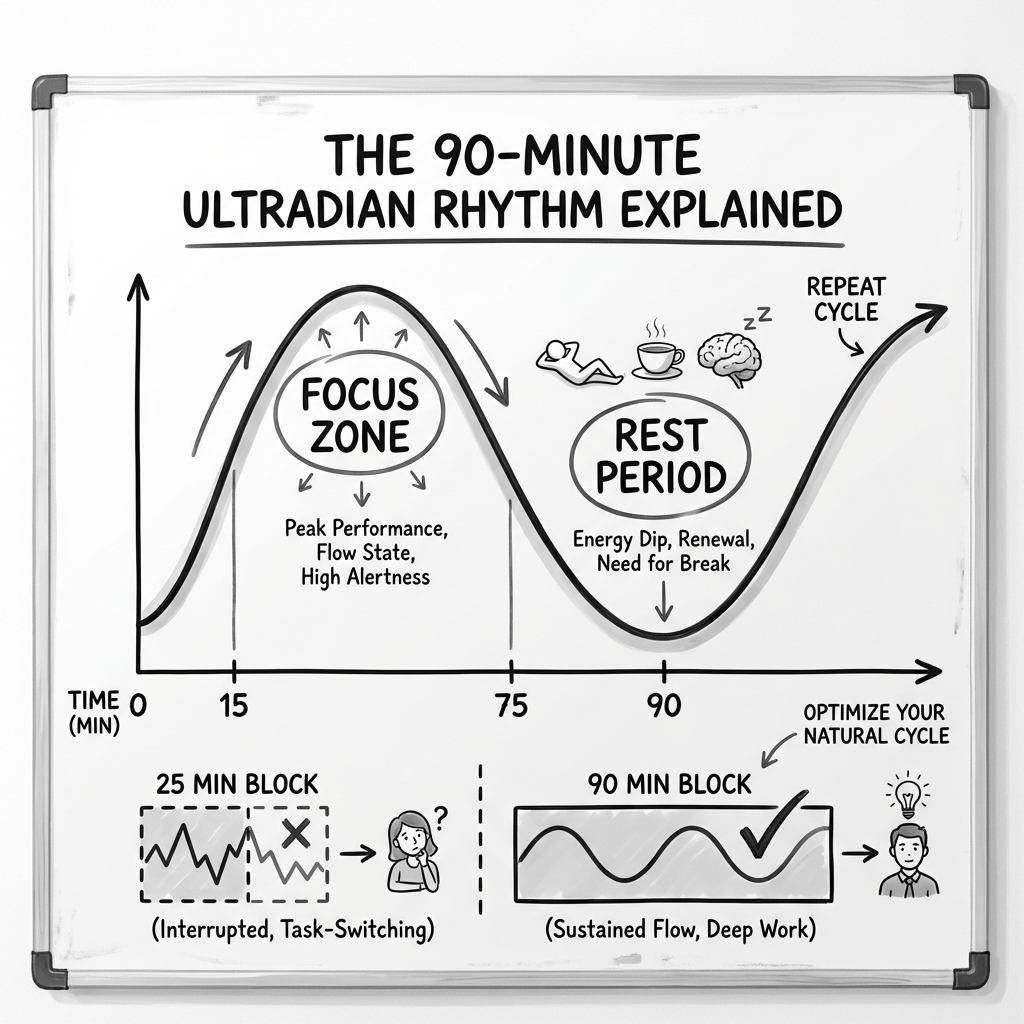
What Is the Ultradian Rhythm?
Your body doesn't run on a single 24-hour clock. It runs on multiple overlapping cycles.
Circadian rhythm: The 24-hour cycle governing sleep-wake patterns.
Ultradian rhythm: 90-120 minute cycles governing energy and focus throughout the day.
Sleep researchers discovered ultradian rhythms first. Pioneering work by Peretz Lavie demonstrated that sleep cycles last approximately 90 minutes, moving through light sleep, deep sleep, and REM. But the same rhythm continues during waking hours.
Every 90-120 minutes, your brain naturally shifts:
- Alertness rises for about 90 minutes
- Alertness drops for 15-20 minutes
- The cycle repeats
This is hardwired biology. You can work against it, but you can't change it.
The Case Against 25-Minute Blocks
The Pomodoro Technique was invented in the 1980s by Francesco Cirillo as a college studying hack. He used a tomato-shaped kitchen timer set to 25 minutes because that's what the timer offered — read the full origin story for context on how a kitchen gadget became a global productivity method.
That's the origin of 25 minutes. Not neuroscience—a kitchen gadget.
Problems with 25-minute blocks for deep work:
Problem 1: Flow Ramp-Up Time
Reaching flow state requires "loading" your mental context:
- Understanding where you are in the project
- Holding multiple related ideas in working memory
- Achieving focused attention without distraction
For complex work, this takes 15-20 minutes. Studies on developer productivity — including research by Chris Parnin and Spencer Rugaber — show it takes about 15 minutes to get into flow after an interruption.
With a 25-minute timer, you spend the first 15 minutes loading context, achieve 5-10 minutes of actual flow, then the timer rings.
Net productive flow time: 5-10 minutes per 30-minute Pomodoro cycle.
Problem 2: Interruption at Peak
Flow state builds momentum. When you're deep in complex work, the 25-minute bell often catches you at your most productive moment.
This isn't just annoying—it's cognitively expensive. The "attention residue" concept (coined by researcher Sophie Leroy) shows that switching tasks leaves part of your mind on the previous task. Even after the break, some cognitive capacity remains occupied.
Problem 3: Break Disrupts the Zone
Sometimes the best thing to do is... keep going.
When you're genuinely in flow, a forced break can pop you out of a state that's difficult to re-enter. The 5-minute break becomes a 15-minute recovery period as you try to reload context.
For task initiation and boring work, frequent breaks help. For deep creative work, they often hurt.
How the 90-Minute Protocol Works
Match your work blocks to your body's natural rhythm.
The Basic Protocol
90 minutes of focused work + 15-20 minutes of rest
That's it. Simple, but aligned with biology.
Why 90 Minutes?
- Long enough to reach and sustain flow: 15-20 minutes to load context, 60-70 minutes of deep work
- Short enough to prevent burnout: Cognitive fatigue becomes significant after 90 minutes
- Aligned with ultradian rhythm: Your body's natural cycle supports this duration
Structure of a 90-Minute Block
Minutes 0-15: Ramp-Up
- Load your mental context
- Review where you left off
- Clear distractions
- Build momentum
Minutes 15-75: Deep Work Zone
- Full cognitive engagement
- Minimal self-monitoring
- Flow state achieved and sustained
- Highest quality output
Minutes 75-90: Wind-Down
- Begin to close loops
- Note where you are for next session
- Finish natural stopping points
- Don't start new complex sub-tasks
Minutes 90-110: True Break
- Physical movement (walk, stretch)
- No screens if possible
- Allow mind to wander
- Transition activity (get coffee, step outside)
Comparison to Pomodoro
| Aspect | Pomodoro (25/5) | 90-Minute Protocol |
|---|---|---|
| Flow time per cycle | 5-10 min | 60-70 min |
| Context loading | 60% of work time | 15% of work time |
| Interruptions per 4 hours | 8 breaks | 2-3 breaks |
| Best for | Task initiation, shallow work | Deep creative work |
| Cognitive overhead | Higher | Lower |
Neither is universally better. But for complex knowledge work, the 90-minute approach often produces dramatically better results.
The Science Behind Flow Triggers
Flow state isn't random. Researchers — including Mihaly Csikszentmihalyi, who pioneered flow research — have identified specific triggers that help you enter flow:
Trigger 1: Clear Goals
You must know exactly what you're working toward. Vague objectives prevent flow.
Before 90-minute block: Write down the specific deliverable or milestone.
Trigger 2: Immediate Feedback
Flow requires knowing whether you're succeeding moment to moment.
During block: Choose work with visible progress (code that compiles, words on page, designs taking shape).
Trigger 3: Challenge-Skill Balance
The task must be hard enough to require full attention but not so hard it causes anxiety.
Task selection: Aim for about 4% beyond current ability—stretch without overwhelm.
Trigger 4: Deep Concentration
All attention on one task. No multitasking. No background distractions.
Environment: Notifications off, door closed, phone elsewhere.
Trigger 5: Sense of Control
You must feel capable of influencing outcomes.
Setup: Start with decisions you can make, not waiting on others.
When these triggers align, flow becomes much more likely. The 90-minute block provides enough time for all triggers to activate.
Who Should Use 90-Minute Blocks
This approach works best for:
Developers and Programmers
Code requires loading complex mental models—file structures, data flows, dependencies. The 15-20 minute ramp-up is real and significant. A 25-minute timer destroys this investment repeatedly.
See Why Developers Hate Pomodoro for more on this problem.
Writers and Content Creators
Good writing requires entering a voice and sustaining a state of creative flow. Short blocks fragment the creative process.
Designers and Artists
Visual work often requires "seeing" a whole composition. Interruptions reset this perception.
Strategic Thinkers
Complex analysis, planning, and problem-solving benefit from extended immersion.
Anyone Doing Work That Requires "Getting Into It"
If your work has a warm-up period, longer blocks pay off.
Who Should Stick With Shorter Blocks
90-minute blocks aren't for everyone:
Task Initiation Challenges
If you struggle to start work, shorter blocks reduce the commitment required. "I can do 25 minutes" is easier than "I can do 90 minutes."
High Variety Workdays
If you genuinely need to switch between many different tasks, long blocks may not fit.
ADHD Without Hyperfocus
Some ADHD individuals find shorter blocks with more breaks easier to manage. Though others thrive with long blocks once engaged. See Harnessing Hyperfocus.
Shallow Work
Email, administrative tasks, and routine work don't require flow state. Shorter blocks work fine and prevent administrative work from expanding.
Implementing the 90-Minute Protocol
Step 1: Choose Your Blocks
Decide how many 90-minute blocks you'll attempt daily.
Most knowledge workers can sustain 3-4 high-quality deep work blocks per day. That's 4.5-6 hours of actual focused work—far more than most people achieve.
Step 2: Time Your Blocks
Map blocks to your ultradian rhythm:
- Morning block 1: Most people's sharpest focus
- Morning block 2: Still strong
- Afternoon block: After energy naturally dips and recovers
- Evening block (optional): If you're a night owl
Avoid scheduling demands (meetings, calls) during your best focus windows.
Step 3: Prepare Before You Start
5 minutes before each block:
- Clear your workspace
- Close all non-essential applications
- Write your specific goal for this block
- Set timer for 90 minutes
- Put phone in another room
Step 4: Protect the Block
Once started:
- No checking email, Slack, or messages
- No context switching
- If interrupted, note it and return immediately
- Don't stop early because it "feels hard"
The first 15 minutes often feel difficult. This is normal—you're loading context. Push through.
Step 5: Honor the Break
When the timer rings:
- Stop, even if you want to continue
- Stand up and move
- Ideally leave your workspace
- Allow 15-20 minutes of genuine rest
The break restores what the block depleted. Skip it and your next block will suffer.
Tracking Your 90-Minute Sessions
Track these blocks by category to understand your time investment:
Example weekly view:
| Day | Building | Promoting | Delivering | Total Blocks |
|---|---|---|---|---|
| Mon | 2 | 1 | 1 | 4 |
| Tue | 1 | 2 | 1 | 4 |
| Wed | 2 | 1 | 0 | 3 |
| Thu | 1 | 1 | 2 | 4 |
| Fri | 2 | 0 | 1 | 3 |
18 blocks × 90 minutes = 27 hours of deep work. That's a productive week.
For weekly analysis guidance, see The Weekly Review System.
The Hybrid Approach
You don't have to choose exclusively between 25 minutes and 90 minutes.
Smart hybrid:
- Deep work (building, creating): 90-minute blocks
- Shallow work (admin, email): 25-30 minute blocks
- Learning and reading: 45-60 minute blocks
Match block length to task cognitive demands. Simple tasks don't need long blocks. Complex tasks do.
Start With One Block
You don't need to restructure your entire day.
Tomorrow's experiment:
- Block 90 minutes on your calendar
- Choose one important task requiring deep focus
- Clear distractions completely
- Work until the timer ends
- Take a genuine 15-minute break
Notice the difference. Did you reach flow? Did the work feel different?
Most people are surprised by how much they accomplish in one uninterrupted 90-minute session. It often exceeds what they'd do in a full fragmented day.
Your body knows how to focus. The 90-minute rhythm is built into your biology.
The 25-minute timer was never based on science. It was based on a kitchen gadget.
For deep work—the work that builds careers and creates value—give yourself enough time to reach flow and stay there.
90 minutes. Deep focus. Real results.
Try it once. Then decide.
You might also like
The Neuroscience of Flow: Why the 25-Minute Bell is a Trap
The science behind why interrupting your focus every 25 minutes might be destroying your best work. Learn what happens in your brain during deep focus.
The Founder's First Two Hours: Why Checking Email Last Multiplies Your Output
Your first two hours determine your entire day. Learn why successful founders protect their morning for high-leverage work and how to design a routine that sticks.
How to Structure Your Ideal Focus Block: A Step-by-Step Template
Master the art of deep work with this practical focus block template. Learn exactly how to prepare, execute, and close each session for maximum productivity.
Ready to take control of your focus?
Stop letting time slip away. The Boring Clock helps you track where your hours actually go, categorized by Building, Promoting, and Delivering.