Are You a Maker or a Manager? Why Your Timer Choice Matters
Are You a Maker or a Manager? Why Your Timer Choice Matters
Paul Graham wrote an essay in 2009 that should have changed how every company operates. It didn't, of course—most managers still think a 30-minute meeting is just 30 minutes. But if you're a maker trapped in a manager's world, this essay might be the most important thing you read this month.
The concept is simple: makers and managers operate on fundamentally different schedules. And using the wrong productivity system for your schedule type is like trying to swim in hiking boots.
Let me explain why this matters more than you think.
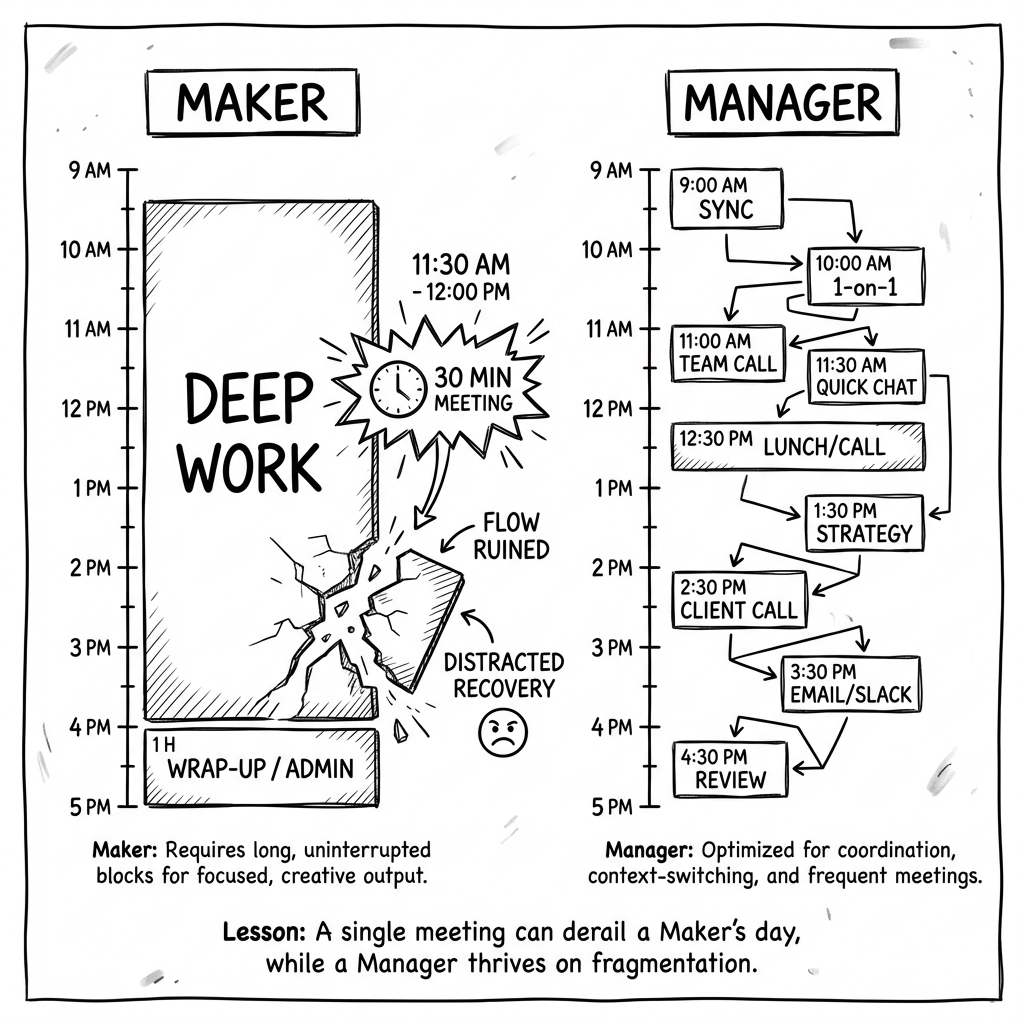
The Maker Schedule
Makers—developers, writers, designers, musicians, anyone whose work requires deep concentration—need long, uninterrupted blocks of time.
Why? Because creative work has a startup cost.
When a developer sits down to code, they don't immediately start typing. First, they need to:
- Load the mental model of the codebase into working memory
- Remember where they left off yesterday
- Understand the relationships between components
- Hold multiple abstractions in mind simultaneously
This process takes 15-20 minutes minimum. Often longer for complex systems.
Here's the problem: that mental model is fragile. A single interruption—a meeting, a Slack message, a quick question—can collapse the entire structure. And once it's gone, you have to rebuild it from scratch.
As Graham puts it, makers need time measured in half-days, not hours. A meeting in the middle of an afternoon doesn't just cost you the meeting time—it destroys the entire afternoon.
The Manager Schedule
Managers operate differently. Their work is inherently interruptible.
A manager's day is filled with:
- One-on-one check-ins
- Status update meetings
- Email responses
- Quick decisions
- People coordination
Each of these tasks is relatively self-contained. You can have a 30-minute meeting, make a decision, and move to the next thing with minimal transition cost. The mental overhead is low because the context is simple.
For managers, the traditional one-hour appointment block makes perfect sense. Your calendar becomes a series of slots, and you fill them as needed. A meeting at 2 PM is just a meeting at 2 PM—not a catastrophe.
The tragedy is that managers often set the schedule for everyone.
They don't experience the devastation of interrupted flow because their work doesn't require it. So they schedule meetings at 10 AM, 2 PM, and 4:30 PM, thinking they've left plenty of "work time" in between.
For a maker, that schedule is a death sentence.
The Asymmetric Cost of Meetings
Let's do the math that managers never do.
You have a 30-minute meeting scheduled at 10 AM. Here's what it actually costs a maker:
Before the meeting:
- 9:00 – 9:30: Could work, but knowing the meeting is coming, you don't start anything complex
- 9:30 – 10:00: Definitely can't start anything now, too close to the meeting
The meeting:
- 10:00 – 10:30: The actual meeting
After the meeting:
- 10:30 – 10:50: Context switching, checking messages, transitioning mentally
- 10:50 – 11:30: Finally getting back into flow... but lunch is at 12:00
That "30-minute meeting" cost you the entire morning. You got maybe 40 minutes of real work—and even that was fragmented and shallow.
Multiply this by 3-5 meetings per week, scattered randomly across your days. Now you understand why developers work at night. It's the only time they can get 4 uninterrupted hours.
For more on the neurological cost of these interruptions, see The Neuroscience of Flow: Why the 25-Minute Bell is a Trap.
Why Traditional Productivity Tools Fail Makers
Here's where this connects to your timer choice.
The Pomodoro Technique — 25 minutes of work, 5-minute break, repeat — was designed for people who can context-switch easily. It works well for:
- Email processing
- Administrative tasks
- Light research
- Task checking
But for makers? Pomodoro is essentially a meeting scheduled every 25 minutes. Just as you're loading your mental model, the bell rings. Just as you're entering flow, you're forced to stop.
The traditional timer assumes you can start productive work immediately. Makers can't. We need warmup time that Pomodoro doesn't account for.
As Cal Newport argues in Deep Work, the ability to perform deep, focused work is becoming both rarer and more valuable. A maker-friendly timer needs:
- Longer focus blocks (30-60 minutes minimum)
- Flexible break timing (don't interrupt flow when it's happening)
- Category awareness (Building, Promoting, Delivering—so you batch similar work)
- No arbitrary bells when you're deep in concentration
Protecting Your Maker Time
If you're a maker working in a manager's world, you need strategies to protect your schedule. Here's what works:
1. Block Your Calendar
Don't wait for free time to appear—create it. Block 4-hour chunks for "deep work" and treat them like immovable meetings.
When someone tries to schedule during your blocked time, you're not lying when you say "I have a conflict." You do have a conflict—with fragmentation.
2. Batch All Meetings
If you must have meetings, cluster them. Put all your meetings on Tuesday and Thursday afternoons. Keep Monday, Wednesday, and Friday mornings sacred.
This gives you 3-4 half-day blocks of uninterrupted maker time. It's not perfect, but it's infinitely better than scattered interruptions.
3. Set Expectations
Tell your team: "I check Slack at 9 AM, 12 PM, and 4 PM. If something is genuinely urgent, text me."
Most things aren't urgent. Most messages can wait 4 hours. But if you don't set the boundary explicitly, people assume you're always available.
4. Communicate the Hidden Cost
When a manager asks for a 30-minute meeting at an inconvenient time, explain the real cost.
"I can do 30 minutes at 2 PM, but that will fragment my afternoon and cost me about 3 hours of development work. Can we move it to 4:30 when I'm wrapping up anyway?"
Most reasonable managers will accommodate once they understand the asymmetry.
The 4/4/4 Method for Makers
Here's how this connects to Alex Hormozi's 4/4/4 framework (4 hours Building, 4 hours Promoting, 4 hours Delivering).
For makers, Building is usually the core work—the coding, writing, designing that requires deep focus. Promoting and Delivering can often be done in shorter blocks with more interruptions.
A maker-optimized daily schedule might look like:
- Morning (8 AM – 12 PM): 4 hours of Building. No meetings. No Slack. Total protection.
- Early Afternoon (1 PM – 3 PM): 2 hours of Delivering. Handle emails, support tickets, client communication.
- Late Afternoon (3 PM – 6 PM): 2-3 hours of Promoting. Content creation, social media, networking calls.
This respects the maker reality: complex creative work requires uninterrupted mornings. Fragmented work can fill the gaps.
Want to track how well you're protecting your maker time? The Boring Clock lets you log focus sessions by category and see your weekly breakdown.
Are You a Maker, a Manager, or Both?
Most people aren't purely one or the other.
A startup founder might be a maker in the morning (coding the product) and a manager in the afternoon (team calls, investor meetings).
A senior developer might be a maker most of the week but a manager during sprint planning and code reviews.
The key is intentional mode-switching. Know which hat you're wearing and structure your time accordingly.
When you're in maker mode:
- Protect the blocks
- Extend the focus sessions
- Minimize context switches
When you're in manager mode:
- Embrace the meetings
- Keep things short and efficient
- Save complex thinking for maker hours
The Manager's Responsibility
If you manage makers, here's your job: protect their time even when they don't ask you to.
That means:
- Don't schedule meetings during morning hours
- Batch related discussions so makers attend one meeting instead of three
- Make meetings optional whenever possible
- Default to async communication — a principle championed by Basecamp
- Judge output, not face time
The best engineering managers understand that their role is often to absorb interruptions so their team doesn't have to. Every meeting you handle is a meeting your developers didn't get pulled into.
For more on strategic time allocation, read Building vs Promoting vs Delivering.
Find Your Schedule Type
Here's a quick diagnostic:
You're probably a Maker if:
- Your best work happens when you're alone
- Interruptions feel physically painful
- You dread days with scattered meetings
- You do your "real work" before or after normal hours
- Finishing a complex task gives you a deep sense of satisfaction
You're probably a Manager if:
- You energize from conversations
- Your value comes from connecting people and ideas
- You don't mind frequent context switches
- Your calendar being full feels productive
- Quick decisions come easily
You might be Both if:
- Your role has changed but your habits haven't
- Some days feel right and others feel wrong
- You're burning out without understanding why
If you're a maker using manager tools—or a manager using maker expectations—the mismatch will drain you.
The Maker's Timer Manifesto
Traditional timers were designed for a world of hourly appointments and frequent breaks. They assume shallow work that can be started and stopped at will.
But makers need something different:
- Extended focus blocks that respect startup costs
- Flexible timing that doesn't interrupt flow
- Category tracking that batches similar work together
- Progress visibility that rewards sustained effort
The timer you choose is a statement about what kind of work you do. Choose one that matches your brain.
Your Schedule, Your Rules
Graham's essay ends with a powerful observation: the maker/manager distinction isn't about superiority. Both schedules are valid. Both create value.
The problem is when you're forced into the wrong one.
If you're a maker, stop apologizing for needing long blocks. Stop accepting scattered meetings as inevitable. Stop using productivity systems designed for a different brain.
Build your schedule around your work. Protect your focus time. Choose tools that respect how you actually create.
You're not broken for needing 4 hours to do 2 hours of deep work. You're a maker. That's how making works.
Ready to take control of your focus?
Stop letting time slip away. The Boring Clock helps you track where your hours actually go, categorized by Building, Promoting, and Delivering.