Burnout Is Not a Badge of Honor: The Periodization Principle for Sustainable Productivity
The Seasons of Work: When to Grind and When to Rest
Hustle culture gets one thing right: there are times when you need to work incredibly hard.
It gets one thing catastrophically wrong: it assumes that intensity should be constant.
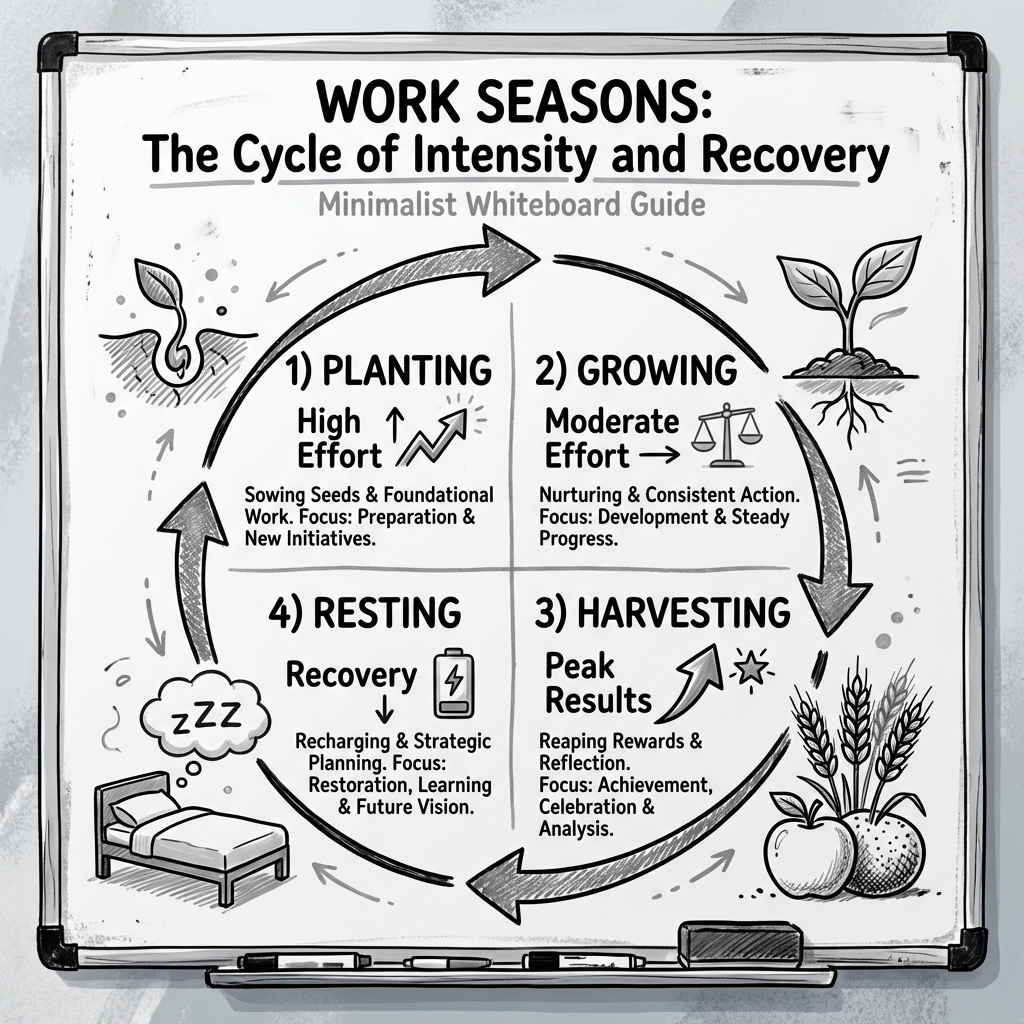
Sustainable high performance isn't about working 12-hour days forever. It's about recognizing that work comes in seasons — periods of intense output followed by periods of recovery. Athletes call this periodization, a training principle backed by decades of sports science research. Farmers call it common sense.
You can't harvest all year. And you can't plant all year either.
This is the guide to working with your natural rhythms instead of against them.
The Myth of Constant Intensity
Social media glorifies the grind. Entrepreneurs post at 5 AM about how they "outwork everyone." The implication is clear: if you're not exhausted, you're not trying hard enough.
This is a recipe for burnout — classified by the World Health Organization as an occupational phenomenon — not success.
Here's what constant intensity actually produces:
- Diminishing returns — After 50 hours per week, productivity drops sharply
- Decision fatigue — Chronic exhaustion degrades judgment quality
- Health breakdown — Sleep deprivation, cortisol spikes, immune suppression
- Relationship damage — No margin for anything outside work
- Creativity death — Original thinking requires rest and mental space
The most successful people don't work harder than everyone else. They work strategically—intense during critical periods, recovered during maintenance periods.
The Four Seasons of Work
Think of your work year (or your project cycle) as having four seasons:
Season 1: Planting (High Effort, Low Visible Results)
Characteristics:
- Building foundations, shipping new products, entering new markets
- Long hours feel necessary and energizing
- Progress is internal—few external wins yet
- Investment mindset: trading time now for returns later
Duration: 4-12 weeks typically
What it looks like:
- Working 10-12 hour days feels right, not forced
- You're energized by possibility
- Sleep may suffer temporarily, but enthusiasm compensates
- Social life gets minimal bandwidth
The danger: Staying in planting mode when you should transition to growing.
Season 2: Growing (Moderate Effort, Increasing Results)
Characteristics:
- Tending what you planted: iterations, refinements, scale
- Sustainable pace—challenging but not burning out
- Results start appearing; momentum builds
- Work feels productive, not just effortful
Duration: 8-16 weeks typically
What it looks like:
- 8-10 hour days with genuine breaks
- Energy is sustainable week over week
- You can maintain exercise, relationships, hobbies
- Focus shifts to optimization, not creation
The danger: Losing discipline because early results feel like arrival.
Season 3: Harvesting (Variable Effort, Peak Results)
Characteristics:
- Reaping what you planted: launches, campaigns, delivery periods
- Intensity may spike briefly, but you're spending stored energy
- Visible wins, recognition, revenue milestones
- Dopamine hits from completion and success
Duration: 2-6 weeks typically
What it looks like:
- Launch weeks may require 12+ hour days—briefly
- High stress, high reward
- Adrenaline carries you through
- Not sustainable, but that's fine—it's temporary
The danger: Trying to live in perpetual harvest without planting new seeds.
Season 4: Resting (Low Effort, Recovery)
Characteristics:
- Deliberate reduction in intensity
- Recovery of sleep, relationships, health, creativity
- Reflection on what worked and what didn't
- Planning for the next cycle
Duration: 2-4 weeks typically
What it looks like:
- 6-8 hour days or genuine time off
- No major initiatives, just maintenance
- Reading, thinking, reconnecting
- Physical recovery: exercise, sleep, nutrition focus
The danger: Guilt about resting, or letting rest extend into avoidance.
Recognizing Your Current Season
Most burnout happens because people don't recognize when to transition between seasons.
Ask yourself:
Am I in Planting Season?
- Have I recently started something significant?
- Am I building foundations that will pay off later?
- Does the current intensity feel exciting, not draining?
If yes: Embrace the grind temporarily. Set an end date.
Am I in Growing Season?
- Am I tending existing projects, not starting new ones?
- Is my pace sustainable for months, not just weeks?
- Are results starting to compound?
If yes: Maintain rhythm. Don't manufacture crises.
Am I in Harvesting Season?
- Am I in a delivery crunch or launch period?
- Is intensity high but temporary?
- Are results directly visible from effort?
If yes: Push through, but schedule recovery immediately after.
Am I in Resting Season?
- Have I recently completed a major sprint?
- Am I running on empty, with no energy to spare?
- Is my body demanding recovery (sleep issues, illness, irritability)?
If yes: Stop trying to be productive. Recovery is the job now.
The Hormozi Perspective on Seasons
Alex Hormozi, known for building $100M businesses, speaks frequently about work intensity — but with crucial nuance often missed.
What Hormozi actually says:
- "I worked 16-hour days for years"—true, but during building seasons
- "Now I work different"—acknowledging that seasons change
- "There are seasons for everything"—explicit recognition of cycles
The lesson isn't that everyone should work 16-hour days forever. It's that there are seasons when extraordinary effort is appropriate and seasons when it's counterproductive.
For more on Hormozi's approach to time allocation, see Deconstructing Alex Hormozi's $100M Schedule.
Warning Signs You've Ignored the Seasons
Your body and mind send signals when you've overridden the natural cycle. Recognize these early:
Physical Warning Signs
- Sleep disruption — Can't fall asleep, can't stay asleep, or waking exhausted
- Persistent illness — Catching every cold, healing slowly, frequent headaches
- Weight changes — Gaining or losing weight from stress eating or appetite loss
- Chronic tension — Neck, shoulders, back constantly tight
Mental Warning Signs
- Persistent irritability — Short temper, overreacting to minor issues
- Cynicism creep — Formerly exciting work feels pointless (one of the three dimensions of burnout identified by Christina Maslach's research and the Maslach Burnout Inventory)
- Decision paralysis — Simple choices feel overwhelming
- Creativity drought — No new ideas, just grinding through
Behavioral Warning Signs
- Increased substances — More caffeine, alcohol, or sleep aids to function
- Relationship neglect — No time or energy for people you care about
- Hobby abandonment — Nothing outside work brings pleasure
- Clock watching — Counting hours until you can stop
If you're experiencing three or more of these, you've likely ignored rest season for too long. The solution isn't to push harder—it's to schedule recovery.
Practical Season Planning
Don't let seasons happen to you. Plan them intentionally.
Annual Season Planning
Map your year with intentional intensity variation:
| Quarter | Season | Focus | Intensity |
|---|---|---|---|
| Q1 | Planting | New product development | High |
| Q2 | Growing | Product iteration, early marketing | Moderate |
| Q3 | Harvesting | Launch campaign, major push | Peak |
| Q4 | Resting + Planting | Recovery, planning next year | Low → Moderate |
This is a template—adjust for your industry and goals. The principle is variation, not any specific pattern.
Monthly Review Questions
Each month, ask:
- What season am I in?
- Is my intensity appropriate for this season?
- When should the current season end?
- What's the next season, and am I ready for it?
Weekly Tracking
Use your time data to monitor intensity:
- High intensity weeks: 50+ hours, Building category dominant
- Moderate intensity weeks: 40-50 hours, balanced categories
- Recovery weeks: < 40 hours, Delivering category minimal
If you're tracking time by category (Building, Promoting, Delivering), you can spot intensity trends over weeks. See Category-Based Time Tracking for how to implement this.
Making Recovery Actually Happen
Rest season sounds nice in theory. In practice, driven people find it almost impossible.
Strategies for actually resting:
1. Schedule Recovery Before You Need It
Book the recovery time immediately after committing to an intensive period.
"I'll work 12-hour days for the launch week"—then block the following week at 50% capacity before you start the push.
Recovery scheduled in advance happens. Recovery planned "when I feel tired" never happens.
2. Define What Rest Means
Rest isn't just "not working." Define it positively:
- Sleep 8+ hours for 7 consecutive nights
- Exercise three times
- Spend unstructured time with family/friends
- Read for pleasure, not professional development
- No Slack, no email on weekends
Vague rest leads to vague work disguised as rest. Specific rest actually restores.
3. Accept the Guilt
Driven people feel guilty resting. This feeling is normal but shouldn't be obeyed.
Reframe:
- "Resting makes me weak" → "Resting makes my next push stronger"
- "I'm falling behind" → "I'm not behind when I'm in recovery season"
- "Successful people don't rest" → "Successful people rest strategically"
The guilt is a signal of your values, not a command to follow.
4. Protect Recovery Fiercely
Rest season is as important as planting season. Protect it:
- Say no to "quick calls" and "small requests"
- Turn off Slack notifications completely
- Tell colleagues and clients you're in recovery mode
- Treat rest blocks like meetings with your most important client
If everything can interrupt rest, rest never happens.
The Compound Returns of Seasons
People who master seasonal intensity outperform chronic hustlers over time.
Year 1:
- Chronic hustler: Consistent 70-hour weeks, burning out by month 10
- Seasonal worker: 4 intense months, 4 moderate months, 4 recovery periods
Year 3:
- Chronic hustler: Major health issue, forced extended break, lost momentum
- Seasonal worker: Consistent output across years, no forced breaks, compounding
Year 5:
- Chronic hustler: Significant life crisis (divorce, health breakdown, business failure from poor decisions)
- Seasonal worker: Sustainable success, maintained relationships, clear thinking maintained
This isn't theoretical. The failure rate among entrepreneurs is largely a stamina problem, not a skill problem.
Know Your Season, Respect It
Right now, you're in a season. Take one minute to identify it.
If you're in Planting:
- Embrace the intensity—but set an end date
- Don't expect visible results yet
- Plan your recovery season now
If you're in Growing:
- Resist the urge to manufacture urgency
- Optimize, don't revolutionize
- Enjoy the sustainable rhythm
If you're in Harvesting:
- Push through—this is what you planted for
- Celebrate wins as they arrive
- Recovery is scheduled immediately after
If you're in Resting:
- Stop apologizing for restoration
- Define what recovery means specifically
- Trust that the next season will come
The grind isn't the goal. Sustainable high performance is the goal.
Work hard when it's time to work hard. Rest when it's time to rest. The seasons give structure to effort.
Those who work with the seasons build lasting success. Those who ignore them burn out, drop out, or break down.
Choose your season. Embrace it fully. And trust the cycle.
Ready to take control of your focus?
Stop letting time slip away. The Boring Clock helps you track where your hours actually go, categorized by Building, Promoting, and Delivering.