Where Do Your Hours Go? Why Generic Time Tracking Fails Entrepreneurs
Your Time Goes Where You Don't Track: The Case for Category-Based Time Tracking
Here's a pattern I see constantly: an entrepreneur feels behind on their business goals. They're working hard—really hard—but the needle isn't moving. Growth is stagnant. Products aren't shipping. Marketing isn't happening.
When we audit their calendar, the mystery solves itself.
They thought they were spending 4 hours daily on product development. The actual number? 45 minutes. The rest was absorbed by email, meetings, fires, and a dozen urgent-but-unimportant tasks.
You can't optimize what you can't see. And without tracking, you're blind to where your time actually goes.
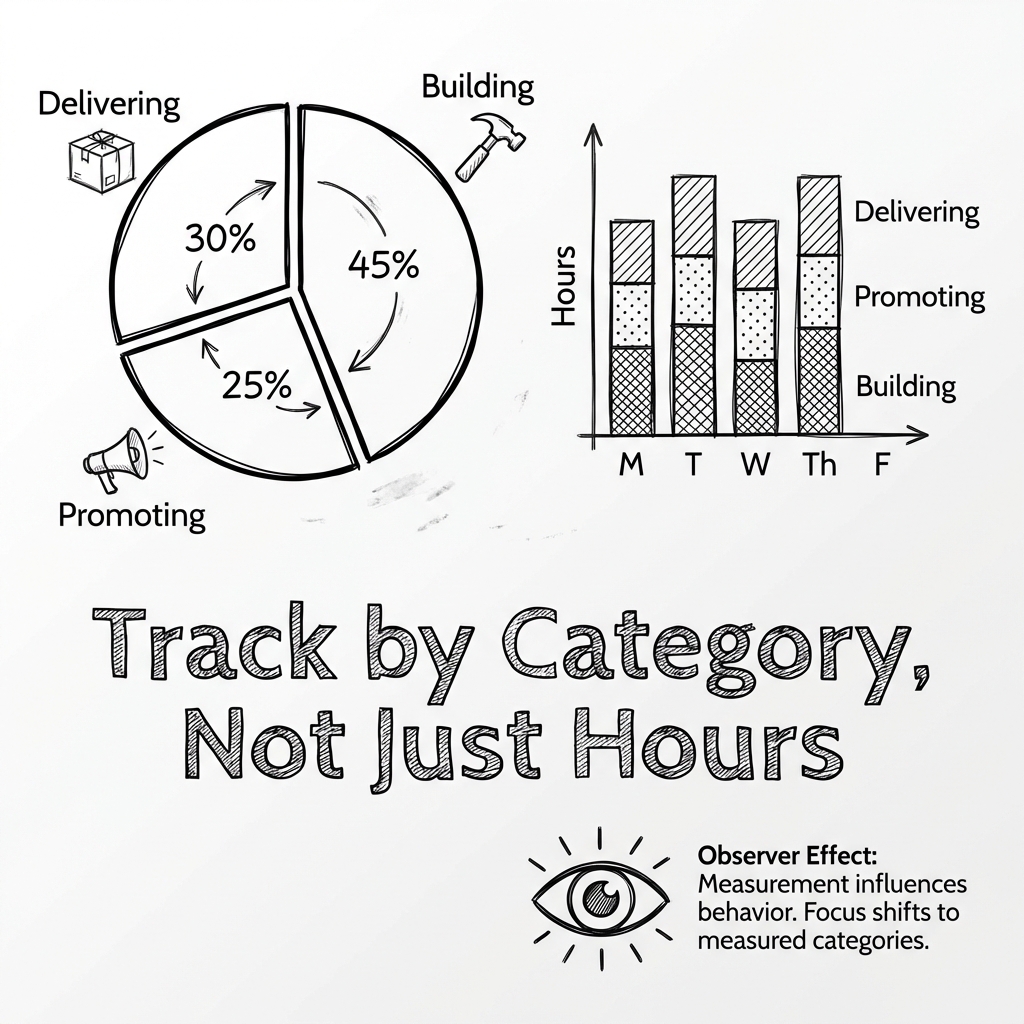
The Observer Effect
There's a principle in physics called the observer effect: the act of observing a phenomenon changes it. The same applies to time management.
When you track your time, you change how you spend it.
Not because you're forcing yourself to work differently. But because awareness precedes change. When you see how many hours vanished into low-value activities, you naturally start redirecting them.
The tracking itself is an intervention.
Studies on weight loss show similar effects: people who log their food eat less, even without trying to diet. The logging creates accountability that changes behavior unconsciously. This is a core idea in the Quantified Self movement — the belief that self-tracking leads to self-knowledge and, ultimately, better decisions.
Time tracking works the same way. Once you see the data, you can't unsee it.
Why Generic Time Tracking Fails
But here's the problem: most time tracking is too blunt to be useful.
Knowing that you "worked 47 hours this week" tells you almost nothing. Were those high-leverage hours or low-value hours? Did you balance strategic priorities or get sucked into one domain? Are you investing or just spending?
Generic time tracking provides:
- Total hours worked
- Maybe project allocations
- A sense of being busy
Generic time tracking doesn't provide:
- Strategic visibility into category balance
- Insight into whether time matches priorities
- Data for rebalancing
If you track only total hours, you optimize for hours—not outcomes. You feel accomplished when the number is high, even if the hours were scattered across low-impact activities.
This is like measuring dieting success by "meals eaten" instead of "calories consumed." The metric doesn't capture what matters.
The Category Advantage
Category-based tracking solves this by grouping your time into strategic buckets.
Using the Building/Promoting/Delivering framework:
- Building: Product development, systems, infrastructure, skills
- Promoting: Marketing, content, sales, audience growth
- Delivering: Customer fulfillment, support, operations
When you track by category, you get answers to questions that matter:
- Am I investing in all three domains?
- Which domain is being neglected?
- Do my time allocations match my stated priorities?
- Are there patterns in how I spend different days?
This is strategic insight. It tells you not just how much you worked, but whether the distribution of work serves your goals.
For a deep dive into these categories, see Building vs Promoting vs Delivering: Where Should You Spend Your Time?.
The Three Imbalance Patterns
When entrepreneurs start category tracking, three failure patterns become visible:
Pattern 1: All Building, No Promoting
The classic technical founder trap. You're constantly improving the product, adding features, refactoring code.
But nobody knows the product exists.
Your weekly report shows 25 hours Building, 2 hours Promoting. That's why you have a great product with no users.
The fix: Block promoting time FIRST. Before you touch code, create content, send outreach, or market.
Pattern 2: All Promoting, No Delivering
The hype-driven business. You're great at marketing—leads are coming in, sales are happening.
But delivery is a mess. Customers are frustrated. Refunds are increasing. Reviews are tanking.
Your weekly report shows 20 hours Promoting, 5 hours Building, 3 hours Delivering. That's why you have sales but no retention.
The fix: Scale back promotion until delivery catches up. Customer success is the foundation for sustainable growth.
Pattern 3: All Delivering, No Building
The fulfillment trap. Every hour goes to serving existing customers. You're responsive, reliable, always available.
But nothing new is being created. The product isn't improving. The business isn't growing.
Your weekly report shows 30 hours Delivering, 2 hours Building, 0 hours Promoting. That's why you're stuck on a treadmill.
The fix: Productize delivery, create systems, and recover time for Building and Promoting.
For more on diagnosing your imbalance, see Are You an Imbalanced Entrepreneur?.
Making the Invisible Visible
Without tracking, you don't see these patterns. You feel busy. You feel productive. The numbers would tell a different story—but you don't have the numbers.
Category tracking makes the invisible visible.
It's like turning on the lights in a dark room. Suddenly you see:
- The hours absorbed by email (often Delivering, sometimes nothing)
- The meetings that felt productive but created no output
- The categories you avoid because they're uncomfortable
- The days that derailed despite good intentions
You can't manage what you can't see. Category tracking gives you sight.
The Minimum Viable Tracking System
You don't need complicated time tracking software. You need three things:
1. Category Selection Before Work
Before each focus session, choose: Building, Promoting, or Delivering.
This takes 2 seconds. But it creates sharp intention. You're not just "working"—you're investing in a specific domain.
2. Session Logging
Log each focused work session with its duration and category.
This can be manual (spreadsheet) or tool-assisted (focus timer with categories). The key is consistent logging.
3. Weekly Review
Once per week—Sunday evening or Monday morning—review your category totals.
Ask:
- How did my time split across categories?
- Which category was strongest?
- Which was weakest?
- Does this match my stated priorities?
- What should I adjust next week?
The review is where insight becomes action. Without it, you have data but no change.
The Tracking Tools
Several approaches work for category-based tracking:
Simple Spreadsheet
Create three categories. Log time manually after each session. Sum weekly.
- Pros: Free, customizable, you control the data
- Cons: Manual entry, easy to forget, no automation
Focus Timer With Categories
Use a timer that lets you select a category before each session and logs automatically.
- Pros: Automatic logging, visible countdown, easy review
- Cons: Requires consistent timer use
The Boring Clock is built exactly for this—category selection before each focus session, automatic logging, and weekly report visibility.
Toggl or Similar
Traditional time tracking tools like Toggl, Clockify, or RescueTime can work if you create three project categories.
- Pros: Robust tracking, detailed reports, integrations
- Cons: Often more complex than needed, tracks everything (not just focused work)
Calendar Blocking
Color-code your calendar by category. Review weekly to see visual distribution.
- Pros: No extra tool, works with existing calendar
- Cons: Tracks planned time, not actual time
The Weekly Report Ritual
Here's how to make your weekly review actionable:
Review Previous Week (5 minutes)
Pull up your category totals. Look at:
- Total hours per category
- Percentage split
- Day-by-day patterns
- Sessions completed
Write down two observations:
- What went well in your time allocation
- What didn't match your intentions
Set Next Week's Targets (5 minutes)
Based on your review, set category targets for the upcoming week.
Example targets:
- Building: 15 hours (35%)
- Promoting: 12 hours (28%)
- Delivering: 10 hours (23%)
- Buffer/other: 6 hours (14%)
These targets are aspirational, not rigid. But having numbers gives you something to aim for.
Identify One Rebalancing Action (2 minutes)
Choose one specific action to shift your time toward the neglected category.
Examples:
- "Block 2 hours of Promoting on Tuesday and Thursday mornings"
- "Delegate weekly customer calls to free 3 hours for Building"
- "Batch email to 3 sessions daily to protect focus time"
One action per week. Small, consistent adjustments accumulate.
Data Over Intuition
Here's the core principle: trust data over intuition for time allocation.
Your intuition about how you spend time is systematically biased:
- Uncomfortable activities feel longer than they were
- Enjoyable activities feel shorter than they were
- Scattered time disappears from memory entirely
- What you planned to do gets confused with what you actually did
Track for a month. Then compare your intuition to the data. You'll discover significant mismatches.
The person who thinks they spend "equal time on everything" discovers they're 80% in one category. The person who "never has time for marketing" discovers they're spending hours on low-value tasks that could be cut.
Data doesn't lie. Your memory does.
From Tracking to Optimization
Tracking is step one. Optimization is step two.
Once you have 3-4 weeks of data, patterns emerge:
- Time of day patterns: When are you most productive in each category?
- Day of week patterns: Which days fall into which categories?
- Session length patterns: What durations work for different work types?
- Interference patterns: What derails your intended time allocation?
Use these patterns to design your ideal week:
- Building sessions during your peak cognitive hours
- Promoting batched into themed days
- Delivering scheduled, not reactive
- Buffer blocks to absorb the unexpected
For more on designing your ideal schedule, see The Perfect Morning Routine for Entrepreneurs.
The Measurement Paradox
There's a paradox in time tracking: it takes time to track time.
This creates resistance. "I don't have time to track my time" is a common excuse.
But here's the math:
- Tracking takes ~30 seconds per session
- Average sessions per day: 6-10
- Daily tracking cost: 3-5 minutes
If those 3-5 minutes help you redirect even one hour per week from low-value to high-value work, you've achieved a 12x return on tracking investment.
The "I don't have time" excuse dissolves when you see the leverage.
The Long-Term Compound Effect
Track for a month and you get insight. Track for a year and you get transformation.
Over extended periods, category tracking reveals:
- How your time allocation has shifted quarter by quarter
- Which categories correlate with business growth
- What your baseline tendencies are
- How much you can actually accomplish in a week
You develop calibrated intuition—gut sense informed by data. You learn how long things take. You predict your capacity accurately. You plan realistically.
This is the compound effect of measurement. Each data point makes the next decision better.
Start Your Tracking Practice
Here's the practical on-ramp:
Week 1: Track without changing Log every work session by category. Don't try to change your behavior yet—just observe.
Week 2: Review and find one pattern At week's end, analyze your data. Identify one surprising pattern or imbalance.
Week 3: Make one adjustment Based on week 2's insight, make one deliberate change to your time allocation.
Week 4: Assess the adjustment Did your category balance improve? What's the next adjustment?
Repeat indefinitely. Each cycle sharpens your time investment strategy.
The Invisible Made Visible
Your time is leaking in places you don't see.
Untracked hours disappear into the void—absorbed by email, consumed by meetings, scattered across low-value tasks that felt urgent but weren't important.
Category tracking shines a light into that void. It shows you where your time actually goes. It reveals the imbalances you couldn't see. It gives you the data to make changes that matter.
You can't fix what you don't measure. And you can't measure what you don't track.
Start tracking. Make the invisible visible. Watch your productivity transform.
Ready to see where your time really goes? The Boring Clock lets you track focus sessions by category and see your weekly breakdown—so you can finally understand and optimize your time investment.
You might also like
Why Entrepreneurs Burn Out: The Hidden Cost of Neglecting One Part of Your Business
Most entrepreneurs unknowingly spend 80% of their time on one business function while the others decay. Learn how to audit and rebalance your time allocation.
Stop Spending Time, Start Investing It: The ROI Framework for Productivity
Not all hours are equal. Some compound, others evaporate. Learn to evaluate your activities by their long-term returns and stop wasting focus on low-ROI tasks.
Stop Doing Low-Value Work: The Delete-Automate-Delegate Framework for Deep Work
Before you can do deep work, you need to eliminate shallow work. Learn Alex Hormozi's hierarchy: Delete first, then Automate, then Delegate what remains.
Ready to take control of your focus?
Stop letting time slip away. The Boring Clock helps you track where your hours actually go, categorized by Building, Promoting, and Delivering.