The Founder's First Two Hours: Why Checking Email Last Multiplies Your Output
The Perfect Morning Routine for Entrepreneurs: A Productivity Blueprint
Your first two hours determine your day.
Not metaphorically—literally. The decisions you make before 10 AM shape your productivity, energy, and output for the remaining hours.
Most entrepreneurs waste their mornings. They wake up, check email, scroll notifications, react to whatever seems urgent. By noon, they've been pulled in a dozen directions and haven't touched their most important work.
There's a better way.
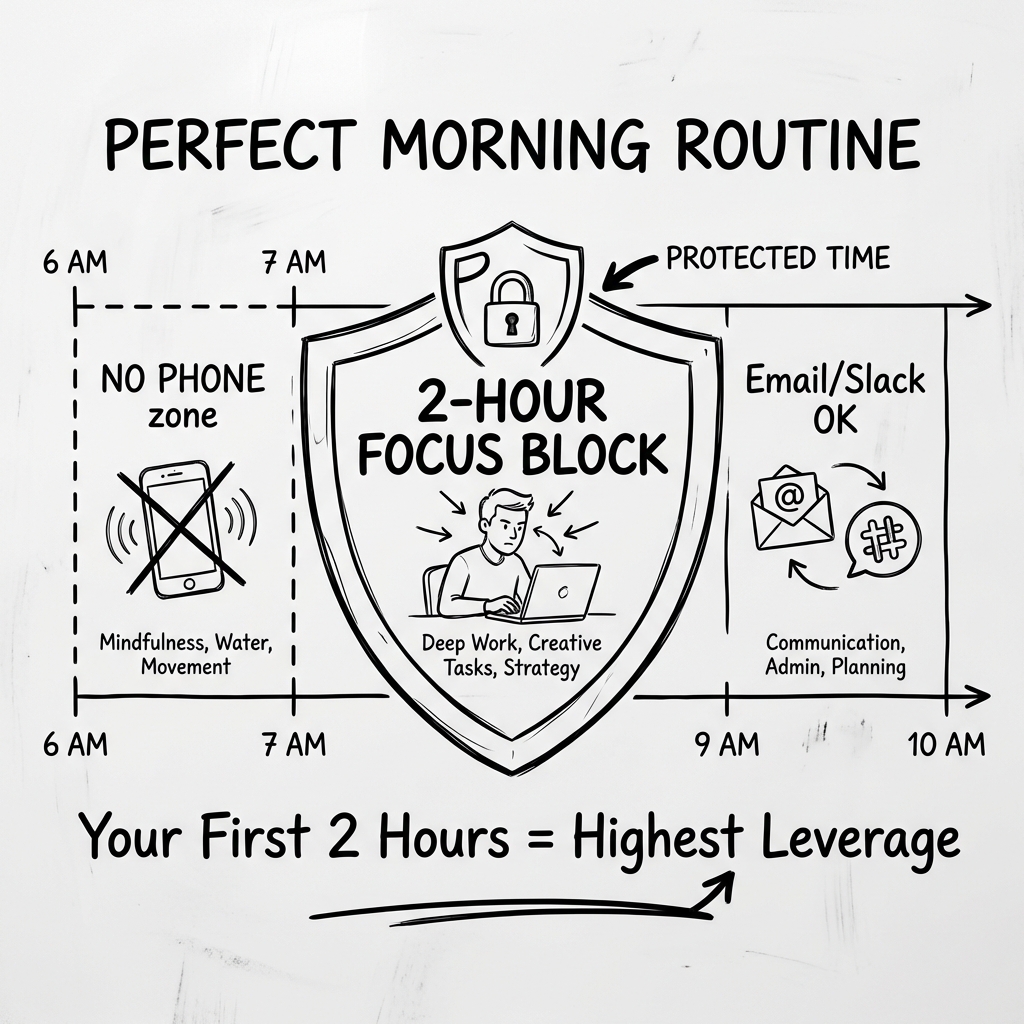
Why Mornings Matter More
Your brain operates on ultradian rhythms—cycles of higher and lower cognitive capacity throughout the day. For most people, the highest-performance window occurs in the first 2-4 hours after waking.
During this window:
- Cortisol is naturally elevated, enhancing alertness
- Willpower reserves are full (they deplete through the day)
- Decision fatigue hasn't accumulated yet
- Fewer interruptions have occurred
- Creative capacity is at its peak
After this window closes, cognitive performance declines. It can be temporarily restored with breaks, caffeine, or ultradian recovery, but never to morning levels.
The implication is stark: using your morning for email is like paying for groceries with investment capital. You're spending your most valuable resource on your least important work.
The Morning Reactivity Trap
Here's what happens when you start the day reactively:
6:30 AM: Wake up, grab phone 6:35 AM: Check email, see 3 "urgent" messages 6:45 AM: Respond to first message, rabbit hole starts 7:15 AM: Remember you should shower, put phone down (but thinking about emails) 7:45 AM: Coffee, scroll news to "just check what's happening" 8:15 AM: Open laptop to "start work," see Slack notifications 8:30 AM: Now responding to Slack, someone starts a meeting 9:30 AM: Meeting ends, need a second coffee 9:45 AM: Finally ready to start "real work"... but actually tired
You've now used your best cognitive hours reacting. The creative work that requires peak brain power will happen in your depleted state—or more likely, tomorrow (which will go the same way).
This is the reactivity trap. It feels productive because you're responding to things. But it's strategically disastrous because you're spending premium hours on reactive work.
The Morning Protection Principle
The alternative: protect your morning for proactive, high-leverage work.
This means:
- No email until after your first focus block
- No Slack, Teams, or messaging until after your first focus block
- No meetings in your morning protection zone
- No "just quickly checking" anything
Zero reactive inputs until your proactive work is complete.
This feels uncomfortable at first. You'll worry about missing something urgent. You'll feel anxious about notifications piling up.
But here's the reality: nothing in your inbox at 7 AM requires a response before 10 AM. If something is genuinely urgent, people will call. Email urgency is almost always artificial.
For more on eliminating low-value work, see Delete, Automate, Delegate.
The 2-Hour Morning Block
The core of a powerful morning routine is a protected 2-hour focus block.
During this block:
- You work on your most important task
- All notifications are disabled
- Your environment is controlled
- Your phone is in another room
The 2-hour duration is intentional:
- Long enough to reach flow state and produce meaningful work
- Short enough to be achievable daily
- Matches the natural ultradian cycle
- Creates urgency without exhaustion
After 2 hours of protected deep work, you've already won the day. Everything else is bonus.
Morning Block Category Selection
The night before, select your morning category and specific task.
Using the Building/Promoting/Delivering framework:
- Building mornings: Product development, code, systems creation, strategic planning
- Promoting mornings: Content creation, marketing assets, sales outreach, audience work
- Delivering mornings: Complex customer work, operations improvements (not routine delivery)
Most entrepreneurs should bias toward Building or Promoting in the morning. These are the high-leverage categories that get squeezed when days become reactive. Delivering often expands to fill available time, so give it the afternoon.
Pre-selection is crucial. If you wake up and ask "What should I work on?", you've already lost. Decision fatigue kicks in. Options paralyze. The inbox calls.
Decide the night before. Wake up with the answer already settled.
For the full category framework, see Building vs Promoting vs Delivering.
The Pre-Work Ritual
Before starting your focus block, prepare your environment:
1. Physical Space
- Desk cleared of clutter
- Water within reach
- Lighting appropriate
- Temperature comfortable
2. Digital Space
- Relevant apps/files open
- Irrelevant tabs closed
- Notifications disabled
- Phone elsewhere
3. Mental Space
- Clear on what you're working on
- Clear on what "done" looks like
- Brief intention statement: "For the next 2 hours, I'm building [specific thing]"
This ritual takes 5 minutes. It eliminates friction that would otherwise cause false starts and restarts.
Sample Morning Routines
Here are three templates based on different life situations (inspired by routines profiled on Tim Ferriss's blog and in Hal Elrod's The Miracle Morning):
The Early Riser (5:30 AM wake)
| Time | Activity |
|---|---|
| 5:30 | Wake, no phone |
| 5:45 | Light movement, water |
| 6:00 | Coffee, pre-work ritual |
| 6:15 | Focus block begins |
| 8:15 | Focus block ends |
| 8:15 | Breakfast, ready for day |
| 8:30 | Can now check email/Slack |
The Standard Schedule (7:00 AM wake)
| Time | Activity |
|---|---|
| 7:00 | Wake, no phone |
| 7:15 | Shower, dress |
| 7:45 | Breakfast, coffee |
| 8:00 | Pre-work ritual |
| 8:15 | Focus block begins |
| 10:15 | Focus block ends |
| 10:15 | Can now check email/Slack |
The Family Schedule (6:30 AM wake, kids involved)
| Time | Activity |
|---|---|
| 6:30 | Wake before family, no phone |
| 6:45 | Pre-work ritual |
| 7:00 | Focus block begins |
| 8:00 | Kids wake, focus block ends (60 min achieved) |
| 8:00-8:45 | Family morning routine |
| 8:45 | Kids to school |
| 9:00 | Second focus block (optional 60 min) |
The pattern is consistent: protect morning focus time before reactive inputs begin.
Tracking Your Morning Productivity
Log your morning focus block every day.
Using a timer with category tracking:
- Select your category (Building, Promoting, or Delivering)
- Start the timer when your block begins
- Work for your full focus duration
- Log the completed session
Over weeks, you'll see your morning productivity patterns:
- Which mornings are strongest?
- What categories dominate your mornings?
- How many 2-hour blocks are you completing weekly?
- Is your morning time being protected or eroded?
The Boring Clock tracks all of this—category, duration, and weekly summary—so you can review your patterns.
Defending Against Morning Erosion
Your protected morning will face attacks:
Attack 1: The Urgent Email
Someone sends a message at 7 AM marked urgent.
Defense: You don't check email until after your focus block. If it's actually urgent, they'll call. It never is.
Attack 2: The Early Meeting
Someone schedules a meeting during your protected time.
Defense: Block your calendar in advance. When asked, say "I have a conflict at that time." Don't explain—just decline.
Attack 3: Your Own Curiosity
You wonder if something important arrived overnight.
Defense: Phone in another room. Browser tabs pre-set. Make checking physically inconvenient.
Attack 4: Family Interruptions
Kids or partners need attention.
Defense: Communicate your focus time clearly. Wake before others if possible. Or accept shorter blocks during family phases.
Attack 5: Self-Sabotage
"I'll just quickly check one thing."
Defense: Recognize this as the trap it is. One check becomes ten. The focus block is all or nothing.
The Compound Effect of Morning Focus
Here's what happens over time:
Week 1: You complete 3-4 morning focus blocks. It feels difficult but productive.
Week 4: Morning blocks become routine. You've completed 12-15 blocks. Significant project progress visible.
Week 12: 50+ morning blocks completed. Major work shipped. Your relationship with mornings has fundamentally changed.
Week 52: 150-200 morning focus blocks. Projects that would have taken years are done. You can't imagine starting days reactively anymore.
The compound effect is massive. 2 hours of protected focus, 5 days a week, is 520 hours per year of your peak cognitive time invested in high-leverage work.
For more on compounding time investments, see Stop Managing Time, Start Investing It.
Night Before Preparation
Your morning really starts the night before:
1. Select Tomorrow's Focus
What category? What specific task? Write it down so morning-you doesn't have to decide.
2. Prepare Your Workspace
Clear your desk. Close browser tabs. Set up what you'll need. Morning friction should be zero.
3. Set Sleep Protection
Backtime from your wake-up to get 7-8 hours. Screen-free wind-down. Sleep quality directly affects cognitive performance.
4. Avoid Evening Alcohol
Even moderate alcohol disrupts sleep architecture. Your morning brain will be impaired even if you don't feel hungover.
5. Phone Out of Bedroom
Charge it elsewhere. This prevents last-night scrolling AND morning-first checking.
Think of this as pre-work: investment that makes morning execution automatic.
Adapting for Night Owls
Not everyone's peak cognitive hours are in the morning. True night owls have later chronotypes—their alertness peaks in the evening.
If you're a genuine night owl:
- Apply the same protection principle to your peak hours (afternoon or evening)
- Front-load reactive work in your low-energy morning
- Guard your high-energy evening for deep work
- Don't fight your biology, work with it
But be honest: many people who claim to be "night owls" are actually sleep-deprived morning types. If you've never experienced 8+ hours of quality sleep consistently, you don't know your true chronotype.
Test it: get proper sleep for 2 weeks, wake naturally without alarms, and see when you're most alert. Neuroscientist Andrew Huberman covers the science of chronotypes and light exposure in detail on the Huberman Lab podcast. Then protect those hours regardless of when they fall.
The Simple Morning Rule
If this all feels like a lot, here's the simplest version:
Rule: Before checking anything, complete one focused hour of your most important work.
That's it.
- One hour of focused work
- Before email, Slack, social, or news
- On your most important task
If you do only this, you'll be ahead of 95% of entrepreneurs who sacrifice their mornings to reactivity.
Start simple. Add complexity only if it helps.
Your Morning Starts Tonight
Your morning routine isn't decided in the morning—it's decided the night before.
Tonight:
- Decide what you'll work on tomorrow morning
- Prepare your workspace
- Set your phone to charge outside your bedroom
- Go to sleep on time
Tomorrow:
- Wake without checking phone
- Brief preparation ritual
- Start your focus block
- Complete your most important work before checking anything
That's the perfect morning routine. Not complicated—just protected.
Your first two hours are your most valuable. Stop giving them away to email.
Invest them in work that matters.
You might also like
5 Pomodoro Technique Alternatives for When 25 Minutes Isn't Enough
The Pomodoro Technique isn't for everyone. Discover 5 proven alternatives that might work better for developers, writers, and anyone who needs deeper focus blocks.
Stop Spending Time, Start Investing It: The ROI Framework for Productivity
Not all hours are equal. Some compound, others evaporate. Learn to evaluate your activities by their long-term returns and stop wasting focus on low-ROI tasks.
Stop Doing Low-Value Work: The Delete-Automate-Delegate Framework for Deep Work
Before you can do deep work, you need to eliminate shallow work. Learn Alex Hormozi's hierarchy: Delete first, then Automate, then Delegate what remains.
Ready to take control of your focus?
Stop letting time slip away. The Boring Clock helps you track where your hours actually go, categorized by Building, Promoting, and Delivering.