Stop Spending Time, Start Investing It: The ROI Framework for Productivity
Stop Managing Time, Start Investing It: A Framework for High-Leverage Productivity
Time management is a scam.
Not completely—but mostly. It treats time like a problem to be solved rather than a resource to be deployed. It optimizes for efficiency when it should optimize for returns.
The question isn't: "How do I fit more into my day?"
The question is: "How do I get the highest return on the hours I invest?"
This shift—from managing time to investing time—changes everything about how you approach productivity.
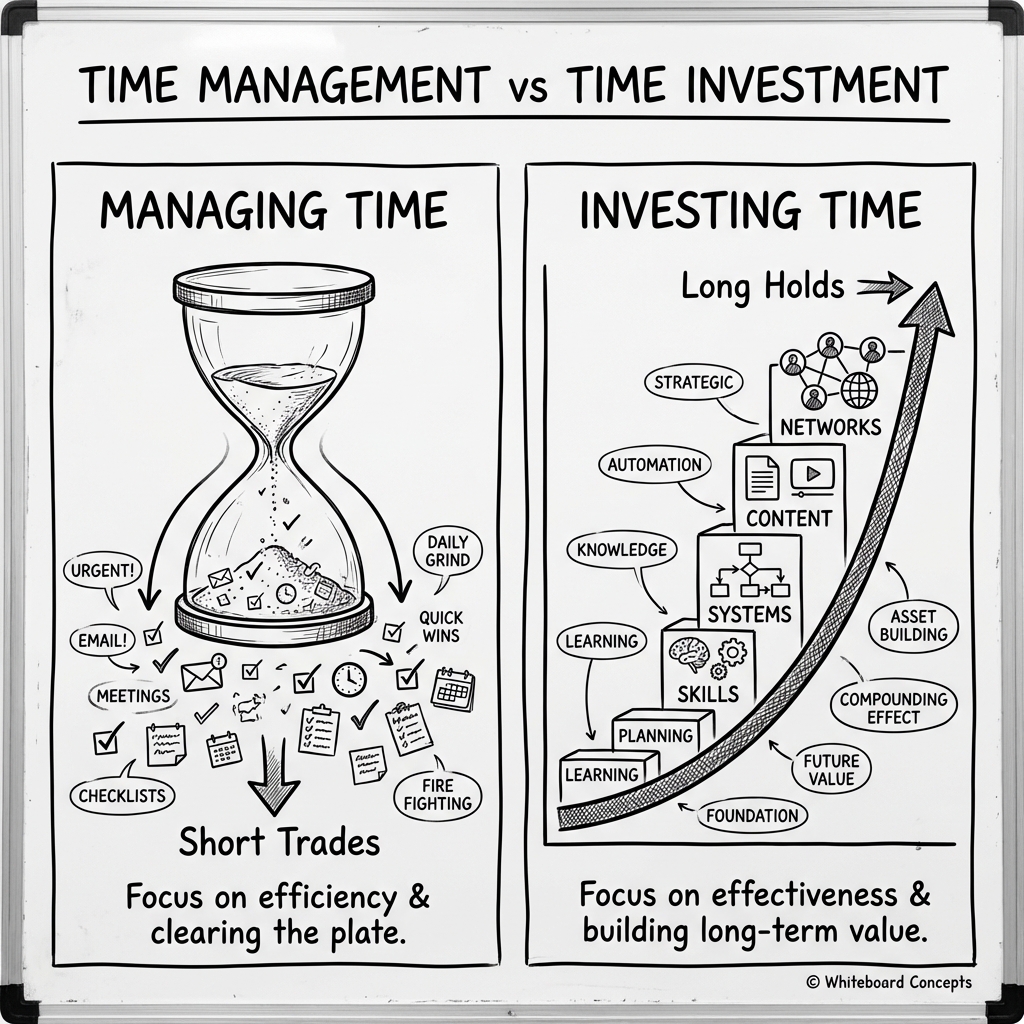
The Investment Mindset
Think about money for a moment.
A financial advisor doesn't just ask "How can I spend less?" They ask "How can I deploy capital for maximum returns?" They consider compound interest, risk, diversification, and time horizons.
Now apply that thinking to time.
Every hour you spend is an investment. Like money, you can:
- Spend it on activities with no lasting value
- Save it by avoiding commitments (but unused time doesn't compound)
- Invest it in activities that generate returns over time
- Waste it on low-return activities that feel productive
Most productivity advice focuses on spending less and saving more. Time investment focuses on deploying your hours where they compound.
The Two Types of Work
All work falls into two categories:
Short Trades
Short trades are activities that generate immediate, one-time value. Once done, they provide no ongoing benefit.
Examples:
- Answering emails
- Attending status meetings
- Processing invoices
- Fixing urgent bugs
- Handling customer complaints
Short trades are necessary. They keep the business running. But they're like buying depreciating assets—valuable in the moment, worthless tomorrow.
The problem with short trades: No matter how efficiently you do them, they don't compound. Today's email responses don't make tomorrow's easier. Last week's meetings don't build value this week.
Long Holds
Long holds are activities that generate returns over extended periods. They build assets—skills, systems, relationships, content—that keep paying off.
Examples:
- Creating content that attracts leads for years
- Building systems that save time repeatedly
- Developing skills that increase your earning power
- Nurturing relationships that generate opportunities
- Writing code that serves thousands of users
Long holds are the focus time equivalent of compound interest. As Naval Ravikant puts it, you want to seek work that provides leverage — code, media, capital, and labor that multiply your efforts beyond the hours you put in. The work you do today continues creating value tomorrow, next month, next year.
The power of long holds: A blog post written in 3 hours might generate traffic for 5 years. A system created in one day might save 20 minutes every day forever. A skill developed over months opens doors for decades.
Calculating Your Time ROI
Let's make this concrete with a simple framework.
For any significant time investment, ask:
- How many hours will this take?
- What value does it create?
- How long does that value persist?
- What's the total return over the time horizon?
Example: Writing a process document
- Investment: 4 hours
- Value: Saves 30 minutes per occurrence
- Frequency: Happens 10 times per month
- Duration: Useful for at least 2 years
ROI calculation:
- Monthly savings: 30 min × 10 = 5 hours
- Annual savings: 60 hours
- 2-year savings: 120 hours
- Return on 4-hour investment: 30x
Example: Processing email
- Investment: 1 hour
- Value: Inbox at zero
- Duration: Roughly 24 hours before it refills
ROI calculation:
- Return: 1 hour back to equilibrium
- Duration: 1 day
- Net return: 0x (maintenance, not investment)
Email processing is necessary but generates no compound returns. The process document generates 30x returns. Yet most people spend more time on email.
The Portfolio Approach
Smart investors diversify their portfolios. Smart time investors do the same.
Your time portfolio should include:
Foundation Assets (25% of time)
These are the maintenance activities that keep everything running. They don't compound, but neglecting them causes decay.
- Email and communication
- Basic administration
- Routine maintenance
- Immediate customer needs
Growth Assets (50% of time)
These are the core building activities that create compound returns.
- Building products or services
- Creating content
- Developing systems
- Learning high-leverage skills
Speculative Assets (25% of time)
These are higher-risk, higher-potential investments. Not all will pay off, but the winners create massive returns.
- Experimental projects
- New market exploration
- Relationship building with key contacts
- Skill development in emerging areas
The percentages aren't rigid. But the principle is: a healthy portfolio emphasizes growth assets while allocating meaningful time to speculation and limiting foundation assets to the minimum necessary.
The Transaction Cost Problem
Here's where the investment metaphor reveals important insight.
In financial markets, every trade has transaction costs—fees, spreads, taxes. Frequent trading erodes returns through accumulated friction.
Time has transaction costs too: context switching.
Every time you switch tasks, you pay a cognitive tax. Research shows it takes approximately 23 minutes to fully refocus after a switch. Frequent switching means you're paying transaction costs constantly.
A day of 20 short trades (20 × 23 minutes = 7.7 hours of switch penalties) leaves almost no time for actual work.
Long holds minimize transaction costs. When you spend 3 hours deeply focused on one activity, you pay the context-switching tax once instead of 12 times. More of your time goes to productive work, less to cognitive overhead.
For more on the mathematics of context switching, see The Hidden Cost of Context Switching.
Building Your Time Balance Sheet
Imagine you could see a "balance sheet" of your time investments. What assets have you built?
Skills table:
| Skill | Investment Hours | Current Value | Compounding? |
|---|---|---|---|
| Writing | 500 | High | Yes |
| Excel | 200 | Moderate | No (plateau) |
| Coding | 1,000 | High | Yes |
| Communication | 300 | High | Yes |
Systems table:
| System | Investment Hours | Time Saved/Month | Months Active |
|---|---|---|---|
| Email filters | 2 | 4 | 36 |
| Onboarding docs | 8 | 10 | 24 |
| Automation scripts | 20 | 30 | 18 |
Content table:
| Content | Investment Hours | Monthly Traffic | Revenue/Month |
|---|---|---|---|
| Pillar post #1 | 10 | 2,000 | $150 |
| Pillar post #2 | 8 | 1,500 | $100 |
| Email course | 15 | n/a | $500 |
Now look at your calendar for last week. How much time went into building assets versus maintaining equilibrium?
If you're spending 80% of your time on foundation work (email, meetings, firefighting) and 20% on growth assets, your time portfolio is dangerously unbalanced. You're treading water, not building wealth.
The Category Investment Strategy
When you track your time by category—Building, Promoting, Delivering—you're essentially running three investment funds.
Building investments: Product development, systems creation, infrastructure. These compound through better offerings and efficiency.
Promoting investments: Content, marketing, relationships. These compound through audience growth and brand recognition.
Delivering investments: Customer success, operations, fulfillment. These compound through retention, referrals, and reputation.
All three need investment. But the mix matters based on your current situation.
Early stage: Heavy Promoting (nobody knows you exist yet) Growth stage: Balanced Building and Promoting (product-market fit needs both) Scale stage: Heavy Delivering (serving existing customers well drives compounding)
For a deep dive into balancing these categories, see Building vs Promoting vs Delivering.
Identifying High-Leverage Activity
Not all investments are equal. Some have 2x returns. Some have 100x.
High-leverage activities share characteristics:
- One-to-many impact: Affect many people or processes from single effort
- Compound over time: Returns grow rather than stay flat
- Create options: Open new possibilities and choices
- Build assets: Create things that retain or increase value
- Develop skills: Improve your capacity for future work
Examples of high-leverage work:
- Writing a book (reaches thousands, creates authority)
- Recording a course (teaches once, sells forever)
- Building an automation (saves time perpetually)
- Hiring well (multiplies capacity)
- Creating a process (runs without you)
Examples of low-leverage work:
- Custom one-off work (helps one client once)
- Meetings without clear outcomes (consumes time, produces nothing)
- Perfectionism (diminishing returns on quality improvements)
- Manual repetitive tasks (linear effort, linear return)
When evaluating how to spend an hour, ask: "Is this high-leverage or low-leverage?" Bias ruthlessly toward leverage.
The Investor's Discipline
Time investment requires the same disciplines as financial investment:
1. Have a Thesis
Don't invest randomly. Know what you're trying to build and why certain activities serve that goal. Warren Buffett is famous for saying he turns down nearly everything — his success comes from saying no to almost every opportunity so he can go all-in on the few that matter.
"I'm building an audience through content marketing" is a thesis. Random tasks are not.
2. Track Your Investments
You can't manage what you don't measure. Track where your hours go, categorized by investment type.
The Boring Clock helps here—categorize your focus time as Building, Promoting, or Delivering to see your investment distribution.
3. Review Performance
Regularly evaluate whether your time investments are paying off. Monthly or weekly, ask:
- What did I invest in?
- What returns did I see?
- What should I invest more in?
- What should I stop?
4. Rebalance Intentionally
When you notice your portfolio is off, make deliberate changes. If you've been over-indexed on Delivering, schedule more Building time. If Promoting is neglected, block content creation hours.
5. Accept Some Losses
Not every time investment pays off. Some content flops. Some systems aren't used. Some skills become obsolete.
That's okay. Diversification and consistent investing smooth out individual losses. The overall portfolio matters more than any single bet.
The Compound Life
Here's the existential version of this framework:
Your skills compound. Your knowledge compounds. Your relationships compound (with nurturing). Your systems compound. Your reputation compounds.
But only if you invest consistently.
Ten years of scattered, reactive work creates nothing lasting. Ten years of intentional investment—building skills, systems, relationships, and assets—creates a compound life where opportunities flow naturally and capacity expands continuously.
The choice isn't "busy or not busy." It's "investing or spending."
Start Your Investment Practice
Here's a practical starting point:
This week, classify your work hours:
- Investment hours: Activities building skills, systems, content, or relationships with compound returns
- Maintenance hours: Necessary activities that don't compound
- Waste hours: Activities that seemed productive but created no value
Aim for:
- 50%+ investment hours
- 40% or less maintenance hours
- Less than 10% waste hours (ideally approaching zero)
Track this for two weeks. The numbers will surprise you.
Most people discover they're spending 80% on maintenance and waste, leaving only 20% for actual investment. That's a portfolio heavily weighted toward deprecating assets.
Flip the ratio. Invest more than you maintain. Build more than you sustain.
That's how you stop managing time and start investing it.
Time is not a problem to be managed. It's capital to be deployed.
As Buffett's long-time partner Charlie Munger observed, the first rule of compounding is to never interrupt it unnecessarily. The same applies to your time investments — consistency and patience are what turn daily effort into exponential results.
Choose your investments wisely. The compound returns await.
You might also like
Stop Doing Low-Value Work: The Delete-Automate-Delegate Framework for Deep Work
Before you can do deep work, you need to eliminate shallow work. Learn Alex Hormozi's hierarchy: Delete first, then Automate, then Delegate what remains.
Where Do Your Hours Go? Why Generic Time Tracking Fails Entrepreneurs
You planned 4 hours of deep work but only got 45 minutes. Learn why tracking time by category reveals the leaks that generic timers miss.
The Founder's First Two Hours: Why Checking Email Last Multiplies Your Output
Your first two hours determine your entire day. Learn why successful founders protect their morning for high-leverage work and how to design a routine that sticks.
Ready to take control of your focus?
Stop letting time slip away. The Boring Clock helps you track where your hours actually go, categorized by Building, Promoting, and Delivering.