How to Structure Your Ideal Focus Block: A Step-by-Step Template
How to Structure Your Ideal Focus Block: A Step-by-Step Template
Most people start a focus session wrong. They sit down, open their laptop, check email "just for a second," and thirty minutes later wonder where their deep work time went.
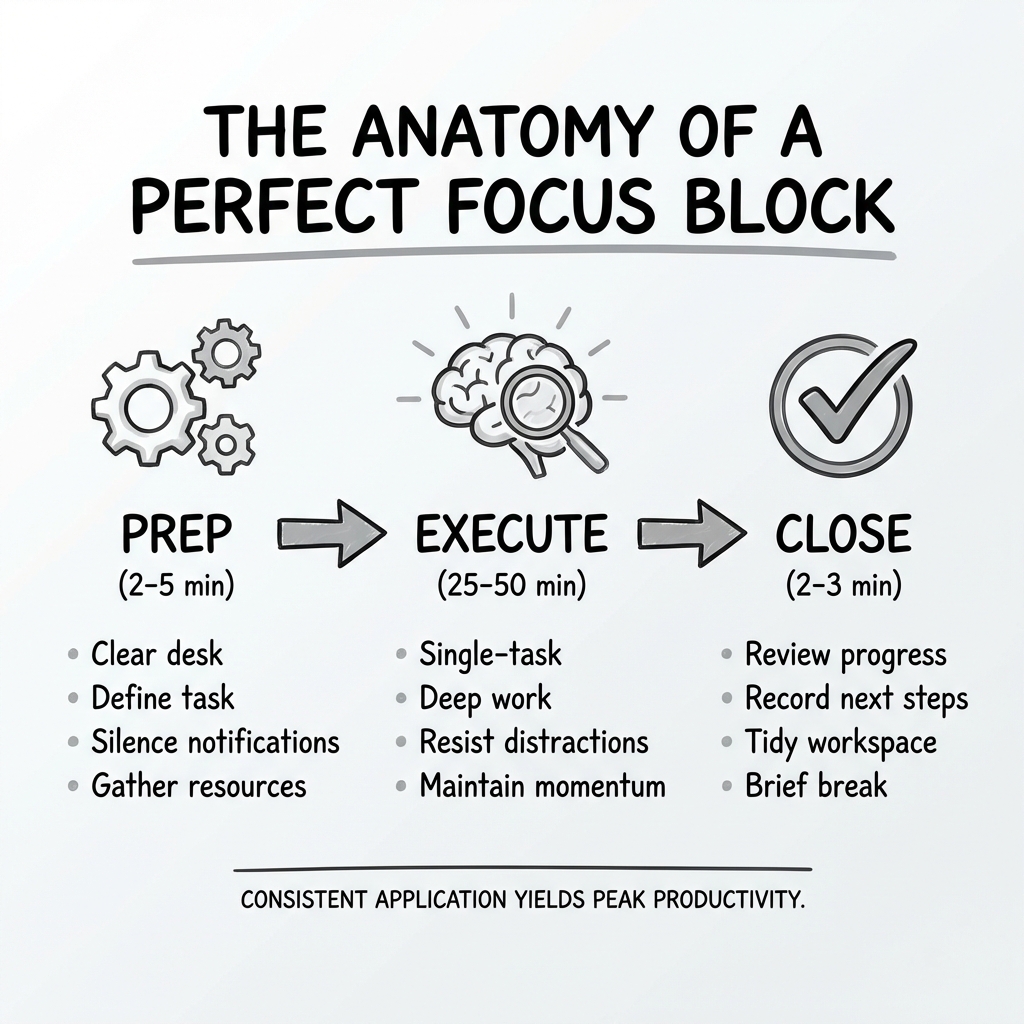
A focus block isn't just time on the calendar. As Cal Newport describes in Deep Work: Rules for Focused Success in a Distracted World, it's a structured ritual with distinct phases: preparation, execution, and closure. Skip any phase and you sabotage the others.
This is the exact template for structuring focus blocks that actually produce results.
Why Structure Matters
Unstructured focus time fails because:
- No clear starting point — You drift into work instead of decisive engagement
- No defined scope — Everything feels equally urgent
- No recovery — You burn out by mid-afternoon
- No completion signal — Work bleeds into breaks
Structure transforms intention into execution. When you know exactly what to do at each phase, you eliminate friction and maximize output.
The Three Phases of a Focus Block
Every effective focus block follows three phases:
Phase 1: Preparation (2-5 minutes before)
Purpose: Prime your environment and mind for focused work.
Preparation isn't optional. It's the difference between hitting the ground running and spending fifteen minutes getting your bearings.
Preparation checklist:
- Select your category — Decide whether this block is Building, Promoting, or Delivering
- Define the deliverable — What will be complete when this block ends?
- Clear physical distractions — Phone in another room, browser tabs closed, desk organized
- Clear digital distractions — Notifications off, messaging apps closed, email hidden. Nir Eyal's book Indistractable offers an excellent framework for managing these triggers systematically
- Set your timer — 30 minutes is ideal; adjust based on task type
- Take one deep breath — Signal your brain that focus mode is starting
The key question: "What is the one thing I will accomplish in this block?"
If you can't answer that clearly, you're not ready to start.
Phase 2: Execution (25-50 minutes)
Purpose: Single-task on your defined deliverable until the timer rings.
This is where work happens. Everything else was setup; this is the game.
Execution rules:
- One task only — Multi-tasking destroys focus quality
- No context switching — If a thought about another task arises, write it down and return immediately
- Honor the timer — Don't stop early; don't work through the timer endlessly
- Use friction against yourself — Make distractions hard to access, not just unappealing
When you get stuck:
- Take 30 seconds to look away from screen
- Write down exactly where you're stuck
- Ask: "What's the smallest next action?"
- Keep moving, even if imperfectly
The focus spiral: If you lose focus, don't restart from scratch. Notice you've drifted, take one breath, and return to the task. This is normal. It's part of training attention.
Phase 3: Closure (2-3 minutes after)
Purpose: Close the loop and prepare for the next block.
Most people skip closure and wonder why they feel exhausted by 3 PM. Closure provides psychological completion and prevents work from invading rest.
Closure checklist:
- Note what you accomplished — Even if incomplete, write down progress
- Capture loose threads — Any tasks or ideas that emerged go on a list, not in your head
- Mark the category — Log this session in your tracker (Building, Promoting, or Delivering)
- Physically move — Stand up, stretch, walk to another room
- Reset environment — Close files, clear desk, prepare for break
The key question: "What did I accomplish, and what's the next action for later?"
Writing this down frees your mind to actually rest during the break.
Sample Focus Block Templates
Different work types need different structures. Here are templates for common scenarios:
Template A: The Developer Block (50 minutes)
For coding, writing, or complex creative work requiring deep immersion.
| Phase | Duration | Activity |
|---|---|---|
| Prep | 5 min | Select file/task, close all browsers except documentation, silence phone |
| Execute | 50 min | Single codebase/feature, no Slack, no email |
| Close | 5 min | Commit/save work, note stopping point, 10-min break |
Why 50 minutes: Loading complex mental models takes 15-20 minutes. Shorter blocks interrupt you before you're fully productive. See Why Developers Hate Pomodoro for the research.
Template B: The Content Block (30 minutes)
For writing, content creation, and marketing tasks.
| Phase | Duration | Activity |
|---|---|---|
| Prep | 3 min | Open draft, review outline, set word count goal |
| Execute | 30 min | Write without editing, no research rabbit holes |
| Close | 2 min | Note word count, mark progress, 5-min break |
Why 30 minutes: Writing benefits from shorter sprints with more frequent breaks. Creativity often renews after brief rest.
Template C: The Administrative Block (25 minutes)
For email, scheduling, and shallow work.
| Phase | Duration | Activity |
|---|---|---|
| Prep | 2 min | Open email, set timer, define "done" (inbox below 10, for example) |
| Execute | 25 min | Process quickly, batch similar tasks, defer what can wait |
| Close | 3 min | Close email completely, note any follow-ups needed |
Why 25 minutes: Administrative work doesn't require deep immersion. Shorter blocks prevent shallow work from expanding to fill available time.
Template D: The Learning Block (30 minutes)
For studying, skill development, and reading.
| Phase | Duration | Activity |
|---|---|---|
| Prep | 3 min | Open materials, set specific learning goal, close distractions |
| Execute | 30 min | Active reading/practice with notes, no passive consumption |
| Close | 2 min | Summarize what you learned in one sentence, review notes |
Why 30 minutes: Learning requires active engagement. Breaks allow consolidation and prevent cognitive overload.
Stringing Blocks Together
One focus block is useful. Multiple blocks in sequence are transformational.
Half-Day Deep Work (3 blocks, ~3 hours)
| Block | Time | Category | Focus |
|---|---|---|---|
| 1 | 8:00-8:50 | Building | Primary project work |
| Break | 8:50-9:00 | - | Movement, hydration |
| 2 | 9:00-9:50 | Building | Continuation or related task |
| Break | 9:50-10:05 | - | Longer break, snack |
| 3 | 10:05-10:55 | Promoting | Content or marketing task |
This structure protects your morning for significant work. By 11 AM, you've accomplished more than most people do all day.
For entrepreneurs balancing multiple domains, this ensures Building and Promoting both get protected time. For more on category allocation, see Building vs Promoting vs Delivering.
Full-Day Focus (6 blocks, ~6 hours of focused work)
| Block | Time | Category | Focus |
|---|---|---|---|
| 1-3 | 8:00-11:00 | Building | Deep project work |
| Lunch | 11:00-12:00 | - | True break, no screens |
| 4 | 12:00-12:50 | Promoting | Marketing or content |
| Break | 12:50-1:00 | - | Short movement break |
| 5 | 1:00-1:50 | Promoting | Sales or outreach |
| Break | 1:50-2:00 | - | Short break |
| 6 | 2:00-2:50 | Delivering | Client work or operations |
Notice this schedule provides 6 blocks (roughly 5.5 hours of actual focused work) within a reasonable workday. That's significantly more deep work than most people achieve.
Common Focus Block Mistakes
Mistake 1: Skipping Preparation
"I'll just dive in" leads to 15 minutes of context-loading that could have been 3 minutes of intentional prep.
Fix: Treat prep as non-negotiable. Set a timer for prep itself if needed.
Mistake 2: Checking "Just One Thing" Mid-Block
Glancing at Slack "for one second" triggers attention residue that persists for 20+ minutes.
Fix: Everything outside the block waits until the block ends. No exceptions.
Mistake 3: Working Through Breaks
"I'm on a roll, I'll skip the break" leads to diminishing returns and afternoon crashes.
Fix: Honor the timer in both directions. Breaks are part of the system.
Mistake 4: Vague Block Goals
"Work on the project" is not a goal. You'll wander between subtasks without completing anything.
Fix: Define the deliverable before starting. "Complete the header component" is a goal.
Mistake 5: Too Many Short Blocks
Eight 25-minute blocks isn't better than four 50-minute blocks for deep work. Transitions have overhead.
Fix: Match block length to task type. Complex work needs longer blocks.
Tracking Your Blocks
What gets measured improves. Track your focus blocks to identify patterns:
Track daily:
- Number of completed blocks
- Category distribution (Building, Promoting, Delivering)
- Blocks where you broke focus
Review weekly:
- Total blocks completed
- Which category got most/least time?
- Which times of day are most productive?
The Boring Clock automates this tracking with built-in category selection and weekly reports. You select Building, Promoting, or Delivering at session start, and your data accumulates automatically.
For detailed guidance on using this data, see The Weekly Review System.
Start Today
You don't need a perfect schedule to start. You need one focus block.
Today's challenge:
- Block 30 minutes on your calendar — tools like Notion, Todoist, or Sunsama can help you plan and schedule these blocks
- Choose one category (Building, Promoting, or Delivering)
- Define exactly what you'll accomplish
- Run through all three phases: Prep, Execute, Close
- Note what you learn
Tomorrow, try two blocks. Build from there.
The template isn't magic. It's discipline made systematic. Every elite performer—athletes, musicians, executives—structures their practice. Your work deserves the same intentionality.
A focused hour beats a distracted day. Every time.
Structure your focus blocks. Protect your deep work. Watch your output compound.
The gap between amateur and professional productivity isn't talent. It's how you structure your time.
Start with one block. Start today.
You might also like
The Founder's First Two Hours: Why Checking Email Last Multiplies Your Output
Your first two hours determine your entire day. Learn why successful founders protect their morning for high-leverage work and how to design a routine that sticks.
5 Pomodoro Technique Alternatives for When 25 Minutes Isn't Enough
The Pomodoro Technique isn't for everyone. Discover 5 proven alternatives that might work better for developers, writers, and anyone who needs deeper focus blocks.
Why 25 Minutes Might Kill Your Flow (And How the 90-Minute Ultradian Cycle Works)
Discover the science behind 90-minute work cycles and why they may produce better results than traditional 25-minute Pomodoro sessions for deep work.
Ready to take control of your focus?
Stop letting time slip away. The Boring Clock helps you track where your hours actually go, categorized by Building, Promoting, and Delivering.